Pavers vs Concrete Driveway: Complete Cost and Durability Guide
Compare pavers vs concrete driveway options. Explore installation costs, lifespan, maintenance, and structural durability to choose the best surface.

The Engineering Reality: Rigid Slabs vs. Flexible Interlock
The debate between pavers and poured concrete for driveways centers on three engineering realities: load distribution, frost heave tolerance, and long-term repair mechanics. Poured concrete is a rigid monolithic structure. It relies on high tensile strength and a perfectly compacted, uniform subgrade to prevent cracking. Interlocking concrete pavers (ICP) form a flexible pavement system. They distribute vehicular loads laterally across the surface through aggregate interlock, making them inherently more forgiving of minor subgrade shifts.
Sub-Base and Material Specifications
For poured concrete, the industry standard for residential driveways is a 4,000 PSI air-entrained mix (5% to 7% air content for freeze-thaw resistance) poured to a minimum thickness of 4 inches, or 6 inches if the driveway will support heavy RVs or dump trucks. Reinforcement typically requires 6x6 W1.4/W4.0 welded wire mesh or #4 rebar on 2-foot centers.
Conversely, driveway pavers must meet ASTM C936 standards, which mandates a minimum thickness of 3 1/8 inches (80mm) and a compressive strength of 8,000 PSI. The base preparation for pavers is significantly more intensive, requiring 6 to 8 inches of compacted crushed angular aggregate (ASTM D2940) topped with a 1-inch layer of coarse, sharp concrete sand (ASTM C33). Using mason sand or play sand for the bedding layer is a critical failure point, as the rounded particles fail to lock the pavers in place.
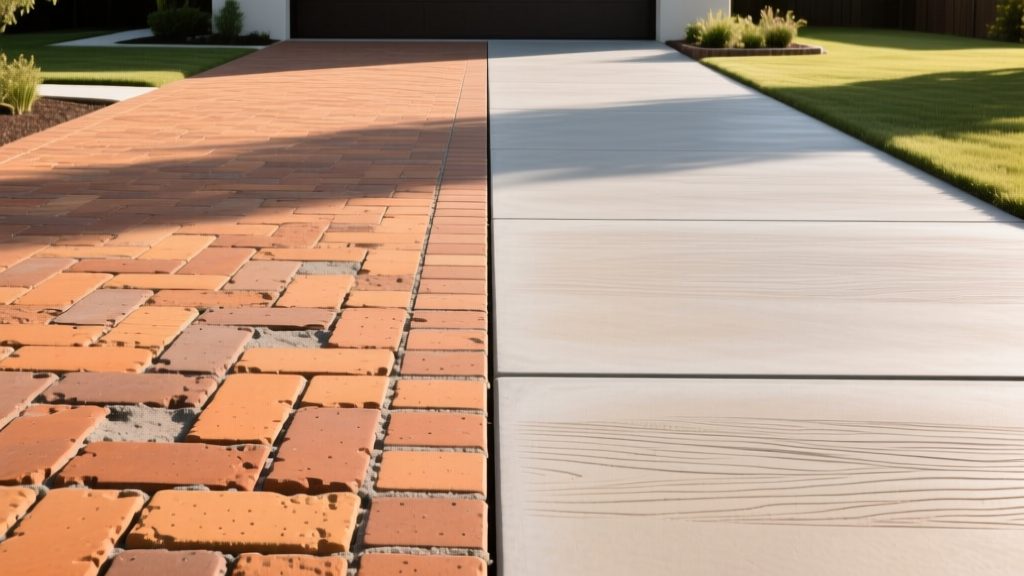
2026 Installed Cost Breakdown
When evaluating the pavers vs concrete driveway cost, it is essential to look beyond the raw material price. Pavers require significantly more manual labor for base preparation, laying, and jointing. Below is a comparative cost matrix for a standard 600-square-foot driveway installation.
| Cost Component | Poured Concrete (Broom Finish) | Poured Concrete (Stamped) | Concrete Pavers (Standard) | Concrete Pavers (Premium) |
|---|---|---|---|---|
| Excavation & Haul-off | $1.50 - $2.50 / sq ft | $1.50 - $2.50 / sq ft | $2.00 - $3.50 / sq ft | $2.00 - $3.50 / sq ft |
| Aggregate Base Material | $0.75 - $1.25 / sq ft | $0.75 - $1.25 / sq ft | $1.50 - $2.50 / sq ft | $1.50 - $2.50 / sq ft |
| Surface Material | $2.00 - $3.50 / sq ft | $4.00 - $7.00 / sq ft | $3.50 - $6.00 / sq ft | $7.00 - $12.00 / sq ft |
| Labor & Installation | $3.00 - $5.00 / sq ft | $6.00 - $10.00 / sq ft | $7.00 - $12.00 / sq ft | $10.00 - $16.00 / sq ft |
| Total Estimated Cost | $7.25 - $12.25 / sq ft | $12.25 - $20.75 / sq ft | $14.00 - $24.00 / sq ft | $20.50 - $34.00 / sq ft |
Lifespan and Specific Failure Modes
Both materials can last 30 to 50 years, but they fail in entirely different ways. Understanding these failure modes is crucial for long-term satisfaction.
Concrete Failure: Cracking and Spalling
Concrete is guaranteed to crack; the goal is to control where it happens. Control joints must be cut or tooled every 10 feet and to a depth of one-quarter the slab thickness. If tree roots invade the subgrade or the soil settles unevenly, the rigid slab will fracture outside these joints. Furthermore, in northern climates, surface spalling (flaking and peeling) occurs when non-air-entrained concrete absorbs water that subsequently freezes and expands by 9%. Applying calcium chloride-based de-icing salts accelerates this chemical degradation.
Never use rock salt (sodium chloride) or calcium chloride on new concrete or pavers during their first winter. Use magnesium chloride or calcium magnesium acetate (CMA), which are significantly less corrosive to cementitious materials and steel reinforcements.
Paver Failure: Edge Creep and Joint Washout
Pavers do not crack, but they can shift, settle, or spread. The most common catastrophic failure in paver driveways is edge restraint collapse. If the perimeter is secured only by plastic edging spiked into the sand base, vehicular turning forces will eventually pull the spikes loose, causing the outer rows of pavers to spread and the entire surface to unlock. Proper installation requires a poured concrete curb footer or heavy-duty restraint anchored directly into the compacted base. Additionally, standard joint sand can wash out during heavy rain, leading to weed growth and loss of interlock.
Maintenance and Long-Term Repair Realities
The maintenance profiles of these two materials dictate their long-term cost of ownership.
- Concrete Maintenance: Requires resealing every 2 to 4 years with a penetrating silane/siloxane sealer (which protects against water ingress without creating a slippery surface film). If a section settles, mudjacking (slab jacking) can lift it back to grade for roughly $3 to $6 per square foot, though the patched area will remain visibly distinct.
- Paver Maintenance: Requires re-sanding joints every 3 to 5 years. Upgrading to high-performance polymeric sand, which hardens when activated with water, drastically reduces weed growth and ant infiltration. If a section settles due to a broken utility line or root growth, the pavers can be unzipped, the base repaired, and the exact same pavers reinstalled seamlessly.
Climate Suitability and Environmental Impact
Local climate and municipal stormwater regulations heavily influence which material is superior for your specific site.
| Environmental Factor | Poured Concrete Performance | Paver Performance |
|---|---|---|
| Freeze-Thaw Cycles | High risk of heaving and cracking if sub-base drainage is poor. | Excellent; individual units shift slightly and settle back without structural failure. |
| Heat Island Effect | High; standard gray concrete reflects light but lighter stamped overlays absorb significant heat. | Moderate; lighter colored pavers and wider joints help dissipate heat. |
| Stormwater Management | Poor; creates 100% surface runoff unless specifically graded to bioswales. | Excellent; permeable paver systems allow water to infiltrate the subgrade, reducing runoff. |
For properties in areas with strict municipal runoff limits, permeable interlocking concrete pavement (PICP) is a highly effective solution. According to the Environmental Protection Agency (EPA), permeable pavers can significantly reduce stormwater runoff volume and filter out pollutants like heavy metals and hydrocarbons before they reach the water table. The Interlocking Concrete Pavement Institute (ICPI) provides extensive engineering manuals for designing these permeable base systems to handle specific local rainfall intensities.
Final Decision Framework
Use this matrix to make your final material selection based on your site conditions and priorities:
Choose Poured Concrete If: You are on a strict budget, prefer a seamless modern aesthetic, have stable and well-draining native soil, and want minimal day-to-day maintenance (no weeds in joints).
Choose Concrete Pavers If: You live in a region with severe freeze-thaw cycles, have expansive clay soils prone to shifting, want a traditional or high-end architectural look, or require easy access to underground utilities without the need to jackhammer and repour a slab.
Ultimately, the longevity of either surface relies 80% on the quality of the excavation and base preparation. A 4-inch concrete slab poured over poorly compacted fill dirt will fail in three years, while a paver driveway installed over a properly engineered 8-inch aggregate base will easily outlast the home itself. Always verify your contractor's base preparation specifications in writing before breaking ground.
Written by
James ThorntonJames Thornton is a construction industry veteran with 25 years of hands-on experience in wood framing, lumber grading, and residential building codes. He started as a framing carpenter in rural Oregon, earned his ICC Residential Building Inspector certification, and eventually became a senior plan reviewer for the City of Portland Bureau of Development Services. James holds a B.S. in Wood Science & Technology from Oregon State University and is a certified lumber grader through the West Coast Lumber Inspection Bureau (WCLIB). He has inspected over 3,000 residential construction sites and authored the city's internal guide on advanced framing techniques (2x6 at 24" O.C.). James lives in Bend, OR, where he builds custom timber-frame cabins and competes in lumberjack sports.
More from James Thornton
View all
Insulation
Best Home Insulation Materials: Complete 2026 Guide
Compare top home insulation materials for 2026. Find R-values, installed costs per square foot, and best uses for fiberglass, spray foam, and mineral wool.
Aug 4, 2026

Sustainable Building
Certify Your Green Building Material for LEED and WELL
Step-by-step guide to certifying a green building material for LEED v5 and WELL v2. Master EPDs, HPDs, and VOC limits for 2026 project specifications.
Aug 4, 2026

Stone & Masonry
Veneer Stacked Stone Panels: Interior Design & Style Showcase
Discover how veneer stacked stone panels transform interiors. Explore modern design profiles, material pairings, and technical installation specs.
Aug 4, 2026