Gravel vs Crushed Concrete: Driveway Base Comparison
Compare gravel vs crushed concrete for driveway bases and drainage. Expert analysis on costs, compaction, and RCA vs #57 stone for your project.

Material Profiles: Defining the Aggregates
The structural integrity of any driveway, patio, or retaining wall relies entirely on its base layer. When specifying materials, contractors and DIYers typically choose between traditional crushed gravel and Recycled Concrete Aggregate (RCA), commonly known as crushed concrete. While both serve as load-bearing foundations, their mechanical properties, drainage characteristics, and long-term behaviors differ significantly.
Traditional Gravel (Crushed Stone)
For base applications, 'gravel' refers to mechanically crushed limestone, granite, or trap rock. The industry standard for base layers is #57 crushed stone, which is screened to pass through a 1-inch sieve but is retained on the No. 4 sieve (roughly 3/4-inch diameter). Because it is mechanically crushed, the stones possess angular faces that interlock under compaction. Crucially, #57 stone is 'washed' or screened to remove fine dust and sand particles, ensuring high permeability.
Crushed Concrete (Recycled Concrete Aggregate)
RCA is produced by milling demolished concrete structures, foundations, and pavements. The resulting material is screened to meet specific Department of Transportation (DOT) gradations, such as the widely referenced 21AA specification (a dense-graded base material with a maximum size of 1.5 inches). Unlike washed gravel, RCA retains a percentage of fine particles and residual mortar from the original concrete mix. This inclusion of 'fines' fundamentally alters how the material compacts and drains.
Head-to-Head Matrix: Gravel vs Crushed Concrete
| Property | #57 Crushed Gravel | 21AA Crushed Concrete (RCA) |
|---|---|---|
| Angularity | High (Mechanically fractured) | High (Mechanically fractured) |
| Fines Content | Negligible (Washed) | High (Residual mortar/dust) |
| Compaction Behavior | Locks together, remains flexible | Locks and binds, cures semi-rigid |
| Permeability | Excellent (High drainage rate) | Moderate to Poor (Fines restrict flow) |
| Average Cost (2026) | $18 - $32 per ton | $12 - $22 per ton |
| Alkalinity (pH) | Neutral to slightly alkaline | Highly alkaline (pH 9-11) |
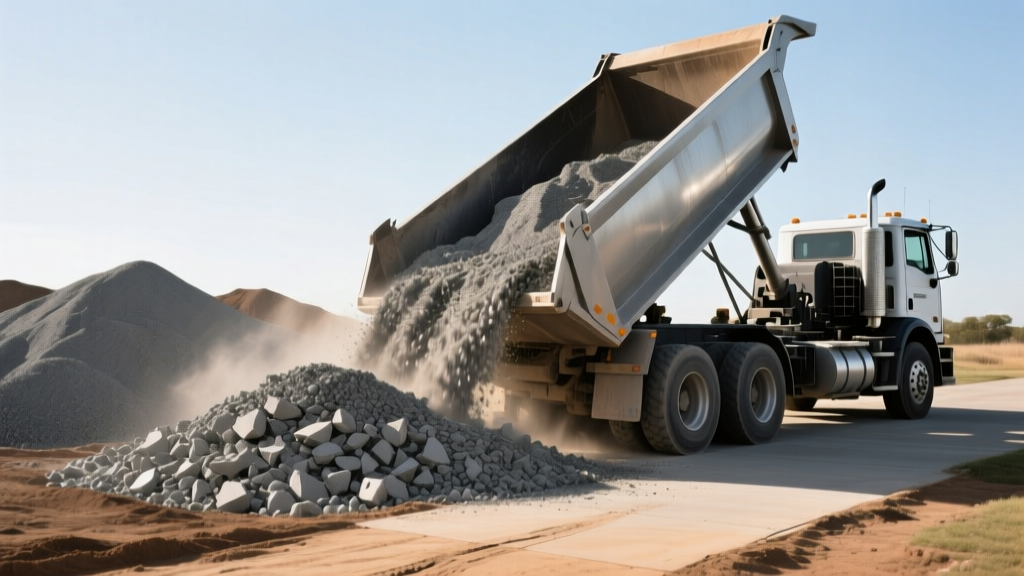
The Compaction and Binding Dynamic
The most critical functional difference between the two materials lies in their binding properties. When #57 gravel is compacted with a vibratory plate or roller, the angular edges wedge together, creating a stable but fundamentally flexible matrix. Water passes freely through the voids, making it highly resistant to frost heave in freezing climates, provided the subgrade is properly sloped.
Crushed concrete behaves differently due to the residual cementitious fines and old mortar attached to the aggregate. When RCA is wetted and compacted, these fines act as a weak binder. Over a period of weeks, the residual unhydrated cement particles in the RCA can undergo secondary hydration, causing the base layer to cure into a semi-rigid slab. This makes RCA an exceptional subbase for poured concrete driveways or asphalt overlays, as it minimizes differential settlement and provides a stiff working platform for heavy equipment.
Because the fines in crushed concrete reduce permeability, water can become trapped in the base layer during freeze-thaw cycles. If you are building a driveway in a climate with deep frost lines (e.g., USDA Hardiness Zones 3-5), RCA must be installed over a properly crowned subgrade with lateral drainage ditches, or capped with a highly permeable layer of #57 stone before paving.
Drainage Applications: Where Gravel is Non-Negotiable
While crushed concrete excels as a structural subbase, it is a critical failure point in drainage applications. French drains, retaining wall weep holes, and foundation perimeter drains require aggregate that will not clog geotextile fabrics or perforated PVC pipes.
The fine dust and degrading mortar in RCA will wash through the aggregate matrix during heavy rain events. These suspended solids quickly clog the pores of non-woven geotextile fabrics and accumulate inside corrugated drain pipes, leading to catastrophic hydrostatic pressure buildup behind retaining walls or flooded basements. For any application where water conveyance is the primary goal, washed #57 or #67 crushed gravel is the only acceptable material. According to the U.S. Environmental Protection Agency (EPA), while C&D (Construction and Demolition) recycling is highly encouraged for bulk fill and structural bases, porous drainage systems require clean, washed natural aggregates to maintain long-term hydraulic conductivity.
Cost Analysis and Supply Chain Realities
Pricing for bulk aggregates is heavily dependent on regional geology and local recycling infrastructure. As of 2026, the U.S. Geological Survey (USGS) tracks steady demand for natural crushed stone, with prices reflecting quarrying, blasting, and crushing costs. Conversely, RCA pricing is dictated by demolition volumes and landfill tipping fees.
- Crushed Gravel (#57): Expect to pay $18 to $32 per ton at the quarry. Delivery fees typically add $50 to $150 per truckload depending on mileage.
- Crushed Concrete (RCA): Generally priced between $12 and $22 per ton. In densely populated urban areas with high demolition rates, RCA can be up to 40% cheaper than natural stone.
- Volume Calculation: A standard 4-inch base layer requires approximately 1.25 tons of compacted aggregate per 100 square feet. A 1,000 sq. ft. driveway base will require roughly 12.5 tons of material.
Decision Framework: Selecting the Right Material
Use this practical framework to specify the correct aggregate for your project:
Choose Crushed Concrete (RCA) When:
- Building a subbase for a poured concrete driveway or patio slab (the semi-rigid binding prevents slab cracking).
- Creating a heavy-duty access road or rural farm lane where surface flexibility is acceptable.
- Filling deep trenches or leveling large depressions where the lower cost per ton yields massive savings.
- Seeking LEED certification or sustainable building credits for utilizing recycled local materials.
Choose Washed Gravel (#57) When:
- Installing French drains, dry wells, or septic field leach beds.
- Backfilling behind retaining walls where hydrostatic pressure must be relieved.
- Working in regions with severe freeze-thaw cycles and poor natural soil drainage.
- Creating a decorative, loose-surface walking path (RCA dust stains shoes and tracks into homes).
Frequently Asked Questions
Will exposed rebar in crushed concrete cause problems?
Modern recycling facilities use powerful electromagnetic separators that remove 95% to 98% of embedded steel. However, stray wire or small rebar fragments occasionally make it into the final RCA product. If used as a subbase under a concrete slab, these fragments will not affect structural integrity. If used as a top layer for a driveway, exposed steel will rust and create orange stains on the surface and flat tires. Always visually inspect RCA loads upon delivery and rake out any visible metal.
Does the high alkalinity of RCA harm landscaping?
Yes, it can. The residual mortar in crushed concrete leaches calcium hydroxide, which significantly raises the pH of surrounding soil. This is highly detrimental to acid-loving plants like azaleas, blueberries, and rhododendrons. If using RCA near landscaping beds, install a heavy-duty impermeable plastic or EPDM barrier between the aggregate and the soil edge to prevent alkaline runoff.
Can I mix gravel and crushed concrete in the same base layer?
Mixing them in a single lift (layer) is not recommended, as it creates inconsistent compaction and unpredictable drainage zones. However, a highly effective engineering technique is to use RCA for the lower 4 to 6 inches of the base to create a rigid foundation, and then cap it with a 2-inch layer of washed #57 gravel. This 'choke' layer provides excellent drainage immediately beneath the final pavement surface while leveraging the cost-savings and binding strength of the RCA below.
Written by
Sarah WhitfieldSarah Whitfield is a chartered quantity surveyor (MRICS) and construction cost analyst with 15 years of experience in material pricing, procurement strategy, and project budgeting. She earned her degree in Construction Management from the University of Reading (UK) and has worked on projects ranging from $2M custom homes to $180M mixed-use developments across North America and Europe. Sarah currently leads cost estimating for BuildMat Insight, maintaining a proprietary database of 4,000+ material price points updated quarterly. She is a frequent contributor to RSMeans cost data panels and has presented at the International Cost Engineering Council (ICEC) congress. Based in Denver, CO, Sarah is an avid trail runner and volunteer mentor for Women in Construction.
More from Sarah Whitfield
View all
Wood & Lumber
What Are the Different Types of Wood? A Builder's Guide
Compare structural softwoods, finish hardwoods, and engineered lumber. Analyze Janka ratings, MOE values, and 2026 pricing for construction.
Aug 4, 2026

Walls & Panels
Steel Framing vs Wood Framing: Corrosion and Moisture Defense
Compare steel framing vs wood framing for moisture resistance. Learn about galvanized coatings, condensation risks, and corrosion protection strategies.
Jul 21, 2026

Stone & Masonry
How to Cut Stone Veneer: Wet Saw vs Grinder Comparison
Compare the best tools for cutting stone veneer. We review wet saws, angle grinders, and chop saws to help you achieve clean, chip-free cuts.
Jul 21, 2026