Lifespan and Durability of UHPC Pestle and Mortar Sets in Labs
Analyze the durability, failure modes, and lifespan of UHPC and cementitious pestle and mortar sets used in construction material labs.
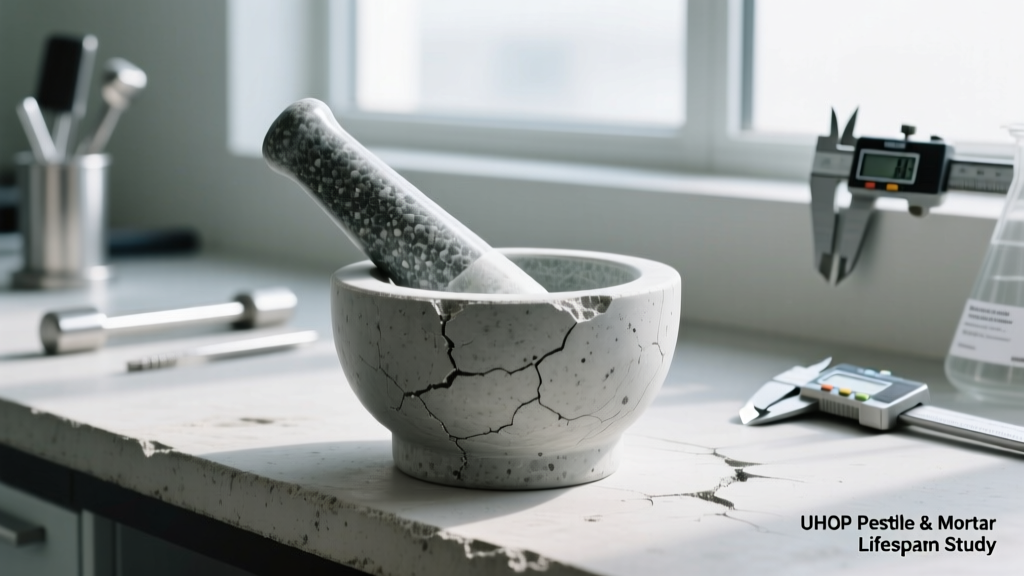
The Role of Cementitious Pestle and Mortar Sets in Material Testing
When analyzing the chemical composition of hardened cement paste, concrete cores, or raw clinker, material testing laboratories face a critical contamination hurdle. Standard steel, tungsten carbide, or agate grinding tools introduce metallic and elemental impurities that severely skew X-Ray Fluorescence (XRF) and Inductively Coupled Plasma (ICP) spectrometry results. To maintain the strict purity requirements outlined in ASTM C150 for Portland cement testing, advanced laboratories rely on specialized pestle and mortar sets cast entirely from cementitious materials.
Unlike kitchen or pharmacy variants, an industrial cementitious pestle and mortar is engineered to withstand extreme compressive forces while remaining chemically inert to the alkaline samples it processes. The durability and operational lifespan of these tools depend entirely on the specific binder matrix, aggregate gradation, and fiber reinforcement used in their casting. Understanding the degradation mechanics of these tools is essential for lab managers aiming to optimize testing budgets and maintain data integrity.
Material Composition and Compressive Strength Metrics
The lifespan of a cement-based pestle and mortar is dictated by its compressive strength and tensile ductility. Laboratories typically source these tools in three distinct material categories, each offering different durability profiles.
Non-Metallic Ultra-High-Performance Concrete (UHPC)
Standard UHPC relies on steel fibers for ductility, which disqualifies it for contamination-sensitive XRF testing. Instead, laboratories utilize non-metallic UHPC formulated with Polyvinyl Alcohol (PVA) fibers and silica fume. According to the Federal Highway Administration, advanced UHPC matrices can achieve compressive strengths exceeding 22,000 psi (150 MPa). The dense microstructure of PVA-reinforced UHPC virtually eliminates capillary porosity, preventing the absorption of sample dust and extending the tool's functional lifespan to over 8,000 crushing cycles.
High-Alumina Cement (HAC) Mortars
High-alumina cement mortars are favored for their rapid strength gain and exceptional resistance to chemical attack. When grinding highly alkaline concrete samples (pH 12-13), standard Portland cement tools can suffer from surface softening. HAC mortars maintain structural integrity in high-pH environments, though their brittle nature makes them susceptible to impact fracturing if the pestle is dropped.
Epoxy-Modified Cementitious Mortars
By replacing a portion of the water-cement ratio with epoxy resins, manufacturers create a polymer-modified pestle and mortar with high tensile strength. While the compressive strength typically caps around 12,000 psi, the epoxy matrix provides superior resistance to micro-chipping along the grinding rim.
Before using a new UHPC pestle and mortar for critical sample analysis, perform a 'sacrificial grind' using high-purity quartz sand. This seats the PVA fibers, removes loose surface laitance, and establishes a baseline contamination profile for your specific tool.
Degradation Mechanisms and Failure Modes
Even the most advanced cementitious tools degrade over time. Identifying the specific failure mode allows technicians to retire a pestle and mortar before it compromises test results.
- Abrasive Micro-Fracturing: Crushing quartz-heavy aggregates (Mohs hardness 7) against a UHPC surface (Mohs equivalent 6-7) causes progressive micro-spalling. Once the surface roughness exceeds 50 microns, the mortar loses its grinding efficiency and begins generating excessive heat, which can alter the hydration state of the sample being tested.
- Internal Alkali-Silica Reaction (ASR): If the mortar casting itself contains reactive silica aggregates and is repeatedly exposed to the high-alkali environment of crushed concrete samples, microscopic ASR gel can form within the tool's matrix. This leads to internal expansion and eventual delamination of the grinding bowl.
- Carbonation Shrinkage: Cementitious tools stored in low-humidity environments undergo carbonation, where atmospheric CO2 reacts with calcium hydroxide to form calcium carbonate. While this increases surface hardness, it induces shrinkage stresses that can cause radial micro-cracking in the mortar bowl.
Never use acidic cleaning solutions (like muriatic acid) to remove clogged cement paste from a high-alumina or UHPC mortar. Acid baths dissolve the calcium silicate hydrate (C-S-H) binder, permanently reducing the compressive strength of the tool by up to 40% and ruining its lifespan.
Lifespan and Durability Comparison Matrix
The following matrix outlines the expected performance parameters for the three primary cementitious pestle and mortar types used in construction material testing as of 2026.
| Material Type | Compressive Strength | Expected Cycle Lifespan | Primary Failure Mode | Approx. Replacement Cost |
|---|---|---|---|---|
| Non-Metallic UHPC (PVA) | > 22,000 psi | 8,000 - 12,000 cycles | Surface micro-spalling | $450 - $600 |
| High-Alumina Cast Stone | 14,000 - 16,000 psi | 4,000 - 6,000 cycles | Impact fracturing | $280 - $350 |
| Epoxy-Modified Mortar | 10,000 - 12,000 psi | 3,000 - 5,000 cycles | Rim chipping / Polymer UV degradation | $150 - $220 |
Maintenance Protocols to Maximize Tool Longevity
Extending the operational lifespan of a cementitious pestle and mortar requires strict adherence to non-destructive maintenance protocols. The Portland Cement Association emphasizes that testing equipment maintenance directly correlates with data repeatability.
- Ultrasonic Debris Removal: After each use, submerge the mortar bowl in an ultrasonic cleaner filled with deionized water. The cavitation bubbles dislodge trapped cementitious dust from the microscopic pores of the UHPC matrix without abrading the surface.
- Climate-Controlled Storage: Store the pestle and mortar in a sealed desiccator cabinet maintaining 45% relative humidity. This halts the carbonation process and prevents moisture-induced dimensional changes that could warp the grinding geometry.
- Rim Inspection via Dye Penetrant: Every 500 cycles, apply a non-fluorescent dye penetrant to the rim of the mortar. This highlights micro-cracks invisible to the naked eye, allowing technicians to retire the tool before catastrophic rim failure occurs during high-force grinding.
- Pestle Re-Surfacing: If the pestle head becomes asymmetrical due to uneven wear, it can be lightly lapped against a diamond-impregnated glass plate to restore the precise geometric curvature required for uniform sample pulverization.
Procurement Specifications for Laboratory Upgrades
When procuring a new cementitious pestle and mortar for material testing, avoid generic 'cast stone' listings which often utilize standard Portland cement and river sand. These contain high levels of reactive silica and iron impurities. Instead, issue purchase orders specifying the following parameters:
Require certification that the mortar matrix is formulated with a minimum of 25% silica fume replacement by weight, utilizes PVA micro-fibers (0.2mm diameter, 8mm length) for tensile reinforcement, and employs fused white alumina as the sole aggregate to guarantee an iron content of less than 0.01%.
Investing in a high-grade, non-metallic UHPC pestle and mortar set represents a higher initial capital expenditure but drastically reduces the long-term cost of contaminated sample re-runs and frequent tool replacement. By understanding the specific degradation mechanics of cementitious grinding tools, laboratories can maintain rigorous quality control while maximizing the lifespan of their specialized testing equipment.