How Much Does Concrete Block Weight Impact Structural Design?
Discover how much concrete block weight impacts structural design. Explore CMU density specs, ASTM standards, and exact weight charts by block size.
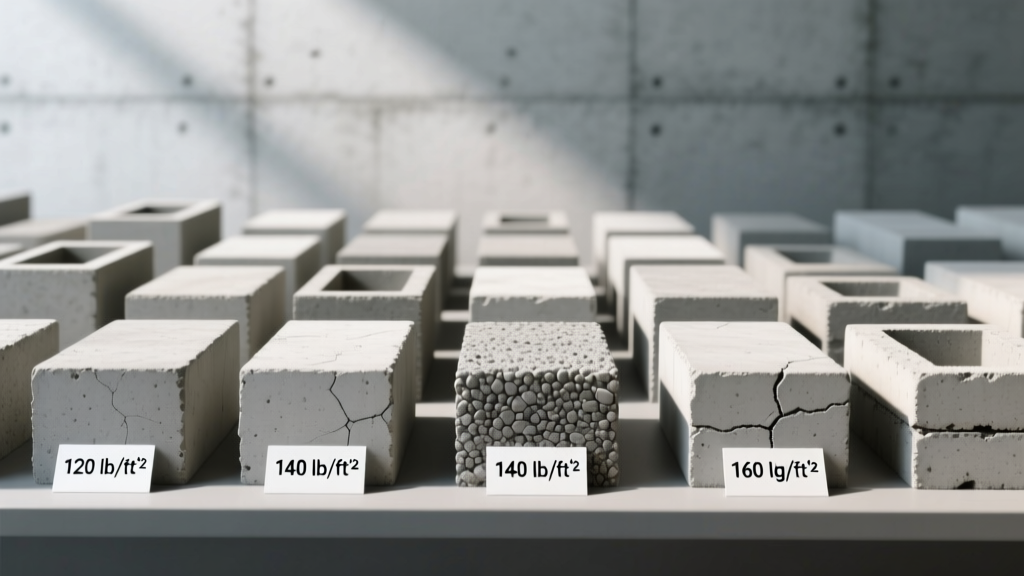
The Core Question: How Much Does Concrete Block Weight Impact Design?
When structural engineers, architects, and masonry contractors ask how much does concrete block weight affect a project, they are evaluating three critical performance vectors: structural dead load, seismic mass, and job-site ergonomics. Concrete Masonry Units (CMUs) are not a monolithic material; their mass varies drastically based on the aggregate used in the mix design. A standard 8x8x16 inch block can weigh anywhere from 22 pounds to 42 pounds depending on its density classification. Understanding these weight specifications is mandatory for accurate foundation sizing, lateral load calculations, and labor cost estimation.
ASTM Density Classifications: The Science of CMU Mass
The weight of a concrete block is governed by the density of the aggregates used in its production. ASTM International categorizes CMU into three distinct density classes. These classifications are based on the oven-dry density of the concrete, measured in pounds per cubic foot (lb/ft³).
| Density Classification | Oven-Dry Density (lb/ft³) | Typical Aggregate Used | Primary Use Case |
|---|---|---|---|
| Normal Weight | 125 – 145 lb/ft³ | Crushed limestone, granite, trap rock | Foundations, retaining walls, high-STC acoustic partitions |
| Medium Weight | 105 – 125 lb/ft³ | Blends of natural sand and lightweight aggregates | Standard commercial exterior walls, elevator shafts |
| Lightweight | Less than 105 lb/ft³ | Expanded shale, clay, slate, or pumice | Multi-story seismic zones, high R-value exterior envelopes |
Comprehensive Weight Matrix by Block Size
To accurately calculate dead loads, you must cross-reference the nominal block size with its density class. The table below provides the average unit weight for standard hollow-core CMUs. Note that actual dimensions are typically 3/8-inch smaller than nominal dimensions to account for mortar joints.
| Nominal Size (W x H x L) | Normal Weight (lbs) | Medium Weight (lbs) | Lightweight (lbs) |
|---|---|---|---|
| 4 x 8 x 16 | 24 - 26 lbs | 19 - 21 lbs | 14 - 16 lbs |
| 6 x 8 x 16 | 30 - 33 lbs | 24 - 27 lbs | 18 - 21 lbs |
| 8 x 8 x 16 | 38 - 42 lbs | 30 - 34 lbs | 22 - 26 lbs |
| 10 x 8 x 16 | 46 - 50 lbs | 37 - 41 lbs | 28 - 32 lbs |
| 12 x 8 x 16 | 54 - 58 lbs | 43 - 48 lbs | 33 - 38 lbs |
Structural Implications: Seismic Base Shear and Dead Loads
The mass of the building envelope directly dictates the structural steel and foundation requirements. In seismic design, this relationship is governed by the equivalent lateral force procedure outlined in ASCE 7 Minimum Design Loads. The seismic base shear ($V$) is calculated using the formula $V = C_s W$, where $W$ is the effective seismic weight (dead load) of the structure.
"By substituting normal-weight 8-inch CMU (38 lbs) with lightweight CMU (24 lbs) on a multi-story commercial tilt-up or masonry project, structural engineers can reduce the building's total seismic mass by up to 15%. This cascades into smaller foundation footings, reduced rebar requirements, and lighter structural steel framing, often offsetting the higher unit cost of the lightweight blocks."
Acoustic and Thermal Performance Ratings
Weight is not just a structural metric; it is a primary driver of acoustic and thermal performance. When evaluating CMU specifications, consider these secondary ratings:
- Sound Transmission Class (STC): Heavier blocks block low-frequency sound more effectively. An 8-inch normal-weight CMU wall yields an STC rating of 48-50, making it ideal for party walls and mechanical rooms. Lightweight equivalents typically achieve an STC of 42-45, which may require supplementary acoustic insulation to meet code.
- Thermal Resistance (R-Value): Lightweight aggregates contain microscopic air voids that impede heat transfer. An 8-inch lightweight block provides an inherent R-value of approximately R-11, compared to just R-4 for an 8-inch normal-weight block. This reduces the thickness and cost of rigid foam insulation required to meet IECC energy codes.
Job Site Ergonomics and the NIOSH Lifting Equation
The human cost of concrete block weight is a major factor in modern construction scheduling. A journeyman mason lays between 300 and 500 blocks per day. If laying normal-weight 8x8x16 units (40 lbs each), a mason lifts up to 20,000 pounds of masonry daily. This repetitive strain is a leading cause of musculoskeletal disorders (MSDs) in the trades.
According to NIOSH Lifting Equation guidelines, the recommended weight limit for repetitive lifting under optimal conditions is 51 pounds, but masonry involves awkward postures and high frequencies that severely reduce this safe limit. Specifying lightweight CMU (24 lbs) drops the daily lifting volume by 40%, significantly reducing mason fatigue, lowering workers' compensation premiums, and increasing daily course-laying rates by an estimated 15% to 20%.
Cost vs. Weight: The Lightweight Premium Trade-Off
Lightweight concrete blocks typically carry a 15% to 25% material premium over normal-weight blocks due to the cost of expanded shale or slate aggregates. However, a holistic project cost analysis often favors lightweight units when factoring in total installed costs.
Decision Framework: When to Specify Lightweight CMU
- High-Seismic Zones (SDC D, E, F): Always specify lightweight. The reduction in seismic base shear will save more in structural steel and concrete foundations than the block premium costs.
- Multi-Story Load-Bearing Masonry: Specify lightweight for upper floors to reduce the cumulative dead load transferred to the lower floors and foundations.
- Tight Labor Markets: If masonry contractors are scarce or charging premium labor rates, lightweight blocks increase daily productivity and reduce injury-related downtime.
- Acoustic-Critical Environments: Stick to normal-weight CMU for recording studios, cinemas, or multi-family demising walls where mass is required to achieve STC 50+ ratings without expensive resilient channel assemblies.
Frequently Asked Specifications Questions
Does the weight of the block affect its compressive strength?
No. ASTM C90 requires all loadbearing CMUs, regardless of density classification, to meet a minimum net area compressive strength of 1,900 psi (for normal-weight) or 1,900 psi (for lightweight, though specific aggregate types may require 2,000 psi to account for higher absorption). A lightweight block is just as structurally capable of supporting vertical axial loads as a normal-weight block.
How does moisture content affect block weight on the job site?
CMUs are highly porous. A normal-weight 8x8x16 block left uncovered in heavy rain can absorb up to 4-6 pounds of water, temporarily pushing its weight over 45 pounds. Lightweight blocks manufactured with expanded shale have lower absorption rates, but specifiers should always mandate covered pallet storage on-site to maintain consistent mortar curing and unit weights.