How Much Does It Cost to Build an Amusement Park? Size Calculator
Calculate the cost to build an amusement park in 2026. Break down CapEx for rides, infrastructure, and theming across FEC, regional, and mega park scopes.
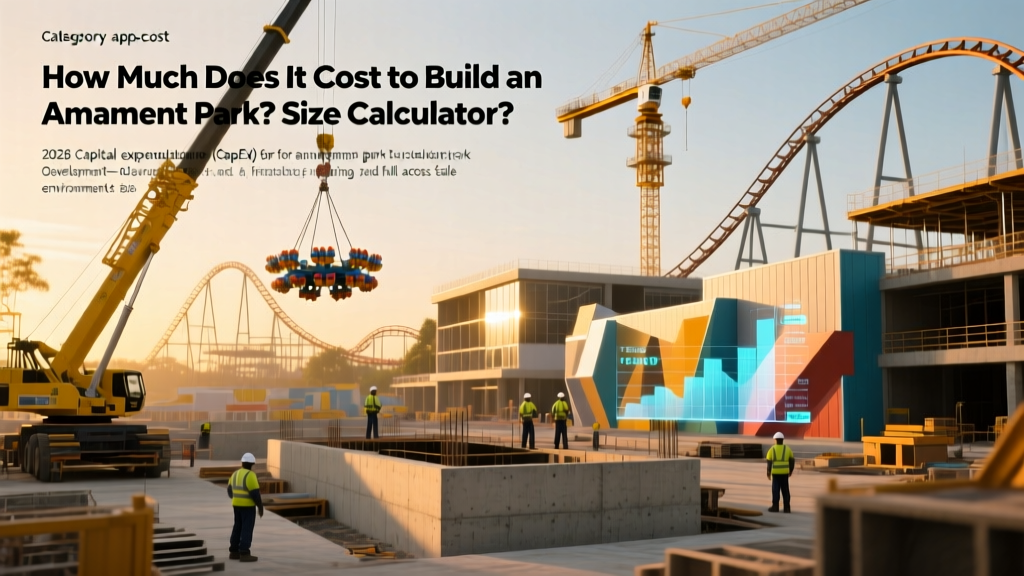
The 2026 Amusement Park Size & Scope Calculator Matrix
Estimating the capital expenditure (CapEx) for an amusement park requires moving beyond simple per-square-foot commercial construction metrics. Unlike standard retail or warehouse developments, amusement parks are highly specialized environments governed by dynamic load engineering, immersive scenic fabrication, and strict ASTM F24 safety standards for ride systems. The total cost to build an amusement park scales non-linearly based on the target demographic, ride mix, and intellectual property (IP) integration.
To accurately scope your project, use the following 2026 tier matrix. These figures represent total turnkey CapEx, including land acquisition, site work, ride procurement, vertical construction, and soft costs.
| Park Tier | Acreage | Anchor Attractions | Est. 2026 CapEx | Cost Per Acre |
|---|---|---|---|---|
| Tier 1: Family Entertainment Center (FEC) | 5 - 15 Acres | Flat rides, go-karts, mini-golf, arcade | $12M - $35M | $2.4M - $2.8M |
| Tier 2: Regional Theme Park | 50 - 150 Acres | 2-3 Steel coasters, dark rides, water park annex | $150M - $450M | $3.0M - $3.5M |
| Tier 3: Mega Destination Resort | 300+ Acres | Multiple E-Ticket coasters, trackless dark rides, hotels | $1.5B - $3.0B+ | $4.5M - $6.0M+ |
Ride Procurement & Foundation Engineering Costs
The most volatile variable in your budget is the ride mix. Amusement rides are not purchased off a shelf; they are manufactured, shipped in hundreds of containers, and erected by specialized millwrights. Below is a breakdown of 2026 procurement and installation costs for standard attraction categories.
Flat Rides & Family Attractions
- SBF Visa Mini Jet / Carousel: $150,000 - $350,000. Requires a standard 12-inch reinforced concrete slab foundation.
- Zamperla Disk'O Coaster: $1.8M - $2.5M. Requires localized deep footings to handle the dynamic lateral G-forces of the half-pipe track.
- Huss Frisbee / Giant Swing: $2.5M - $4.0M. Demands massive subterranean concrete counterweights, often requiring 400+ cubic yards of high-psi concrete per foundation.
Roller Coasters
- Vekoma Family Boomerang: $3.5M - $5.5M. A staple for regional parks, offering high throughput with a moderate footprint.
- Mack Rides LSM Launch Coaster: $18M - $28M. Requires extensive electrical infrastructure, including dedicated substations and flywheel or capacitor banks to handle the massive instantaneous power draw of the linear synchronous motors.
- Bolliger & Mabillard (B&M) Hypercoaster: $25M - $35M+. B&M coasters are renowned for their massive steel spine tracks and deep pile foundations. Foundation costs alone can exceed $3M due to the need for friction piles driven 40+ feet into bedrock to prevent frost heave and structural settling.
Dark Rides & Immersive Attractions
- Sally Dark Rides (Traditional Track): $8M - $15M. Includes animatronics, scenic sets, and localized show-control systems.
- ETF Trackless Ride System: $20M - $35M. Requires perfectly flat, polished concrete floors with embedded RFID or wire navigation grids, plus heavy investment in projection mapping and AV hardware.
A single modern launched coaster can draw up to 8 megawatts of power in a 3-second window. Standard municipal grids cannot support this. Budget $1.5M - $3M for dedicated utility substations, heavy-gauge trenching, and kinetic energy storage systems (KESS) to prevent localized brownouts during dispatch cycles.
Site Infrastructure & Utility Scaling
According to data tracked by the Dodge Construction Network, heavy civil and utility work for specialized entertainment venues has seen compounding cost increases due to material volatility and specialized labor shortages. Amusement parks are essentially small, high-density cities.
Grading and Earthwork
Unlike flat warehouse developments, theme parks require complex grading for drainage, sightline berms (to hide backstage areas), and water ride flumes. Budget $150,000 to $350,000 per acre for mass grading, soil stabilization, and retention pond construction. If your site contains expansive clay or peat, soil remediation (e.g., lime stabilization or over-excavation) can double this figure.
Water & Wastewater Systems
If your scope includes a water park or log flume attractions, water volume is a critical CapEx driver. A single large log flume ride holds and circulates over 500,000 gallons of water. You must budget for commercial-grade filtration plants, UV sanitization arrays, and massive underground cisterns to capture splash-off and backwash, ensuring compliance with local municipal wastewater discharge limits.
Queue Shading and Hardscaping
Guest comfort directly impacts per-capita spending. Modern parks utilize tensile fabric structures (PTFE-coated fiberglass or HDPE knitted shade cloth) over queues and midway pathways. Expect to pay $45 to $85 per square foot for engineered shade canopies, which require their own wind-load calculations and deep concrete footings.
Thematic Scenic Fabrication & Intellectual Property
The difference between a carnival and a theme park is immersion. Scenic fabrication involves specialized contractors who work with fiberglass, glass-fiber reinforced concrete (GFRC), and themed shotcrete (Gunite).
- Themed Rockwork (Gunite): $120 - $250 per square foot of surface area. Used for waterfall grottos, mountain facades, and queue caves.
- GFRC Architectural Facades: $80 - $150 per square foot. Used for midways, retail shops, and restaurant exteriors to simulate brick, timber, or stone without the structural weight.
- Intellectual Property (IP) Licensing: If you are licensing existing IP (e.g., Nickelodeon, DreamWorks, or anime franchises), expect upfront licensing fees ranging from $2M to $10M, plus a 5% to 12% royalty on gross park revenue. Original IP eliminates royalties but requires a $3M+ upfront investment in concept art, storyboarding, and character design.
Soft Costs: Engineering, Permitting, and Compliance
Soft costs typically account for 15% to 22% of the total project budget. The International Association of Amusement Parks and Attractions (IAAPA) emphasizes that rigorous upfront engineering prevents catastrophic budget overruns during the commissioning phase.
- Ride Engineering & Peer Review: Every major ride requires stamped structural and mechanical engineering. Independent peer review of dynamic load calculations typically costs $50,000 to $150,000 per E-Ticket attraction.
- Environmental Impact Studies: Large-scale land disturbance requires Phase I and Phase II environmental site assessments, wetland delineation, and traffic impact studies. Budget $200,000 to $500,000 and 12-18 months for permitting.
- Show Control & AV Integration: Programming the centralized show-control systems (e.g., Alcorn McBride or Medialon) that synchronize ride audio, lighting, and animatronics requires specialized integrators. Budget 8% to 12% of the total attraction cost for AV and show-control engineering.
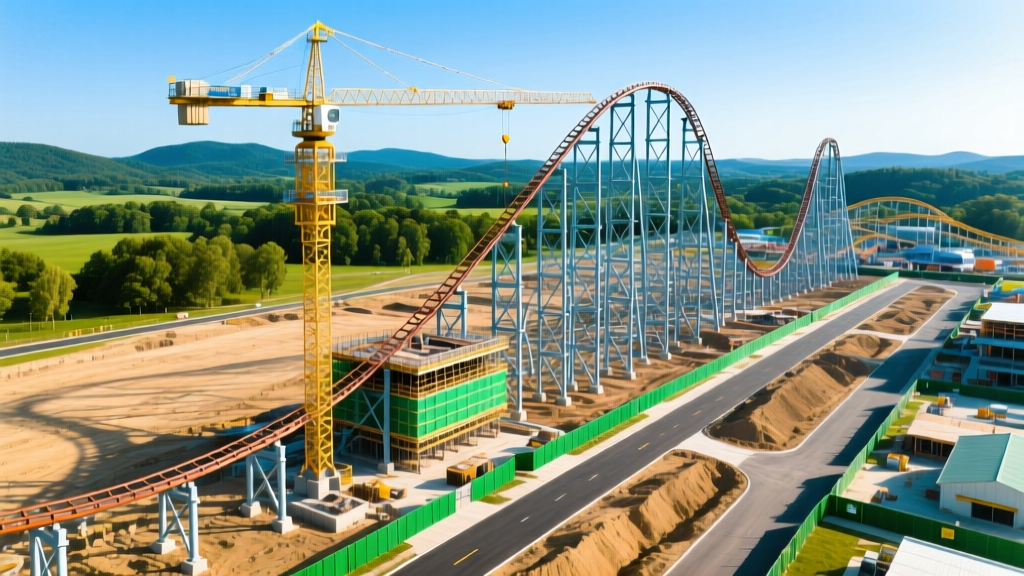
Capital Stack & Phasing Strategy
Few developers finance a Tier 2 or Tier 3 park in a single phase. The standard financial model relies on a phased opening strategy to generate operating cash flow (EBITDA) that services the debt for subsequent expansions.
Do not underfund your opening day infrastructure. A common failure mode is building a 50-acre park but only installing utility mains for the initial 20 acres. When Phase 2 expansion begins, tearing up newly paved midways to upgrade water and electrical trunk lines will cost 3x more than installing the oversized infrastructure during initial site work. Always overbuild your underground utilities on Day 1.
By utilizing this size and scope calculator framework, developers and investors can move beyond back-of-the-napkin math. Accurate amusement park cost estimating requires a granular understanding of ride dynamics, heavy civil infrastructure, and thematic fabrication. Secure your geotechnical reports early, engage a specialized ride millwright during the design phase, and ensure your capital stack accounts for the heavy soft costs inherent to ASTM-compliant entertainment venues.
Written by
David NakamuraDavid Nakamura is a licensed architect (AIA) and construction technology writer focused on sustainable building methods, mass timber engineering, and high-performance building envelopes. He holds a Master of Architecture from the University of Washington and is a certified Passive House Consultant (CPHC). David spent eight years at the Seattle firm Mithun, where he led the design of three LEED Platinum projects, before founding his own practice specializing in net-zero residential design. He serves on the editorial advisory board of GreenBuilder Magazine and has authored peer-reviewed papers on cross-laminated timber (CLT) connections for the Journal of Structural Engineering. In his spare time, David teaches woodworking at Pratt Fine Arts Center and kayaks the Puget Sound.
More from David Nakamura
View all
Construction Cost
Labor Cost to Build a Deck Per Sq Ft: 2026 Installation Guide
Discover the exact labor cost to build a deck per sq ft in 2026. This installation guide breaks down contractor rates, complexity factors, and hidden fees.
Aug 4, 2026

Construction Cost
How Much Does It Cost to Build a 3 Bedroom House? Financing Guide
Learn exactly how much it costs to build a 3 bedroom house and explore 2026 financing options, construction loan types, and budget frameworks for your build.
Aug 4, 2026

Construction Cost
Cost to Build a Tennis Court: 2026 Guide
How much does it cost to build a tennis court in 2026? Breakdowns for asphalt, concrete, and synthetic surfaces plus fencing and lighting.
Jul 30, 2026