Cost to Build a Tennis Court: 2026 Guide
How much does it cost to build a tennis court in 2026? Breakdowns for asphalt, concrete, and synthetic surfaces plus fencing and lighting.

The True Cost to Build a Tennis Court
Building a regulation-sized residential tennis court is a major landscaping and construction investment that requires precise engineering and specialized materials. In 2026, the national average cost to build a tennis court ranges from $75,000 to $135,000, with most homeowners spending around $95,000 for a fully fenced, lighted, and surfaced post-tensioned concrete court. According to HomeGuide's 2026 tennis court cost report, luxury installations with heated surfaces, premium cushioning, and advanced LED lighting can easily exceed $160,000.
Quick 2026 Cost Summary
- Asphalt Base: $65,000 - $85,000
- Post-Tensioned Concrete: $85,000 - $120,000
- Modular Synthetic Tile: $90,000 - $130,000
- Average Total Project: $95,000
Court Dimensions and Footprint Requirements
A common budgeting mistake is pricing out only the painted playing lines. The actual playing area of a doubles court is 36 feet by 78 feet. However, you must construct the total fenced enclosure to allow for player runoff and safety. The United States Tennis Association (USTA) recommends a minimum total footprint of 130 feet by 66 feet. For optimal residential play and proper drainage integration, a 150-foot by 80-foot pad (12,000 square feet) is the industry gold standard. This extra perimeter space prevents players from backing into fences during deep volleys and accommodates necessary grading swales.
Base Material Comparison: Asphalt vs. Concrete
The structural base dictates the lifespan, maintenance cycle, and ultimate playability of your court. While asphalt is cheaper upfront, it comes with long-term structural compromises.
| Feature | Asphalt (Bituminous) | Post-Tensioned Concrete |
|---|---|---|
| Installation Cost | $65,000 - $85,000 | $85,000 - $120,000 |
| Lifespan | 15 - 20 years | 40+ years |
| Cracking Risk | High (structural & surface) | Extremely Low |
| Resurfacing Cycle | Every 4 - 6 years | Every 8 - 12 years |
Why Post-Tensioned Concrete is the Industry Standard
Asphalt is highly susceptible to temperature fluctuations, tree root intrusion, and ground settling, leading to structural cracks and 'birdbath' depressions that hold water. Post-tensioned concrete utilizes high-strength steel cables tensioned after the concrete cures. This compresses the slab, effectively neutralizing the tensile forces that cause cracking. The American Sports Builders Association (ASBA) heavily favors post-tensioned concrete for its superior structural integrity, making it the undisputed best choice for a permanent residential installation.
Acrylic Surfacing and Color Coatings
You cannot play directly on raw concrete or asphalt; the surface requires a multi-layer acrylic coating system to provide texture, UV protection, and the characteristic court colors. Premium systems like Plexipave or DecoTurf typically cost between $12,000 and $20,000 for a 12,000 sq. ft. pad.
- Standard Texture (3 layers): $12,000 - $14,000. Provides standard ball bounce and medium-speed play.
- Cushioned System (5-7 layers): $16,000 - $20,000. Adds a rubberized mat layer beneath the acrylic, significantly reducing impact on joints and knees.
Site Preparation: The Hidden Cost Multiplier
Earthwork is the most unpredictable variable in your budget. A perfectly flat, clear, and well-draining lot is rare. Site prep generally costs between $10,000 and $35,000, encompassing tree removal, stump grinding, cut-and-fill grading, and soil compaction.
Expert Insight: If your site requires a retaining wall over 4 feet high to support the court pad, expect your site preparation costs to jump by $15,000 to $30,000. Mechanically Stabilized Earth (MSE) walls or poured concrete cantilever walls are engineering necessities to prevent catastrophic pad failure, not just cosmetic additions.
Fencing, Lighting, and Equipment Specifications
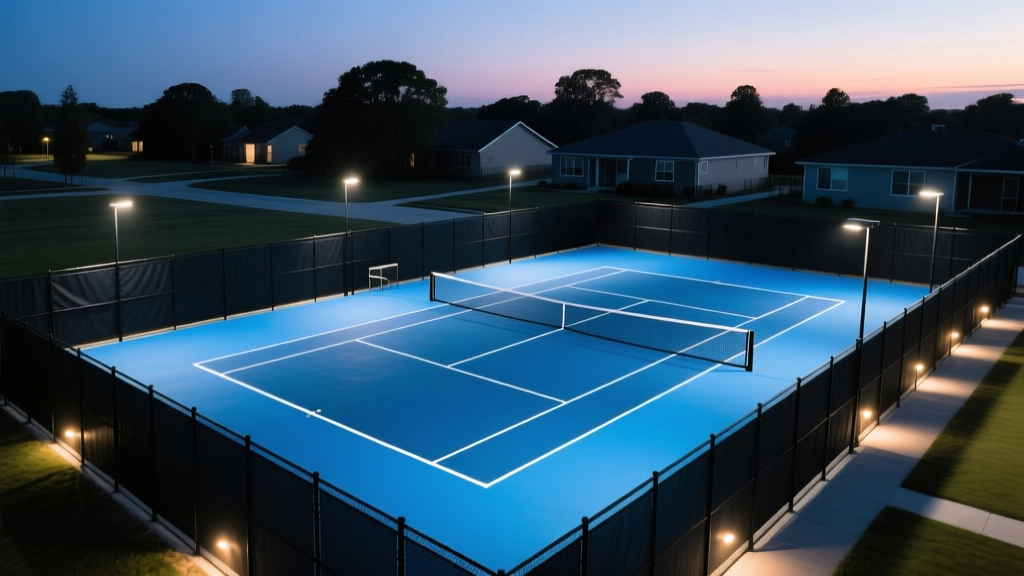
The accessories surrounding the court are just as critical as the surface itself. Fencing must be exactly 10 feet high to contain most lobbed balls, and it must utilize a 2-inch chain link mesh. Standard 2.5-inch residential fencing will trap tennis balls, causing frustration and damaging the fence over time. Black vinyl-coated chain link is highly recommended as it reduces sun glare for players looking up at the ball and blends into the landscaping.
| Accessory | Specifications | Estimated Cost (2026) |
|---|---|---|
| Fencing | 10ft high, 2-inch mesh, black vinyl-coated | $14,000 - $19,000 |
| Lighting | LED, 4-pole or 6-pole, 35-50 foot-candles | $22,000 - $38,000 |
| Net & Posts | Center strap, heavy-duty steel posts | $800 - $1,500 |
| Wind Screens | 90% blockage, custom fitted | $1,200 - $2,000 |
Lighting Requirements for Night Play
If you plan to play at night, do not skimp on illumination. Recreational courts require 35 to 50 foot-candles of illuminance to eliminate harsh shadows and track high balls. Modern LED fixtures from brands like Musco or Qualite are now the standard, drawing significantly less power than old metal-halide lamps while providing instant on/off capabilities and zero warm-up time.
Complete 2026 Line-Item Budget (150' x 80' Footprint)
To provide a realistic financial framework, here is a comprehensive line-item breakdown for a premium residential post-tensioned concrete court with standard accessories.
| Phase | Description | Cost Range |
|---|---|---|
| Site Prep | Grading, drainage, compaction | $12,000 - $25,000 |
| Base Construction | Post-tensioned concrete slab | $45,000 - $60,000 |
| Surfacing | Plexipave standard acrylic system | $12,000 - $15,000 |
| Fencing | 460 linear feet, 10ft vinyl-coated | $15,000 - $18,000 |
| Lighting | 4-pole LED system with timer | $24,000 - $30,000 |
| Total Estimated Cost | Turnkey Residential Court | $108,000 - $148,000 |
Frequently Asked Questions
Do I need a permit to build a tennis court?
Yes, in almost all municipalities. You will need grading permits, electrical permits for the lighting, and potentially structural permits if retaining walls are required. Additionally, if you live in an HOA, you must submit your architectural plans for approval, as fencing height and lighting spill are common HOA pain points.
Does a tennis court increase property value?
A well-maintained tennis court can increase your property value by 5% to 10%, particularly in high-end residential neighborhoods where such amenities are expected. However, a neglected, cracked asphalt court will actively detract from your home's appraisal value due to the high cost of demolition or repair.
How long does construction take?
From breaking ground to the first serve, expect the project to take 60 to 90 days. Concrete requires a mandatory 28-day curing period before the acrylic surfacing can be applied, and weather delays during the earthwork phase are common. According to Angi's construction timelines, rushing the concrete curing process is the leading cause of premature surface delamination.
Written by
David NakamuraDavid Nakamura is a licensed architect (AIA) and construction technology writer focused on sustainable building methods, mass timber engineering, and high-performance building envelopes. He holds a Master of Architecture from the University of Washington and is a certified Passive House Consultant (CPHC). David spent eight years at the Seattle firm Mithun, where he led the design of three LEED Platinum projects, before founding his own practice specializing in net-zero residential design. He serves on the editorial advisory board of GreenBuilder Magazine and has authored peer-reviewed papers on cross-laminated timber (CLT) connections for the Journal of Structural Engineering. In his spare time, David teaches woodworking at Pratt Fine Arts Center and kayaks the Puget Sound.
More from David Nakamura
View all
Construction Cost
Labor Cost to Build a Deck Per Sq Ft: 2026 Installation Guide
Discover the exact labor cost to build a deck per sq ft in 2026. This installation guide breaks down contractor rates, complexity factors, and hidden fees.
Aug 4, 2026

Construction Cost
How Much Does It Cost to Build a 3 Bedroom House? Financing Guide
Learn exactly how much it costs to build a 3 bedroom house and explore 2026 financing options, construction loan types, and budget frameworks for your build.
Aug 4, 2026

Construction Cost
Financing the Cost to Build an Indoor Tennis Court
Discover how to finance the cost to build an indoor tennis court. Compare residential equity loans, commercial SBA options, and 2026 construction budgets.
Jul 22, 2026