How Much Does It Cost to Build an Apartment Complex? Full Breakdown
Discover how much it costs to build an apartment complex. Explore detailed 2026 construction cost breakdowns, per-unit pricing, and material expenses.

The True Cost of Multifamily Development
When evaluating the financial feasibility of a multifamily project, the question of how much does it cost to build an apartment complex does not have a single flat-rate answer. In 2026, total development costs range from $175,000 to over $550,000 per unit. This massive variance is dictated by structural classification (Type V wood-frame vs. Type I concrete), regional labor markets, and the ratio of soft costs to hard costs. Developers must move beyond national averages and calculate costs based on precise building typologies and localized supply chain realities.
Executive Cost Summary (2026 Baselines)
- Garden-Style (1-3 Stories): $175,000 – $240,000 per unit
- Mid-Rise Podium (4-6 Stories): $260,000 – $380,000 per unit
- High-Rise (7+ Stories): $420,000 – $600,000+ per unit
- Average Hard Cost Ratio: 65% to 75% of total project budget
Per-Unit vs. Per-Square-Foot Pricing Models
Contractors and developers speak two different cost languages. General contractors estimate using cost per square foot (PSF) to establish a Guaranteed Maximum Price (GMP) based on the physical footprint. Conversely, developers and equity partners underwrite deals using cost per unit (or per key) to model Net Operating Income (NOI), cap rates, and debt service coverage ratios.
Understanding the bridge between these two metrics is critical. A 1,000-square-foot unit in a garden-style complex might cost $200,000 ($200 PSF), while a 1,000-square-foot unit in a high-rise tower might cost $450,000 ($450 PSF) due to the exponential increase in structural steel, fireproofing, and vertical transportation (elevators) required for high-rises.
| Building Class | Structural Type | Avg. Cost PSF | Avg. Cost Per Unit |
|---|---|---|---|
| Garden-Style | Type V-A (Wood Frame) | $175 - $230 | $175k - $240k |
| Mid-Rise Podium | Type V-A over Type I-A Podium | $240 - $320 | $260k - $380k |
| High-Rise | Type I-A (Concrete/Steel) | $380 - $550+ | $420k - $600k+ |
Hard Costs: Where the Budget Actually Goes
Hard costs represent the physical construction of the asset. According to data tracked by the Associated General Contractors of America (AGC), material volatility and skilled labor shortages continue to push hard costs upward, making precise specification vital.
Substructure and Superstructure Framing
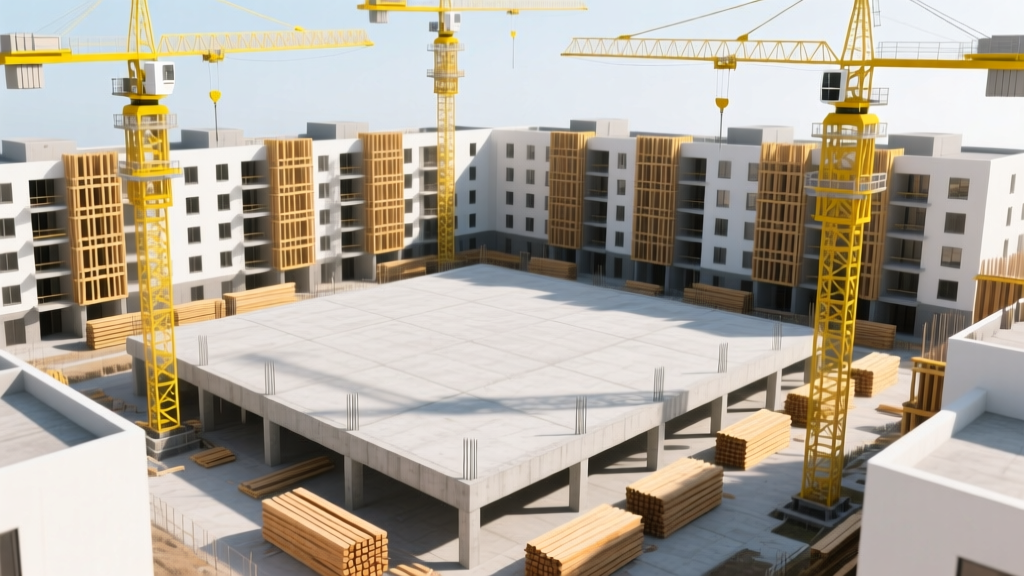
For mid-rise podium builds, the concrete podium (Type I-A) typically accounts for 18% to 22% of total hard costs. A post-tensioned concrete slab is the industry standard here, costing between $14 and $22 per square foot of deck area, offering superior span capabilities for ground-floor retail or parking. The wood-frame superstructure above utilizes engineered lumber (LVL and Glulam beams) and prefabricated wall panels to reduce on-site framing labor by up to 30%.
MEP (Mechanical, Electrical, Plumbing) Systems
MEP systems in multifamily construction typically consume 20% to 28% of the hard budget. In 2026, the shift toward electrification and energy code compliance (like IECC 2024 adoptions) has changed the baseline. Instead of traditional PTAC (Packaged Terminal Air Conditioner) units, developers are increasingly specifying Variable Refrigerant Flow (VRF) systems. While VRF systems carry a 15% higher upfront equipment cost (roughly $22 to $28 PSF compared to $16 PSF for PTAC), they drastically reduce electrical service requirements and improve long-term operational efficiency.
Supply Chain Warning: Electrical Switchgear
Lead times for custom commercial electrical switchgear and transformers remain a critical bottleneck. Developers must procure switchgear 50 to 70 weeks in advance of the rough-in phase. Failing to secure early procurement slots can delay the certificate of occupancy (CO) by months, devastating carrying cost projections.
Soft Costs: The Hidden Budget Eaters
Soft costs encompass all non-physical expenses required to entitlement, design, finance, and insure the project. These typically represent 15% to 25% of total project costs but can spike in highly regulated municipalities. Key soft cost line items include:
- Architecture & Engineering (A&E): 5% to 9% of hard costs. Includes structural, MEP, civil, and landscape engineering.
- Permits and Impact Fees: Highly localized. Water and sewer tap fees alone can range from $3,000 to over $15,000 per unit depending on the municipality.
- Legal and Entitlements: Zoning variances, environmental reviews, and community opposition mitigation can add $150,000 to $500,000+ in legal fees and delay costs.
- Insurance: Builder's risk, general liability, and wrap-up (OCIP) policies typically cost 1.5% to 3% of total construction value.
Land Acquisition and Site Work Variables
Land costs are entirely decoupled from construction costs but are heavily influenced by zoning density (units per acre). A developer paying $4 million for a 4-acre site zoned for 120 units pays $33,333 per unit for land. If they successfully rezone that same parcel for 180 units, the land cost drops to $22,222 per unit, dramatically improving the project's yield on cost.
Site work is equally volatile. Geotechnical surprises are the number one cause of budget overruns in the site-work phase. If soil borings reveal expansive clay requiring deep pier foundations, or solid rock requiring blasting, site prep costs can jump from $15,000 per unit to over $35,000 per unit. Always budget a minimum 10% contingency specifically for subgrade conditions.
Actionable Framework: Estimating Your Specific Project
To move from macroeconomic averages to a reliable pro-forma budget, follow this three-step estimation framework based on current U.S. Census Bureau construction spending data and regional multipliers.
Step 1: Establish the Base Hard Cost
Select your building typology from the table above. Assume a baseline of $250 PSF for a standard 5-story wood-over-podium build in a median-cost U.S. market (e.g., Dallas, TX or Charlotte, NC).
Step 2: Apply Regional Labor and Material Modifiers
Construction costs are hyper-local. Use the following multipliers to adjust your baseline PSF cost to your specific target market.
| Market Tier | Example Cities | Cost Multiplier |
|---|---|---|
| Tier 3 (Low Cost) | Memphis, TN; Oklahoma City, OK | 0.85 - 0.92 |
| Tier 2 (Median Cost) | Atlanta, GA; Phoenix, AZ | 0.98 - 1.05 |
| Tier 1 (High Cost) | Seattle, WA; Boston, MA | 1.25 - 1.45 |
| Tier 0 (Ultra High) | San Francisco, CA; Manhattan, NY | 1.60 - 2.10+ |
Step 3: Factor in Soft Costs and Financing
Multiply your adjusted hard cost by 1.25 to account for standard soft costs, architectural fees, and permits. Finally, calculate your construction loan interest reserves. With construction interest rates hovering between 7.5% and 9.5% in 2026, an 18-month build schedule will add roughly 8% to 12% to your total capitalized budget in carrying costs alone.
Expert Insights: Avoiding Common Budget Pitfalls
According to multifamily development analyses published by the National Association of Home Builders (NAHB), projects that fail to meet their yield-on-cost targets rarely do so because of lumber prices. They fail due to unanticipated municipal requirements and utility delays.
Pro-Tip: Off-Site Utility Extensions
If your site requires extending municipal water or sewer mains across adjacent private property or state highways, the costs and legal easement negotiations can add $200,000+ and 6 months to your timeline. Always verify the exact point of utility connection during the initial due diligence period, not during civil engineering design.
Ultimately, answering how much does it cost to build an apartment complex requires treating the budget as a dynamic model. By locking in structural typologies early, procuring long-lead MEP equipment before finalizing the GMP, and applying rigorous regional modifiers, developers can build resilient pro-formas that withstand the realities of the modern construction market.
Written by
Priya KapoorPriya Kapoor is a real estate market analyst and construction economics researcher with expertise in housing affordability, development feasibility, and infrastructure investment. She holds a Master of Regional Planning from Cornell University and previously worked as a senior analyst at CBRE's Investment Properties group, where she modeled returns for $4B in mixed-use development pipelines. Priya now runs an independent research practice advising developers, municipalities, and REITs on construction cost forecasting and market timing. She publishes the quarterly "BuildMat Market Pulse" report tracking material price indices across 12 commodity categories. Based in Austin, TX, Priya serves on the board of Habitat for Humanity Austin and is a marathon runner.
More from Priya Kapoor
View all
Construction Cost
Cost to Build a 1600 Sq Ft Home in 2026: Full Breakdown
Accurate 2026 cost to build a 1600 sq ft home—material, labor, and regional pricing breakdowns included. Plan your budget with real-time estimates.
Aug 11, 2026

Wood & Lumber
Name the Types of Wood for Pressure Treatment and Preservation
Learn how to name the types of wood best suited for pressure treatment. Compare species treatability, chemical retention levels, and 2026 preservation costs.
Aug 4, 2026

Stone & Masonry
Stone Veneer Suppliers Lindenhurst: 2026 Cost Analysis
Analyze 2026 stone veneer costs in Lindenhurst, NY. Compare local supplier pricing, delivery fees, and Suffolk County installation labor rates.
Aug 4, 2026