Cost of Building Materials 2025 vs 2026: Price Comparison
Compare the cost of building materials from 2025 to 2026. Get real pricing data on lumber, concrete, steel, and insulation for accurate project estimating.

The Shift in Material Pricing: 2025 Baseline vs. 2026 Projections
When evaluating the cost of building materials 2025 benchmarks against early 2026 projections, general contractors and estimators must account for divergent supply chain pressures. While 2025 saw stabilized pricing in softwood lumber and structural steel due to normalized global shipping rates, 2026 introduces new cost variables: carbon-capture mandates in cement production, updated blowing agent regulations for foam insulation, and renewed softwood lumber tariff adjustments. Accurate estimating now requires moving beyond historical square-foot averages and adopting material-specific forecasting.
Lumber and Framing: Dimensional vs. Engineered Wood
Framing packages typically consume 18% to 22% of a residential construction budget. According to the Federal Reserve Economic Data (FRED Softwood Lumber PPI), softwood pricing experienced high volatility in the early 2020s but plateaued through 2025. Heading into 2026, the primary cost driver is not raw timber, but rather the treatment chemicals and milling surcharges for specialized grades.
2025 vs. 2026 Framing Material Cost Matrix
| Material Specification | 2025 Avg. Unit Cost | 2026 Proj. Unit Cost | Primary Cost Driver (2026) |
|---|---|---|---|
| SPF #2 2x4x8 (Standard) | $3.65 - $4.10 | $3.80 - $4.25 | Canadian softwood tariff renewals |
| Douglas Fir-Larch #2 2x6x10 | $8.90 - $10.50 | $9.10 - $10.80 | West Coast logging restrictions |
| LVL Beam (1.75' x 9.25') | $48.00 / linear ft | $51.50 / linear ft | Resin adhesive cost increases |
| TJI I-Joists (9.5' depth) | $3.10 / linear ft | $3.25 / linear ft | OSB web component pricing |
| Ground Contact Treated 4x4x8 | $14.20 - $16.00 | $15.50 - $17.80 | Copper-based preservative (MCQ) costs |
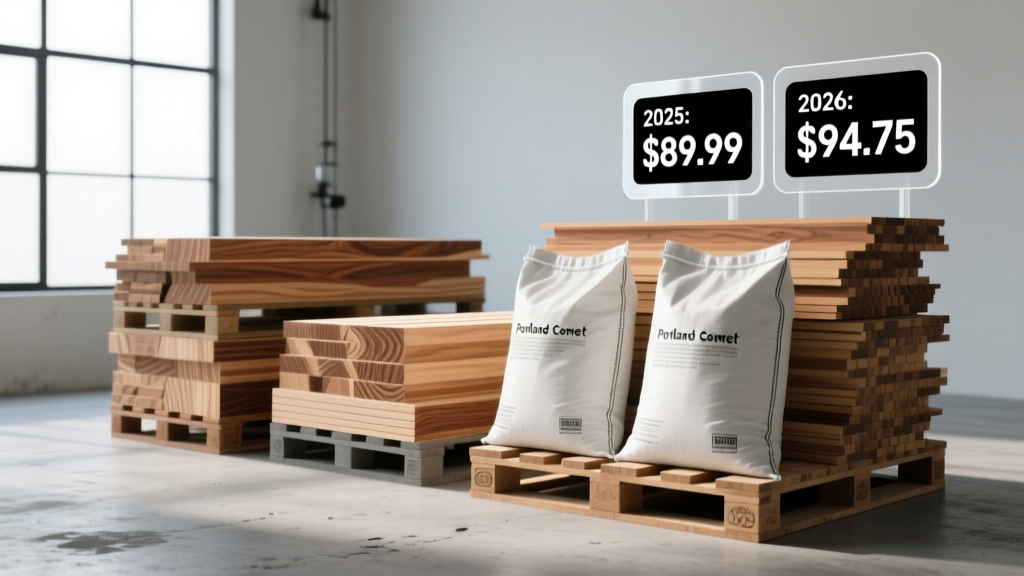
Concrete and Masonry: The Impact of Carbon-Capture Integration
Ready-mix concrete is experiencing the most significant upward price pressure. Data from the USGS National Minerals Information Center indicates that domestic cement production is heavily pivoting toward carbon-reduced manufacturing processes to meet 2026 environmental compliance targets. This transition requires massive capital expenditure, which manufacturers are passing down via base price hikes.
Ready-Mix Pricing by PSI and Application
- 3000 PSI (Standard Footings/Flatwork): $135 - $150 per cubic yard (2025) vs. $148 - $165 per cubic yard (2026).
- 4000 PSI (Driveways/Suspended Slabs): $155 - $175 per cubic yard (2025) vs. $172 - $192 per cubic yard (2026).
- 5000+ PSI (Post-Tensioned/Commercial): $185 - $210 per cubic yard (2025) vs. $205 - $235 per cubic yard (2026).
Cost-Saving Substitution Strategies
To mitigate the rising cost of Portland cement in 2026, structural engineers are increasingly specifying Supplementary Cementitious Materials (SCMs). Substituting 20% to 30% of the Portland cement with fly ash (Class F) or slag cement can reduce the per-yard material cost by $8 to $14 while improving long-term compressive strength and reducing permeability. However, be aware that high-slag mixes cure slower in cold weather, potentially requiring heated blankets (adding $0.50 - $0.80 per sq. ft. to curing costs) if pouring below 40°F.
Insulation and Envelope Materials: Blowing Agent Regulations
The U.S. Department of Energy continues to mandate stricter building envelope performance, pushing builders toward higher R-value assemblies. The cost divergence between traditional batt insulation and advanced foam systems is widening in 2026 due to the EPA's phasedown of HFC blowing agents used in closed-cell spray foam.
Insulation Material Comparison (Per Square Foot Installed)
| Insulation Type | R-Value per Inch | 2025 Cost / Sq. Ft. | 2026 Cost / Sq. Ft. | Best Application |
|---|---|---|---|---|
| Fiberglass Batt (R-15) | 3.1 - 3.4 | $0.45 - $0.65 | $0.48 - $0.68 | Standard 2x4 exterior walls |
| Mineral Wool (Rockwool) | 4.0 - 4.2 | $0.95 - $1.25 | $1.00 - $1.30 | Fire-rated assemblies, soundproofing |
| XPS Rigid Board (2-inch) | 5.0 | $1.60 - $1.90 | $1.75 - $2.10 | Exterior continuous insulation, below-grade |
| Open-Cell Spray Foam | 3.5 - 3.8 | $0.75 - $1.10 | $0.85 - $1.25 | Interior stud cavities, rooflines |
| Closed-Cell Spray Foam | 6.0 - 6.5 | $1.60 - $2.20 | $1.85 - $2.60 | Space-constrained cavities, moisture barriers |
Expert Insight: If your 2026 budget cannot absorb the premium for closed-cell spray foam (which now exceeds $2.40/board-foot in many markets due to HFO-1234ze blowing agent costs), utilize a 'flash-and-batt' hybrid system. Applying 1.5 inches of closed-cell foam for the air and vapor seal, followed by R-15 mineral wool batts, yields an R-23 assembly that meets 2026 IECC codes while reducing overall insulation costs by 35% compared to a full closed-cell fill.
Light Gauge Steel vs. Wood Framing: The 2026 Tipping Point
For commercial interiors and multi-family residential projects, the decision between 25-gauge light gauge steel (LGS) studs and traditional wood framing has historically hinged on local lumber prices. With 2026 lumber stabilization, LGS remains highly competitive for non-load-bearing partitions.
Pros of 25-Ga Steel Studs (3-5/8')
- Price stability: $12.50 - $14.00 per piece (2026 est.)
- Zero risk of warping, twisting, or moisture rot
- Non-combustible (reduces insurance premiums in some zones)
- Pre-punched for electrical and plumbing runs
Cons of 25-Ga Steel Studs
- Requires specialized self-drilling screws (Tek screws)
- Thermal bridging requires continuous exterior insulation
- Labor costs 10-15% higher if crew is wood-only
- Poor acoustic performance without resilient channels
Strategic Procurement Framework for 2026 Estimates
To protect profit margins against the 2026 material cost shifts, estimators should implement the following procurement protocol:
- Lock Concrete Early: Ready-mix suppliers are moving to 90-day price guarantees rather than 6-month locks. Secure your 2026 flatwork and foundation pricing during the Q4 2025 bidding phase before spring carbon-surcharge adjustments hit.
- Specify Alternative Fasteners: With Simpson Strong-Tie and USP structural connectors facing steel coating surcharges, evaluate galvanized alternatives or specify powder-actuated anchoring systems where structural engineering permits, saving $0.15 to $0.30 per connection point.
- Pre-Fabricate Wall Panels: Off-site panelization reduces lumber waste from the standard 10-15% down to 3-5%. In 2026, the labor savings of panelized walls will offset the 4% increase in raw dimensional lumber costs.
Frequently Asked Questions
Will drywall costs increase in 2026?
Standard 1/2-inch tapered-edge gypsum board (e.g., USG Sheetrock) is projected to remain flat or see a marginal 2% increase, hovering around $13.50 to $15.00 per 4x8 sheet. However, specialized boards like 5/8-inch Type X (fire-rated) and fiberglass-mat moisture-resistant boards (e.g., Georgia Pacific DensArmor) will see 5% to 7% increases due to fiberglass mat supply constraints.
How do I account for material waste in 2026 estimates?
Given the elevated cost of engineered lumber and rigid foam, reduce your standard waste factor. For dimensional lumber, maintain a 10% waste factor. For LVL beams, I-joists, and PSL columns, calculate exact cut lists and reduce the waste factor to 3% to 5%. For closed-cell spray foam, rely on the subcontractor's board-foot guarantee rather than adding a volumetric waste buffer.
Are roofing material prices dropping?
Asphalt architectural shingles (e.g., GAF Timberline HDZ) saw peak pricing in 2022-2023 and stabilized in 2025 at $32 to $38 per square (100 sq. ft.). For 2026, expect a 3% increase due to asphalt binder (petroleum) market fluctuations. Standing seam metal roofing (24-gauge Galvalume) remains highly volatile, tied directly to global zinc and aluminum tariffs, and should be priced at the time of contract signing rather than estimated months in advance.
Written by
David NakamuraDavid Nakamura is a licensed architect (AIA) and construction technology writer focused on sustainable building methods, mass timber engineering, and high-performance building envelopes. He holds a Master of Architecture from the University of Washington and is a certified Passive House Consultant (CPHC). David spent eight years at the Seattle firm Mithun, where he led the design of three LEED Platinum projects, before founding his own practice specializing in net-zero residential design. He serves on the editorial advisory board of GreenBuilder Magazine and has authored peer-reviewed papers on cross-laminated timber (CLT) connections for the Journal of Structural Engineering. In his spare time, David teaches woodworking at Pratt Fine Arts Center and kayaks the Puget Sound.
More from David Nakamura
View all
Construction Cost
Labor Cost to Build a Deck Per Sq Ft: 2026 Installation Guide
Discover the exact labor cost to build a deck per sq ft in 2026. This installation guide breaks down contractor rates, complexity factors, and hidden fees.
Aug 4, 2026

Construction Cost
How Much Does It Cost to Build a 3 Bedroom House? Financing Guide
Learn exactly how much it costs to build a 3 bedroom house and explore 2026 financing options, construction loan types, and budget frameworks for your build.
Aug 4, 2026

Construction Cost
Cost to Build a Tennis Court: 2026 Guide
How much does it cost to build a tennis court in 2026? Breakdowns for asphalt, concrete, and synthetic surfaces plus fencing and lighting.
Jul 30, 2026