How Much Do Car Washes Cost to Build? Full 2026 Breakdown
Discover how much car washes cost to build in 2026. Complete cost guide covering express tunnels, in-bay automatics, equipment, and hidden site fees.

Baseline Construction Costs by Car Wash Model
Determining exactly how much car washes cost to build requires separating the business model from the real estate. A self-serve bay and a 100-foot express exterior tunnel operate on entirely different capital expenditure (CapEx) scales. In 2026, supply chain stabilization has normalized structural steel and concrete pricing, but municipal utility tap fees and advanced water reclamation mandates continue to drive site-development costs upward.
According to industry data tracked by the International Carwash Association (ICA), the national average for a fully equipped, land-included express tunnel now sits between $3.2 million and $4.8 million. Below is the baseline cost matrix for the three primary car wash formats.
| Car Wash Type | Typical Footprint | Total Project Cost (Inc. Land) | Cost Per Sq. Ft. (Building) |
|---|---|---|---|
| Self-Serve (4 Bays) | 3,000 - 4,500 sq ft | $650,000 - $1,100,000 | $110 - $145 |
| In-Bay Automatic (Rollover) | 4,000 - 6,000 sq ft | $850,000 - $1,400,000 | $130 - $175 |
| Express Exterior Tunnel (100 ft) | 10,000 - 14,000 sq ft | $3,200,000 - $4,800,000 | $180 - $240 |
Express Tunnel Cost Breakdown: The 100-Foot Standard
The express exterior tunnel is the dominant model for new builds due to its high throughput and low labor requirements. For a standard 100-foot conveyor system housed in a 130-foot by 20-foot building, the capital stack breaks down into five distinct phases.
1. Land Acquisition & Site Preparation ($600,000 - $1,200,000)
Car washes require high-traffic visibility, corner lots, and minimum 1.5-acre parcels to accommodate stacking lanes. Site prep includes demolishing existing structures, grading, and installing stormwater retention ponds. Soil remediation can add $40,000 to $150,000 if previous commercial use left hydrocarbon contamination.
2. Concrete & Structural Shell ($800,000 - $1,100,000)
Car wash environments are highly corrosive. Standard commercial concrete will spall and degrade within five years under constant exposure to alkaline soaps and acidic tire cleaners. Specifications must mandate 6,000 PSI concrete with a broadcast quartz hardener. The tunnel floor requires #4 rebar at 18 inches on center, and all control joints must be sealed with polyurethane rather than standard silicone to prevent chemical penetration to the sub-base.
3. Wash Equipment & Conveyor ($900,000 - $1,300,000)
Equipment represents the core operational asset. A 100-foot friction or touchless tunnel from manufacturers like Sonny's The CarWash Factory or MacNeil Wash Systems includes high-pressure manifolds, foam applicators, mitters, and blowers. The conveyor system alone (typically a dual-belt or chain-and-roller design) accounts for $150,000 to $220,000 of this total.
4. Water Reclamation & Utilities ($250,000 - $400,000)
Municipalities increasingly mandate closed-loop water systems. A commercial-grade reclaim system from brands like Aqua-Ox or Hydro Engineering captures, filters, and reuses up to 85% of wash water. While the EPA WaterSense program highlights the environmental necessity of these systems, the financial reality is that they reduce municipal water and sewer discharge fees by thousands of dollars monthly, yielding a typical ROI of 18 to 24 months.
5. Soft Costs, Permits & POS Integration ($150,000 - $250,000)
Architectural engineering, environmental impact studies, and point-of-sale (POS) integration (e.g., DRB Systems or Sonny's CarWash POS) finalize the budget. POS systems must integrate with automated license plate recognition (ALPR) cameras and monthly subscription management software.
Many first-time developers underestimate municipal utility tap fees. Connecting a 3-inch water meter and a 6-inch sewer line to city mains can trigger impact fees ranging from $40,000 to over $150,000, depending on the jurisdiction. Always request a formal utility capacity letter and fee schedule from the local public works department before purchasing land.
Equipment Specifications & Brand Pricing
Selecting the right equipment configuration directly impacts your cost-per-wash and long-term maintenance overhead. Below is a pricing guide for standard 2026 equipment packages.
- Touchless In-Bay Automatics (e.g., PDQ LaserWash 4000): $38,000 - $45,000 per bay. Ideal for markets with high winter road salt usage where friction brushes might damage vehicles or freeze.
- Friction Tunnel Components: Top brushes and wrap-around mitters cost between $12,000 and $18,000 per arch. Neoprene and closed-cell foam materials are standard, requiring replacement every 3 to 5 years at a cost of $4,000 per arch.
- High-Pressure Pumps: Cat Pumps or General Pump triplex plunger pumps (operating at 1,000 to 1,200 PSI) cost $3,500 to $5,000 each. A 100-foot tunnel typically requires 6 to 8 dedicated pump stations.
- Dryer Blowers: 30HP to 50HP regenerative blowers cost $4,500 to $7,000 per unit. A standard tunnel uses 8 to 12 blowers, requiring a dedicated 480V 3-phase electrical panel.
Structural & Mechanical Edge Cases
Failure to account for the mechanical realities of a car wash leads to catastrophic change orders during construction. Address these specific engineering requirements during the design phase:
- Trench Drain Sizing: Do not use standard 4-inch PVC plumbing. Car wash trench drains must be 6-inch or 8-inch Schedule 40 PVC or cast iron, sloped at a minimum of 1/4 inch per foot to handle the 60 to 100 gallons per minute (GPM) discharge rate of modern tunnel arches.
- Grease Interceptors: Municipal codes require oversized gravity grease interceptors (GGIs) or automatic grease removal devices (AGRDs) like the Thermaco Big Dipper. Budget $15,000 to $25,000 for a 2,000-gallon exterior concrete grease trap.
- Electrical Load: A fully equipped express tunnel routinely draws 800 to 1,200 amps. Ensure the local utility can provide a 1,500-amp service drop; upgrading a neighborhood transformer can add $60,000 and 6 months of lead time to your project.
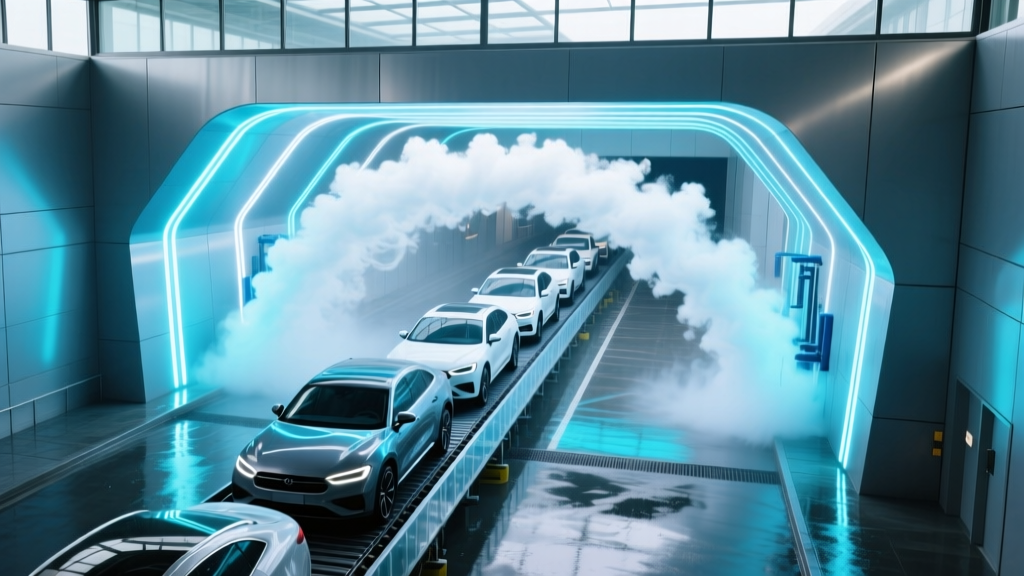
Financial Modeling: Wash Volume vs. Payback
Understanding how much car washes cost to build is only half the equation; calculating the break-even threshold dictates the viability of the investment. The express tunnel model relies on volume over high per-wash margins.
The 300-Wash Daily Threshold:
A standard 100-foot tunnel with $1.4M in annual debt service and $600,000 in fixed operational costs (labor, chemicals, utilities, insurance) requires an average of 280 to 320 cars per day at a $15 average ticket price to achieve cash-flow positivity. Sites that cannot realistically stack 300 cars on a Saturday due to poor ingress/egress design or low traffic counts will fail to service their debt, regardless of construction quality.
When evaluating a potential build, map the stacking lane capacity. A 100-foot tunnel processes roughly 100 to 120 cars per hour. If your site only allows for 15 cars in the queue, you will experience "stack-out" (where cars leave the line and drive away) during peak weekend hours, artificially capping your revenue despite having the equipment capacity to wash more vehicles. Always prioritize lot geometry and traffic light proximity over raw square footage when selecting a build site.
Written by
James ThorntonJames Thornton is a construction industry veteran with 25 years of hands-on experience in wood framing, lumber grading, and residential building codes. He started as a framing carpenter in rural Oregon, earned his ICC Residential Building Inspector certification, and eventually became a senior plan reviewer for the City of Portland Bureau of Development Services. James holds a B.S. in Wood Science & Technology from Oregon State University and is a certified lumber grader through the West Coast Lumber Inspection Bureau (WCLIB). He has inspected over 3,000 residential construction sites and authored the city's internal guide on advanced framing techniques (2x6 at 24" O.C.). James lives in Bend, OR, where he builds custom timber-frame cabins and competes in lumberjack sports.
More from James Thornton
View all
Insulation
Best Home Insulation Materials: Complete 2026 Guide
Compare top home insulation materials for 2026. Find R-values, installed costs per square foot, and best uses for fiberglass, spray foam, and mineral wool.
Aug 4, 2026

Sustainable Building
Certify Your Green Building Material for LEED and WELL
Step-by-step guide to certifying a green building material for LEED v5 and WELL v2. Master EPDs, HPDs, and VOC limits for 2026 project specifications.
Aug 4, 2026

Stone & Masonry
Veneer Stacked Stone Panels: Interior Design & Style Showcase
Discover how veneer stacked stone panels transform interiors. Explore modern design profiles, material pairings, and technical installation specs.
Aug 4, 2026