Touchless Car Wash Cost to Build: Complete 2026 Pricing Guide
Discover the true touchless car wash cost to build in 2026. Breakdowns for land, equipment, plumbing, and ROI for in-bay automatic systems.

Executive Summary: The True Touchless Car Wash Cost to Build
Calculating the accurate touchless car wash cost to build requires moving beyond generic equipment brochures and analyzing the complete site-to-software infrastructure. For an In-Bay Automatic (IBA) touchless facility, the total capital expenditure typically ranges from $450,000 to $850,000 per bay when factoring in land acquisition, site work, building shell, high-pressure equipment, and water reclamation systems. If you already own the land and have existing utility stubs, the hard construction and equipment costs drop to a tighter window of $225,000 to $380,000 per bay.
Unlike friction washes that rely on physical contact to agitate dirt, touchless systems depend on extreme water pressure (1,000 to 1,500 PSI), precise chemical titration, and advanced 3D vehicle profiling. This fundamental difference dictates heavier utility requirements, specialized concrete treatments, and higher ongoing chemical overhead. This guide dissects the exact line-item costs, engineering specifications, and operational realities required to launch a profitable touchless IBA in 2026.
- Total Project (Including Land): $450,000 - $850,000+
- Hard Construction & Equipment Only: $225,000 - $380,000
- Equipment Package (Wash & POS): $55,000 - $75,000
- Average Wash Ticket: $9.00 - $14.00
Capital Expenditure Breakdown: Where the Money Goes
The financial architecture of a touchless car wash is heavily weighted toward site preparation and utility infrastructure. Because touchless systems consume significantly more water and electricity per cycle than friction tunnels, municipal tap fees and electrical upgrades often catch first-time operators off guard.
| Construction Phase | Estimated Cost Range | Critical Specifications & Notes |
|---|---|---|
| Land & Site Prep | $75,000 - $250,000 | Highly dependent on market. Includes grading, soil testing, and environmental impact studies. |
| Building Shell & Canopy | $60,000 - $110,000 | Pre-engineered steel structures with insulated bay walls and polycarbonate or aluminum entry doors. |
| Touchless Wash Equipment | $45,000 - $65,000 | Includes gantry, high-pressure pump station, chemical injectors, and 3D profiling sensors. |
| Water Reclamation & RO | $25,000 - $45,000 | Reverse Osmosis (RO) system for spot-free rinse plus biological or centrifugal reclaim system. |
| Plumbing & Trench Drains | $35,000 - $60,000 | Schedule 80 PVC or stainless steel lines; 12-inch wide modular trench drains with heavy-duty grates. |
| Concrete & Floor Coatings | $30,000 - $55,000 | 5,000 PSI air-entrained concrete with polyurea chemical-resistant sealants. |
| Electrical & Control Room | $20,000 - $40,000 | 480V 3-phase service, NEMA 4X watertight control panels, and climate-controlled equipment room. |
| Soft Costs & Permits | $25,000 - $50,000 | Architectural drawings, municipal tap fees, impact fees, and environmental permitting. |
Equipment Specifications & Brand Pricing
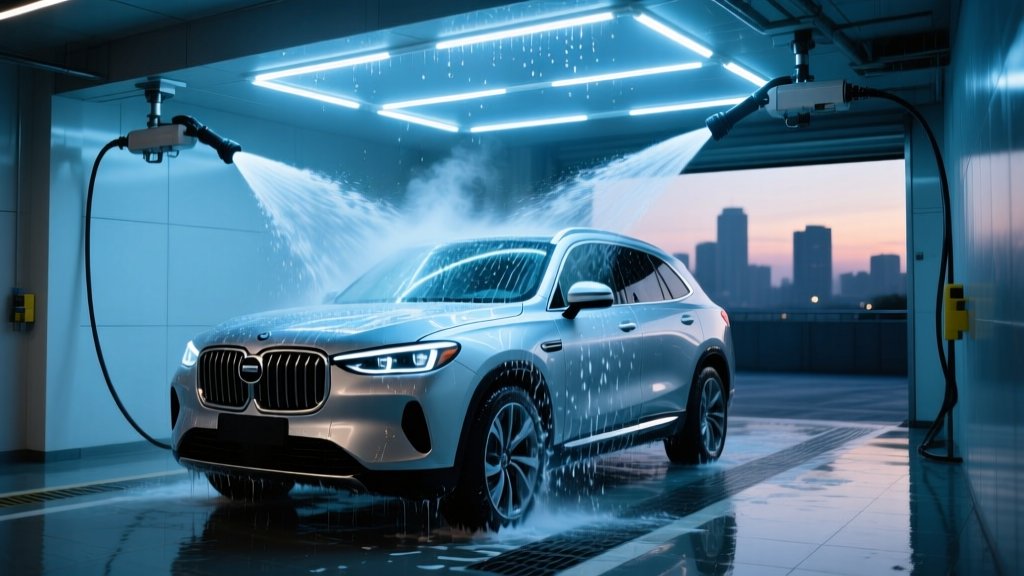
The core of your touchless car wash cost to build is the gantry system. The market is dominated by a few key manufacturers, each offering distinct profiling technologies and pump configurations. When spec'ing equipment, prioritize systems with non-contact 3D profiling (using LiDAR or ultrasonic sensors) to map the vehicle's contour, allowing the nozzles to maintain an optimal 12-to-18-inch distance from the paint surface.
Leading Touchless Platforms
- PDQ LaserWash 4000: The industry benchmark for contouring touchless technology. Features dual-dryer systems and advanced 3D profiling. Equipment costs typically range from $50,000 to $60,000 per bay.
- Ryko Odyssey Touchless: Known for robust build quality and integrated LED light shows that enhance the customer experience. Pricing generally sits between $48,000 and $58,000.
- MacNeil Wash Systems: Offers highly customizable high-pressure manifolds and proprietary chemical delivery systems, often favored by operators running multi-bay hybrid setups.
Site Work, Concrete, and Utility Infrastructure
The physical environment of a touchless bay endures extreme chemical and thermal stress. Standard commercial concrete specifications will fail prematurely when exposed to daily applications of high-pH pre-soaks and hydrofluoric acid-based wheel cleaners.
Concrete and Drainage Engineering
Floors must be poured with a minimum of 5,000 PSI air-entrained concrete, reinforced with #4 rebar on 24-inch centers. The floor requires a minimum slope of 1/8-inch per foot directing all runoff to a central 12-inch wide modular trench drain. Because high-pressure water creates significant splash-back and atomization, the lower 8 feet of the bay walls should be constructed with glazed concrete block or coated with a chemical-resistant polyurea lining to prevent moisture intrusion and rebar corrosion.
Plumbing and Water Reclamation
Touchless systems demand high volume and high pressure. You must supply a minimum of 30 to 40 Gallons Per Minute (GPM) per bay. According to guidelines tracked by the Environmental Protection Agency (EPA), modern municipal codes increasingly mandate water reclamation for commercial wash facilities. A centrifugal reclaim system will filter and recycle up to 80% of the wash water, but the final spot-free rinse requires fresh water processed through a Reverse Osmosis (RO) system. Budget $3,000 to $5,000 annually for RO membrane replacements and resin bed maintenance.
Electrical Service Requirements
The high-pressure cat pumps (typically 20HP to 25HP per bay) and heavy-duty blowers require 480V, 3-phase electrical service. A single bay typically demands a 200-amp to 400-amp dedicated panel. All electrical components inside the bay must be rated NEMA 4X (watertight and corrosion-resistant), and the main Variable Frequency Drives (VFDs) should be housed in a climate-controlled technical room adjacent to the bay to prevent humidity-induced board failures.
Operational Overhead: The Chemistry Factor
Understanding the touchless car wash cost to build is only half the equation; operational chemistry dictates your ongoing margins. In the car wash industry, cleaning efficacy is governed by the TACT circle: Time, Action, Chemistry, and Temperature. Because a touchless wash eliminates 'Action' (physical friction from brushes), 'Chemistry' and 'Temperature' must be increased to compensate.
Friction washes rely on mechanical agitation, allowing them to use milder, less expensive soaps. Touchless washes require aggressive chemical reactions—typically a high-pH (11.0 to 13.0) alkaline pre-soak to break down organic road film, followed by a low-pH (2.0 to 4.0) acidic rinse to neutralize and aid in sheeting. This aggressive chemical profile increases the cost per car from roughly $0.20 in a friction wash to $0.45 - $0.65 in a touchless environment.
To mitigate chemical costs, install positive displacement chemical injection pumps rather than aspirator-based systems. Positive displacement pumps guarantee exact dilution ratios regardless of fluctuations in municipal water pressure, preventing the over-usage of expensive triple-foam and ceramic sealant products.
Financing and ROI Timelines
Most independent operators finance the touchless car wash cost to build through commercial real estate loans or government-backed programs. The Small Business Administration (SBA) 7(a) loan program is a popular route, offering up to $5 million with favorable amortization schedules (up to 25 years for real estate, 10 years for equipment). Lenders will require a comprehensive business plan and typically demand a 15% to 25% down payment.
Revenue Projections: A well-located single-bay touchless IBA can process 15 to 20 cars per hour. At an average ticket of $11.00, operating 12 hours a day, the maximum theoretical daily gross is $2,640. However, accounting for weather fluctuations, seasonal demand, and off-peak hours, a realistic stabilized average is 80 to 110 cars per day, yielding $880 to $1,210 daily. With typical operating expenses (utilities, chemicals, maintenance, and debt service) consuming 45% to 55% of gross revenue, operators can expect to achieve break-even on the equipment investment within 24 to 36 months, according to data aggregated by the International Carwash Association.
Frequently Asked Questions (FAQ)
Can I convert an existing friction in-bay wash to a touchless system?
Yes, but it requires significant infrastructure upgrades. Friction washes typically operate on standard 208V/240V single-phase or light 3-phase power. Touchless high-pressure pumps require heavy 480V 3-phase power. Additionally, the existing plumbing lines may need to be upsized from 3/4-inch to 1.5-inch to support the 40 GPM volume requirement. Budget $40,000 to $70,000 for the conversion, exclusive of the new gantry equipment.
Do touchless car washes damage vehicle paint or antennas?
Modern touchless systems are specifically designed to eliminate the micro-marring (swirl marks) caused by friction brushes, making them highly preferred by owners of luxury vehicles, matte-finish wraps, and classic cars. However, operators must post clear signage requiring customers to remove or fold in loose aftermarket accessories, as the 1,000+ PSI water jets can catch the edge of loose trim or poorly secured license plate covers.
What is the ideal lot size for a two-bay touchless facility?
For a two-bay IBA setup with adequate stacking lanes to prevent traffic backups onto municipal roads, you need a minimum of 12,000 to 15,000 square feet (approx. 0.3 to 0.35 acres). Each bay requires a minimum 60-foot stacking lane ahead of the wash bay to accommodate 4 to 5 waiting vehicles during peak Saturday hours.
Written by
Sarah WhitfieldSarah Whitfield is a chartered quantity surveyor (MRICS) and construction cost analyst with 15 years of experience in material pricing, procurement strategy, and project budgeting. She earned her degree in Construction Management from the University of Reading (UK) and has worked on projects ranging from $2M custom homes to $180M mixed-use developments across North America and Europe. Sarah currently leads cost estimating for BuildMat Insight, maintaining a proprietary database of 4,000+ material price points updated quarterly. She is a frequent contributor to RSMeans cost data panels and has presented at the International Cost Engineering Council (ICEC) congress. Based in Denver, CO, Sarah is an avid trail runner and volunteer mentor for Women in Construction.
More from Sarah Whitfield
View all
Wood & Lumber
What Are the Different Types of Wood? A Builder's Guide
Compare structural softwoods, finish hardwoods, and engineered lumber. Analyze Janka ratings, MOE values, and 2026 pricing for construction.
Aug 4, 2026

Walls & Panels
Steel Framing vs Wood Framing: Corrosion and Moisture Defense
Compare steel framing vs wood framing for moisture resistance. Learn about galvanized coatings, condensation risks, and corrosion protection strategies.
Jul 21, 2026

Stone & Masonry
How to Cut Stone Veneer: Wet Saw vs Grinder Comparison
Compare the best tools for cutting stone veneer. We review wet saws, angle grinders, and chop saws to help you achieve clean, chip-free cuts.
Jul 21, 2026