How Much Does It Cost to Build an ADU? 2026 Finance Guide
Discover exactly how much it costs to build an ADU and explore the best financing options, from HELOCs to Fannie Mae renovation loans, to fund your project.

The True Cost to Build an ADU: Hard Numbers by Type
Answering the question of how much does it cost to build an ADU requires separating the structure type from site-specific variables like grading, utility trenching, and permitting. In 2026, the national average cost to build an Accessory Dwelling Unit ranges from $90,000 for a basic garage conversion to over $400,000 for a custom, stick-built two-story detached unit.
| ADU Construction Type | Average Cost Per Sq. Ft. | Total Cost (500 Sq. Ft. Unit) | Typical Timeline |
|---|---|---|---|
| Garage Conversion (Attached) | $180 - $260 | $90,000 - $130,000 | 3 - 5 Months |
| Prefab / Modular Detached | $320 - $450 | $160,000 - $225,000 | 4 - 7 Months |
| Stick-Built Custom Detached | $450 - $700+ | $225,000 - $350,000+ | 8 - 14 Months |
Matching Your ADU Cost to the Right Financing Vehicle
Funding an ADU is fundamentally different from funding a primary residence purchase. You are financing a construction project that will alter the appraisal of your existing collateral. The right loan depends entirely on your current equity position, your existing mortgage rate, and whether you intend to occupy the ADU or rent it out.
1. Home Equity Line of Credit (HELOC)
A HELOC is the default choice for homeowners with substantial equity (typically 30% or more) who are building a lower-cost garage conversion or purchasing a prefab unit under $150,000. HELOCs operate on a draw schedule, meaning you only pay interest on the capital actually disbursed to your contractor.
- Best For: Garage conversions, prefab ADUs, and homeowners keeping their current low-rate first mortgage.
- The Catch: Variable interest rates expose you to payment shock if the prime rate increases during your 10-year draw period.
- LTV Limits: Most lenders cap combined loan-to-value (CLTV) at 80% to 85% for HELOCs.
2. Fannie Mae HomeStyle & FHA 203(k) Renovation Loans
If you lack the cash reserves for a large down payment on a construction loan, renovation mortgages allow you to bundle the ADU construction costs into a single first mortgage. These loans underwrite based on the future appraised value of the property once the ADU is completed.
3. Cash-Out Refinance
A cash-out refinance replaces your existing mortgage with a new, larger one, handing you the difference in cash at closing. This is only mathematically viable if current market rates are at or below your existing rate, or if the ADU's projected rental income drastically alters your long-term wealth equation. You will need a minimum of 20% post-cash-out equity remaining in the property.
The "Subject Property" Appraisal Trap
The single biggest point of failure in ADU financing is the appraisal. Lenders cannot lend against the value of a structure that does not exist yet. They must order a "Subject" appraisal, which evaluates the property as if the ADU is fully completed.
The Fannie Mae B3-3.1-07 Rental Income Advantage: If you plan to rent the ADU, Fannie Mae allows lenders to use 75% of the lesser of the signed lease agreement or the appraiser's market rent schedule to offset your Debt-to-Income (DTI) ratio. This projected income can be the deciding factor in qualifying for a $300,000 construction loan.
To secure an accurate subject appraisal, your contractor must provide a highly detailed, line-item cost breakdown (the "draw schedule") and complete architectural plans. Vague estimates will result in the appraiser assigning a conservative value, potentially leaving you with a financing shortfall right before foundation pouring.
State and Local ADU Grant Programs
Before taking on high-interest debt, investigate local subsidies. Programs modeled after the California Housing Finance Agency (CalHFA) ADU Grant Program provide up to $40,000 in forgivable grants for low-to-moderate-income homeowners to cover pre-development and non-recurring closing costs. While California's specific grant funding fluctuates, municipalities in states like Oregon, Washington, and Massachusetts have introduced localized forgivable loan programs tied to affordability covenants (e.g., agreeing to rent the ADU to tenants earning below 80% of the Area Median Income).
ROI Reality Check: Debt Service vs. Rental Yield
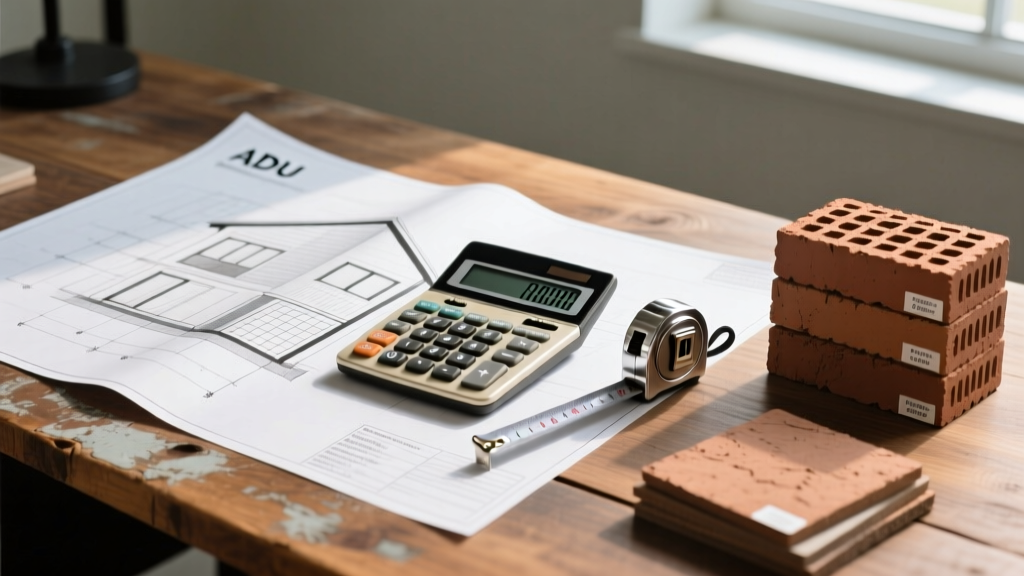
Understanding how much does it cost to build an ADU is only half the equation; you must model the debt service against local rental yields. Consider a $220,000 stick-built ADU financed via a HomeStyle loan at a 6.8% interest rate over 30 years.
- Monthly Principal & Interest: $1,439
- Property Tax & Insurance Escrow: ~$350
- Total Monthly ADU Debt Service: $1,789
- Average Market Rent (1-Bed/1-Bath ADU): $2,100 - $2,600
- Net Monthly Cash Flow: +$311 to +$811
This positive cash flow assumes 100% occupancy. Smart financial modeling requires a 10% vacancy factor and a $150/month maintenance reserve for appliance replacement and exterior upkeep.
Frequently Asked Questions
Can I use a personal loan to build an ADU?
Technically yes, but practically no. Unsecured personal loans cap out around $50,000 to $100,000 with interest rates frequently exceeding 10% to 15%. The monthly debt service on a $75,000 personal loan at 12% over 7 years is roughly $1,330, which destroys your cash flow. Personal loans should only be used to cover architectural and permitting soft costs (typically $8,000 - $15,000) prior to securing your main construction financing.
What if my property is zoned for an ADU, but the HOA forbids it?
State laws (such as California's Civil Code 4751) increasingly supersede Homeowner Association rules, rendering HOA bans on ADUs legally void. However, HOAs can still enforce reasonable restrictions on exterior aesthetics, rooflines, and material colors. Factor in potential architectural review delays when calculating your financing draw schedule.
Do construction loans require interest-only payments during the build?
Yes. Standalone ADU construction loans typically feature a 9-to-12-month interest-only period where you only pay interest on the funds drawn to date. Once the certificate of occupancy (CO) is issued, the loan either converts to a standard amortizing mortgage or requires a balloon payoff via a refinance. Renovation loans like the FHA 203(k) bypass this by wrapping the construction and permanent mortgage into one from day one.
Written by
Priya KapoorPriya Kapoor is a real estate market analyst and construction economics researcher with expertise in housing affordability, development feasibility, and infrastructure investment. She holds a Master of Regional Planning from Cornell University and previously worked as a senior analyst at CBRE's Investment Properties group, where she modeled returns for $4B in mixed-use development pipelines. Priya now runs an independent research practice advising developers, municipalities, and REITs on construction cost forecasting and market timing. She publishes the quarterly "BuildMat Market Pulse" report tracking material price indices across 12 commodity categories. Based in Austin, TX, Priya serves on the board of Habitat for Humanity Austin and is a marathon runner.
More from Priya Kapoor
View all
Construction Cost
Cost to Build a 1600 Sq Ft Home in 2026: Full Breakdown
Accurate 2026 cost to build a 1600 sq ft home—material, labor, and regional pricing breakdowns included. Plan your budget with real-time estimates.
Aug 11, 2026

Wood & Lumber
Name the Types of Wood for Pressure Treatment and Preservation
Learn how to name the types of wood best suited for pressure treatment. Compare species treatability, chemical retention levels, and 2026 preservation costs.
Aug 4, 2026

Stone & Masonry
Stone Veneer Suppliers Lindenhurst: 2026 Cost Analysis
Analyze 2026 stone veneer costs in Lindenhurst, NY. Compare local supplier pricing, delivery fees, and Suffolk County installation labor rates.
Aug 4, 2026