How Much Does an Outdoor Kitchen Cost to Build in 2026?
Discover how much an outdoor kitchen costs to build in 2026. Get exact pricing for appliances, masonry, plumbing, and labor to plan your backyard upgrade.

The Real Cost of Building an Outdoor Kitchen in 2026
Building an outdoor kitchen is one of the highest-impact upgrades you can make to your property, but pricing varies wildly based on material choices, utility routing, and appliance tiers. In 2026, the national average cost to build an outdoor kitchen sits at $18,500, with most homeowners spending between $10,000 and $35,000. However, a basic prefabricated setup can start around $5,000, while luxury estates with custom masonry and high-end appliances easily exceed $75,000.
Unlike indoor remodels, outdoor kitchens require materials engineered to withstand UV radiation, freeze-thaw cycles, and extreme humidity. This guide breaks down the exact line-item costs, material specifications, and hidden utility expenses you need to budget for your project.
Cost Tiers: What Your Budget Actually Buys
To understand how much does an outdoor kitchen cost to build, you must first identify which construction tier aligns with your goals. According to industry data from Angi's 2026 outdoor living cost reports, projects generally fall into three distinct categories.
Tier 1: Prefabricated & Entry-Level ($5,000 – $12,000)
- Structure: Prefabricated modular islands (e.g., RTA Outdoor Living kits) or basic concrete block with stucco veneer.
- Countertops: Poured concrete or basic outdoor-rated tile.
- Appliances: Mid-grade freestanding gas grill ($1,500–$3,000), no built-in refrigeration or plumbing.
- Best For: DIYers, small patios, and homeowners who want a dedicated grilling station without the need for trenching water or gas lines.
Tier 2: Custom Mid-Range ($12,000 – $30,000)
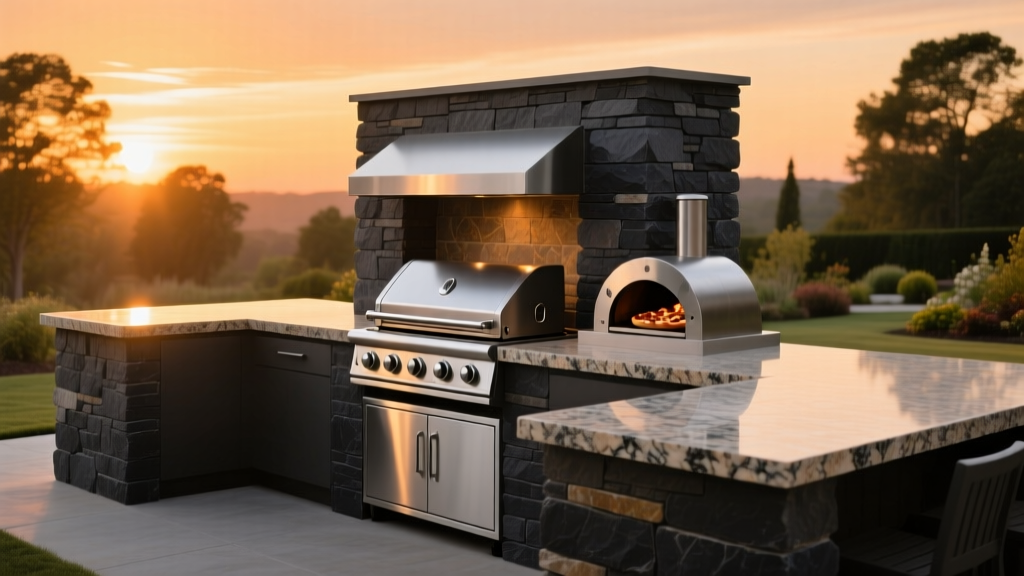
- Structure: Custom masonry (CMU block with natural stone veneer or architectural stucco).
- Countertops: 3cm Granite or quartzite with a bullnose edge.
- Appliances: Built-in premium grill (e.g., Weber Summit or Bull Outlaw), outdoor-rated undercounter fridge, and a drop-in ice bin.
- Utilities: Includes trenching for a dedicated 240V electrical circuit and basic cold-water plumbing for a bar sink.
Tier 3: Luxury & High-End ($30,000 – $75,000+)
- Structure: Engineered steel framing (e.g., Studco) with premium stacked stone or sintered stone cladding.
- Countertops: High-end quartzite, Dekton, or custom polished concrete with integrated drainage.
- Appliances: Heavy-duty luxury brands (Kalamazoo Outdoor Gourmet, Lynx), built-in pizza ovens, kegerators, and side burners.
- Utilities: Full hot/cold plumbing, integrated grease traps, gas lines, and structural pergolas with integrated lighting and heating.
Line-Item Cost Breakdown: Materials & Labor
The table below details the average 2026 pricing for individual components. Labor typically accounts for 35% to 50% of the total budget, heavily influenced by local masonry rates and utility trenching distances.
| Component | Material / Specification | Average Cost Range (Installed) |
|---|---|---|
| Base Framing | Concrete Masonry Units (CMU) vs. Galvanized Steel | $45 – $95 per linear foot |
| Cladding / Veneer | Manufactured Stone vs. Natural Stacked Stone | $25 – $85 per sq. ft. |
| Countertops | Granite vs. Dekton / Quartzite | $70 – $160 per sq. ft. |
| Built-In Gas Grill | 36-inch to 42-inch Premium Models | $3,500 – $12,000+ |
| Outdoor Refrigeration | UL-Rated Undercounter Fridge / Ice Maker | $1,800 – $4,500 |
| Pizza Oven | Built-in Gas or Wood-Fired Brick | $3,000 – $8,500 |
| Plumbing & Sink | 304 Stainless Steel Bar Sink + Faucet | $800 – $2,200 |
| Masonry Labor | Custom Block & Veneer Installation | $75 – $140 per hour |
Critical Material Selections: Avoid Costly Mistakes
The outdoor environment destroys indoor-rated materials. Selecting the wrong countertop or cabinetry will result in catastrophic failure within 12 to 24 months. The National Kitchen and Bath Association (NKBA) emphasizes using strictly outdoor-rated specifications for all exterior builds.
Never use standard engineered quartz (e.g., Cambria, Caesarstone) in an outdoor kitchen. Quartz is bound by petroleum-based resins that yellow, warp, and degrade under direct UV exposure. Instead, specify Dekton (an ultra-compacted sintered stone) or dense natural stones like Absolute Black Granite or Quartzite, which are naturally UV-stable.
Cabinetry and Storage Solutions
Wood and MDF will rot or delaminate outdoors. You have two primary options for outdoor cabinetry:
- Marine-Grade Polymer (MGP): Brands like King StarBoard use high-density polyethylene (HDPE) that is impervious to water, salt, and insects. Cost: $300 – $500 per linear foot.
- 304 Stainless Steel: Ensure the steel is strictly 304-grade (not 430-grade, which will rust). Brands like Danver or NatureKast offer powder-coated 304 stainless steel that mimics wood grain while surviving harsh winters. Cost: $450 – $850 per linear foot.
Hidden Costs: Utilities, Trenching, and Permits
When calculating how much an outdoor kitchen costs to build, homeowners frequently underestimate site preparation and utility routing. If your kitchen is located more than 20 feet from the main house, expect utility costs to multiply.
- Gas Line Trenching: Running a dedicated natural gas or propane line requires trenching, typically costing $25 to $45 per linear foot. If a new high-pressure regulator or meter upgrade is required by the utility company, add $1,000 to $2,500.
- Electrical Subpanels: High-end grills with rotisserie motors, outdoor fridges, and LED lighting usually require a dedicated 240V circuit or a mini subpanel. Budget $1,500 to $3,500 for an electrician to trench conduit and install GFCI-protected outdoor receptacles.
- Plumbing & Winterization: Installing a sink requires both supply lines and a drain. If tying into the home's sewer line is impossible, you may need a dry well or French drain for greywater ($800 – $1,500). Furthermore, all plumbing must be equipped with frost-proof sill cocks and accessible shut-off valves for winter blow-outs.
- Permits & HOA Fees: Most municipalities require structural, electrical, and plumbing permits for outdoor kitchens, averaging $300 to $900 total. HOA architectural review fees may add another $150 to $300.
Climate-Specific Engineering Considerations
Where you live dictates how your kitchen must be built to prevent structural heaving and material failure.
Freeze-Thaw Regions (Northeast, Midwest, Mountain)
In areas with harsh winters, the masonry base must be poured on a concrete footing that extends below the local frost line (often 36 to 48 inches deep). If the footing sits on top of the frost line, winter heaving will crack the stone veneer and snap the gas lines. Additionally, use Type S mortar for veneer installation, as it offers higher compressive strength and better flexibility than Type N.
High-Humidity & Coastal Regions (South, Southeast, Coastal)
Salt air and high humidity accelerate oxidation. In these zones, 304 stainless steel is mandatory for all appliances, fasteners, and lath. Avoid galvanized steel framing, which will eventually rust when the zinc coating is compromised by salt spray. Opt for aluminum or marine-grade polymer framing instead.
Return on Investment (ROI) and Resale Value
Outdoor kitchens generally yield a strong return on investment, particularly in regions with long outdoor living seasons. According to historical data from Remodeling Magazine's Cost vs. Value Report, high-end outdoor living spaces and patios can recoup between 55% and 75% of their cost at resale. However, the true ROI is often realized in the 'joy factor' and the speed at which the home sells, as outdoor kitchens are a top-tier emotional trigger for luxury homebuyers.
Frequently Asked Questions
Can I build an outdoor kitchen myself to save money?
You can save 30% to 40% on labor by building a DIY outdoor kitchen using prefabricated modular kits or RTA (Ready-To-Assemble) steel frames. However, you must hire licensed professionals for the gas line trenching, electrical wiring, and plumbing. Unpermitted or improperly installed gas lines pose severe explosion risks and will void your home insurance.
Do I need a roof or pergola over my outdoor kitchen?
While not structurally required, a roof, pergola, or cantilevered umbrella is highly recommended. It protects premium appliances from direct rain and UV degradation, keeps the cooking area cooler in the summer, and allows for the installation of ceiling fans and overhead lighting. A basic aluminum pergola adds $4,000 to $9,000 to the total project cost.
How do I winterize an outdoor kitchen?
Winterization requires shutting off the interior water supply valve to the outdoor sink and blowing out the lines with an air compressor to prevent frozen, burst pipes. Gas lines should be shut off at the main exterior valve. Remove all food from outdoor refrigerators, leave the doors propped open to prevent mold, and invest in custom-fitted, breathable marine-grade canvas covers for the grill and ice makers.
Written by
Priya KapoorPriya Kapoor is a real estate market analyst and construction economics researcher with expertise in housing affordability, development feasibility, and infrastructure investment. She holds a Master of Regional Planning from Cornell University and previously worked as a senior analyst at CBRE's Investment Properties group, where she modeled returns for $4B in mixed-use development pipelines. Priya now runs an independent research practice advising developers, municipalities, and REITs on construction cost forecasting and market timing. She publishes the quarterly "BuildMat Market Pulse" report tracking material price indices across 12 commodity categories. Based in Austin, TX, Priya serves on the board of Habitat for Humanity Austin and is a marathon runner.
More from Priya Kapoor
View all
Construction Cost
Cost to Build a 1600 Sq Ft Home in 2026: Full Breakdown
Accurate 2026 cost to build a 1600 sq ft home—material, labor, and regional pricing breakdowns included. Plan your budget with real-time estimates.
Aug 11, 2026

Wood & Lumber
Name the Types of Wood for Pressure Treatment and Preservation
Learn how to name the types of wood best suited for pressure treatment. Compare species treatability, chemical retention levels, and 2026 preservation costs.
Aug 4, 2026

Stone & Masonry
Stone Veneer Suppliers Lindenhurst: 2026 Cost Analysis
Analyze 2026 stone veneer costs in Lindenhurst, NY. Compare local supplier pricing, delivery fees, and Suffolk County installation labor rates.
Aug 4, 2026