Cost to Build Home in California: 2026 Budget Guide
Plan your 2026 budget with our detailed guide on the cost to build home in California, covering regional pricing, Title 24 codes, and soft costs.
The True Baseline: 2026 California Construction Costs
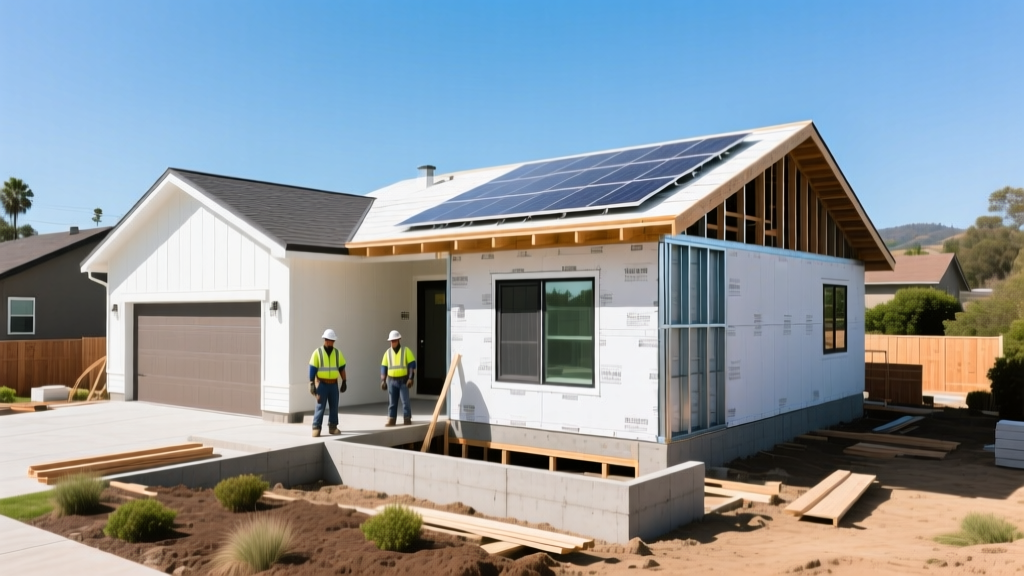
Calculating the accurate cost to build a home in California requires moving beyond national averages. While the National Association of Home Builders (NAHB Construction Cost Survey) places the national average for custom home construction at roughly $175 to $225 per square foot, California’s unique regulatory environment, topography, and labor markets push this baseline significantly higher. In 2026, prospective builders must budget between $280 and $550+ per square foot for hard construction costs, depending heavily on the municipality and site conditions.
This massive variance is not arbitrary. It is driven by three primary factors: stringent state-mandated energy and fire codes, localized impact fees that fund municipal infrastructure, and a highly unionized, high-cost labor pool. To plan a realistic budget, you must dissect the project into hard costs (materials and labor), soft costs (permits, engineering, and fees), and site-specific risk premiums.
Regional Cost Matrix: Bay Area vs. Central Valley vs. SoCal
Geography dictates your baseline pricing. Labor rates, material transport logistics, and local jurisdiction fees create distinct pricing tiers across the state. Below is a 2026 regional breakdown for a standard 2,500-square-foot, single-story custom home on a flat, prepared lot.
| Region | Avg Hard Cost / Sq Ft | 2,500 Sq Ft Total | Primary Cost Drivers |
|---|---|---|---|
| San Francisco Bay Area | $450 - $600+ | $1,125,000 - $1,500,000 | Extreme labor costs, strict local design reviews, logistical delays, high permit fees. |
| Los Angeles / Orange County | $375 - $500 | $937,500 - $1,250,000 | Coastal commission overlays, WUI fire codes in foothills, prevailing wage requirements. |
| San Diego County | $350 - $475 | $875,000 - $1,187,500 | Water conservation mandates, seismic engineering, high school district facility fees. |
| Sacramento / Central Valley | $250 - $325 | $625,000 - $812,500 | Expansive clay soil foundations, agricultural land conversion fees, Title 24 solar mandates. |
California-Specific Budget Killers (And How to Plan for Them)
National cost estimators fail in California because they omit state-specific building codes. If your budget does not explicitly account for the following three regulatory requirements, your project will face severe financial shortfalls during the plan-check phase.
Title 24 Energy Compliance & Electrification Mandates
The California Energy Commission updates the Building Energy Efficiency Standards (Title 24) on a triennial basis. The current 2026 enforcement cycle heavily favors all-electric construction. According to the California Energy Commission, new low-rise residential buildings must include solar photovoltaic (PV) systems and are strongly pushed toward electric heat pump technology for both space and water heating.
Wildland-Urban Interface (WUI) Fire Codes
If your parcel is located in a State Responsibility Area (SRA) or a designated Very High Fire Hazard Severity Zone, you must comply with California Building Code Chapter 7A. This dictates the use of ignition-resistant exterior materials.
- Roofing: Must be Class A fire-rated (e.g., concrete tile, standing seam metal, or specific fiberglass asphalt shingles).
- Siding: Combustible wood siding is heavily restricted. You must budget for fiber cement siding (like James Hardie Artisan or Stucco systems) or fire-retardant-treated wood.
- Vents: All attic and crawlspace vents must feature 1/8-inch non-combustible wire mesh to block wind-blown embers.
Cost Adder: WUI compliance typically increases exterior envelope costs by 12% to 18%, translating to an additional $15,000 to $30,000 for a standard-sized home.
Seismic Bracing and Foundation Engineering
California’s seismic zones require robust structural engineering. Standard foundation plans from out-of-state drafters will be rejected by local building departments. You must hire a licensed California structural engineer to design hold-downs, shear walls, and continuous footings. In areas with expansive clay soils (common in the Central Valley and parts of Southern California), you may require a post-tensioned slab or deep drilled pier foundations, which can add $20,000 to $45,000 to your site-work budget.
Soft Costs: The Hidden 25% of Your Budget
Soft costs encompass everything required to build that isn't physically nailed to the house. In California, these are notoriously high:
- School and Park Impact Fees: Many municipalities charge school facility fees based on square footage. In some districts, this can exceed $7.00 per square foot, adding $17,500 to a 2,500 sq ft home.
- Mello-Roos and CFD Taxes: If building in a newer master-planned community, you may be subject to Mello-Roos special tax assessments to fund local infrastructure. While this is a post-build carrying cost, it heavily impacts your construction loan underwriting and debt-to-income ratios.
- Plan Check and Permit Fees: Expect to pay 1% to 1.5% of the total construction valuation in municipal permit fees. For a $1,000,000 build, allocate $10,000 to $15,000 purely for the privilege of having the city review and approve your plans.
- Utility Hookups: Bringing sewer, water, and PG&E/SCE electrical service to a raw infill lot can cost anywhere from $8,000 to $35,000, depending on the distance to the main lines and street trenching requirements.
Step-by-Step Budget Allocation Framework
To maintain control over your cash flow during construction, structure your draw schedule and budget allocation using this proven California-specific framework. This assumes a $1,000,000 total project budget (excluding land acquisition).
- 15% Soft Costs & Engineering ($150,000): Architectural design, structural engineering, Title 24 energy modeling, soil reports, surveys, and municipal permit fees.
- 10% Site Work & Foundations ($100,000): Demolition, grading, utility trenching, retaining walls, and concrete flatwork. (Increase to 15% if on a steep hillside lot).
- 35% Framing & Exterior Envelope ($350,000): Lumber packages, engineered trusses, roofing, WUI-compliant siding, and high-efficiency window installations.
- 20% MEP Rough-Ins & Systems ($200,000): Electrical wiring, plumbing rough-ins, solar PV installation, heat pump HVAC systems, and insulation (spray foam or dense-pack cellulose to meet Title 24).
- 10% Interior Finishes ($100,000): Drywall, flooring, cabinetry, countertops, and trim. (Note: This assumes mid-grade finishes; luxury finishes will require shifting funds from other categories).
- 10% Contingency Reserve ($100,000): Held in a separate escrow account for unforeseen site conditions, material price escalations, or change orders.
Financing and Contractor Selection
Securing a construction-to-permanent loan in California requires a highly detailed, line-item budget from a licensed general contractor. Lenders will not accept owner-builder estimates unless you have a proven track record of development. Always verify your contractor's license status, bond, and workers' compensation insurance through the Contractors State License Board (CSLB) before releasing any initial deposits. California law limits the initial down payment for a home improvement or construction contract to $1,000 or 10% of the contract price, whichever is less. Any contractor demanding 20% upfront is operating outside state regulations and poses a severe financial risk to your project.
Written by
Priya KapoorPriya Kapoor is a real estate market analyst and construction economics researcher with expertise in housing affordability, development feasibility, and infrastructure investment. She holds a Master of Regional Planning from Cornell University and previously worked as a senior analyst at CBRE's Investment Properties group, where she modeled returns for $4B in mixed-use development pipelines. Priya now runs an independent research practice advising developers, municipalities, and REITs on construction cost forecasting and market timing. She publishes the quarterly "BuildMat Market Pulse" report tracking material price indices across 12 commodity categories. Based in Austin, TX, Priya serves on the board of Habitat for Humanity Austin and is a marathon runner.
More from Priya Kapoor
View all
Construction Cost
Cost to Build a 1600 Sq Ft Home in 2026: Full Breakdown
Accurate 2026 cost to build a 1600 sq ft home—material, labor, and regional pricing breakdowns included. Plan your budget with real-time estimates.
Aug 11, 2026

Wood & Lumber
Name the Types of Wood for Pressure Treatment and Preservation
Learn how to name the types of wood best suited for pressure treatment. Compare species treatability, chemical retention levels, and 2026 preservation costs.
Aug 4, 2026

Stone & Masonry
Stone Veneer Suppliers Lindenhurst: 2026 Cost Analysis
Analyze 2026 stone veneer costs in Lindenhurst, NY. Compare local supplier pricing, delivery fees, and Suffolk County installation labor rates.
Aug 4, 2026