How Much Does It Cost to Build a Cruise Liner? 2026 Financing Guide
Discover how much it costs to build a cruise liner. Explore capital expenditures, shipyard pricing, ECA financing structures, and payment milestones.
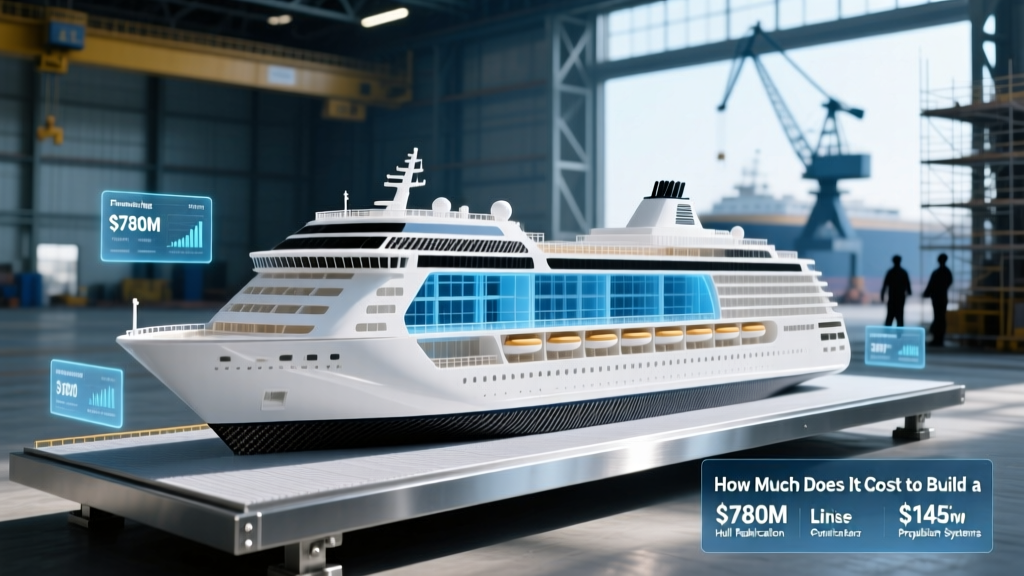
The True Capital Expenditure: Breaking Down Cruise Liner Costs
Constructing a modern cruise liner is one of the most capital-intensive and complex engineering projects in global heavy industry. Unlike commercial cargo vessels, which are priced primarily by deadweight tonnage (DWT) and structural steel weight, cruise ships are valued by Gross Tonnage (GT) and interior outfitting complexity. A cruise ship is essentially a floating, self-sustaining municipality, requiring the integration of advanced marine propulsion with luxury hospitality infrastructure.
In the current 2026 shipbuilding market, mainstream cruise vessels typically cost between $7,500 and $9,500 per GT. Conversely, ultra-luxury and specialized expedition ships command a massive premium, ranging from $14,000 to over $22,000 per GT due to low passenger-to-space ratios, ice-class hull reinforcements, and bespoke interior materials.
To understand where the capital goes, we must look beyond the raw steel. According to orderbook analyses tracked by Cruise Industry News, the financial distribution of a standard $1.2 billion mega-ship contract breaks down into highly specialized tranches.
| Cost Category | Percentage of Total | Estimated Cost (on $1.2B Ship) | Primary Components |
|---|---|---|---|
| Hull & Steelwork | 15% - 20% | $180M - $240M | High-tensile steel, block assembly, dry dock fees, basic piping. |
| Propulsion & Machinery | 20% - 25% | $240M - $300M | Dual-fuel engines (e.g., Wärtsilä 50DF), Azipod thrusters, HVAC, desalination. |
| Outfitting & Interiors | 45% - 50% | $540M - $600M | Cabins, theaters, galleys, lifeboats, custom millwork, lighting systems. |
| Design & Project Mgmt | 5% - 10% | $60M - $120M | Naval architecture, class society certifications, owner's site team. |
Ship Size and Class: Cost Multipliers
The total capital requirement scales non-linearly with ship size and intended market segment. Building a 200,000 GT vessel does not simply cost twice as much as a 100,000 GT vessel; the engineering requirements for stability, life-saving appliances (LSA), and power distribution exponentially increase the complexity. Below is a comparative matrix of 2026 newbuild pricing across primary market segments.
| Vessel Class | Gross Tonnage (GT) | Passenger Capacity | Average Newbuild Cost | Primary Shipyards |
|---|---|---|---|---|
| Expedition / Luxury | 10,000 - 35,000 | 200 - 600 | $150M - $350M | Fincantieri (VARD), SunStone |
| Premium / Mid-Size | 50,000 - 90,000 | 1,200 - 2,500 | $450M - $750M | Fincantieri, Meyer Werft |
| Mainstream Mega-Ship | 150,000 - 250,000+ | 4,000 - 7,500+ | $1.2B - $2.2B | Chantiers de l'Atlantique, Meyer Turku |
Structuring the Debt: How Cruise Lines Finance Billion-Dollar Assets
Very few cruise operators pay cash for a newbuild. A $1.5 billion capital expenditure would severely impair a company's balance sheet and liquidity. Instead, the industry relies on a sophisticated blend of sovereign guarantees, corporate debt, and operating cash flow. The cornerstone of cruise ship financing is the Export Credit Agency (ECA).
The Role of Export Credit Agencies (ECAs)
Because the global cruise shipbuilding duopoly is heavily concentrated in Europe—specifically Italy (Fincantieri), Germany (Meyer Werft), and France (Chantiers de l'Atlantique)—national governments have a vested interest in supporting their domestic shipyards. ECAs such as Italy's SACE, Germany's Euler Hermes, and France's Bpifrance provide sovereign loan guarantees to the cruise lines purchasing these vessels.
- Coverage: ECAs typically guarantee up to 80% of the hull contract price.
- Amortization: The guaranteed portion is usually amortized over a 12-year period post-delivery, aligned with the vessel's peak revenue-generating lifecycle.
- Interest Rates: Backed by sovereign guarantees, cruise lines secure interest rates significantly below standard commercial maritime lending rates.
Alternative and Supplementary Financing Vehicles
For the remaining 20% of the capital requirement, or for vessels built outside ECA jurisdictions, operators utilize alternative mechanisms:
- Unsecured Senior Notes: Investment-grade cruise operators frequently issue corporate bonds in the public markets to raise capital, leveraging their broader fleet as collateral rather than tying debt to a single hull.
- Sale-Leaseback Agreements: An operator may sell the vessel upon delivery to a specialized maritime leasing consortium (often backed by Asian banking institutions) and immediately lease it back on a bareboat charter, freeing up immediate capital while retaining operational control.
- Revolving Credit Facilities: Drawdowns on multi-billion-dollar corporate revolvers are used to cover interim milestone payments before long-term debt is syndicated at delivery.
Hidden Capital Drains: Propulsion Tech and Regulatory Compliance
When estimating the final cost of a cruise liner, base contract prices rarely tell the whole story. Change orders and evolving environmental regulations routinely inflate final capital expenditures by 5% to 12% before the vessel leaves the yard.
To comply with the IMO's EEXI (Energy Efficiency Existing Ship Index) and the EU Emissions Trading System (ETS), 2026 newbuilds must integrate advanced alternative fuel architectures. Specifying dual-fuel LNG propulsion systems (such as MAN B&W ME-LGI engines) or methanol-ready tank and piping configurations adds a $35 million to $60 million premium to the machinery budget. Furthermore, integrating shore-power (cold ironing) capabilities and advanced exhaust gas cleaning systems (scrubbers) requires significant spatial and financial investments that were largely optional a decade ago.
Supply chain bottlenecks also play a critical role. As noted by The Maritime Executive's shipbuilding desk, shortages in specialized marine-grade cabling, high-voltage switchboards, and custom HVAC units have forced shipyards to invoke escalation clauses in recent contracts, passing raw material inflation directly to the cruise line owners.
The 36-Month Payment Milestone Schedule
Cash flow management during the 3-year construction phase is critical. Shipyards do not finance the construction entirely out-of-pocket; they require the buyer to fund the project progressively. A standard $1.5 billion cruise ship contract follows a rigid, milestone-based payment schedule verified by the owner's on-site marine surveyors and the classification society (e.g., DNV or Lloyd's Register).
- Milestone 1: Contract Signing (5%) - $75M paid upon formalizing the letter of intent and securing the dry-dock slot.
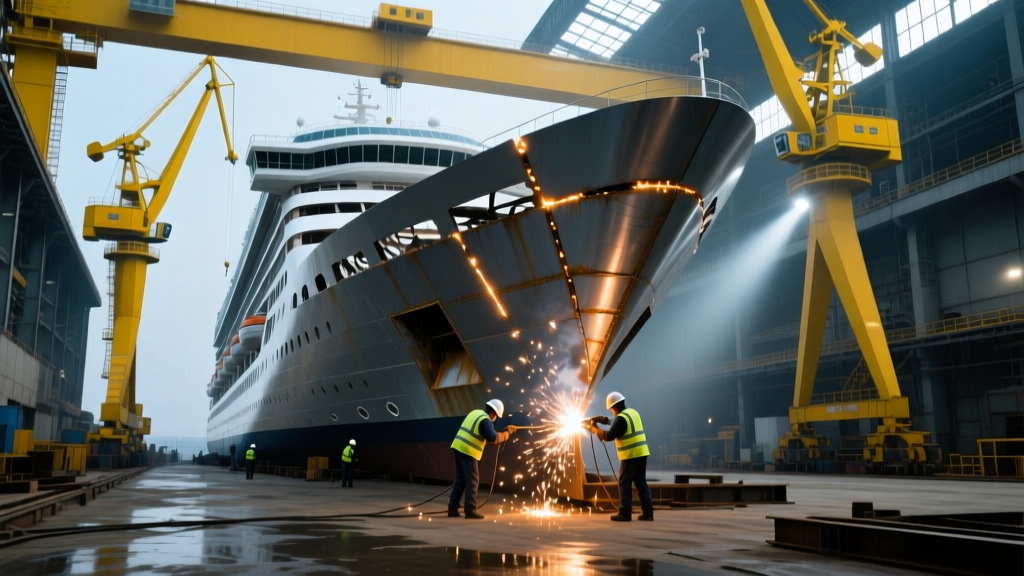
- Milestone 2: First Steel Cutting (5%) - $75M paid when the first plasma cutters begin shaping the hull blocks.
- Milestone 3: Keel Laying (5%) - $75M paid when the first massive hull block is lowered into the dry dock, officially beginning assembly.
- Milestone 4: Float Out (5%) - $75M paid when the dry dock is flooded and the vessel touches water for the first time, transitioning from structural work to interior outfitting.
- Milestone 5: Sea Trials & Delivery (80%) - $1.2B paid upon successful completion of builder's sea trials, regulatory sign-offs, and formal transfer of the flag and title.
Frequently Asked Questions
How long does it take to build a modern cruise liner?
The physical construction from first steel cutting to delivery typically takes 24 to 30 months. However, the design, engineering, and contractual negotiation phases begin 12 to 18 months before steel is cut, making the total project lifecycle roughly 3.5 to 4 years.
Who actually builds the world's cruise ships?
The market is highly consolidated. Fincantieri (Italy), Meyer Werft (Germany), and Chantiers de l'Atlantique (France) control the vast majority of the global mega-ship orderbook. Asian shipyards, while dominant in commercial cargo, have historically struggled with the intricate interior outfitting and hospitality logistics required for large cruise vessels, though they are increasingly capturing the expedition and luxury ferry segments.
What happens if a cruise line goes bankrupt during construction?
If an operator defaults on milestone payments, the shipyard retains the right to halt construction, seize the hull, and resell the vessel on the secondary market. Because ship designs are often highly customized to a specific brand's demographic, reselling a half-finished cruise ship usually results in a massive financial loss, which is why ECAs and shipyards rigorously audit the buyer's liquidity covenants before signing.
Written by
Marcus ChenMarcus Chen is a licensed structural engineer (PE) and building materials analyst with over 12 years of experience across residential, commercial, and industrial construction. He holds a Master of Science in Civil Engineering from UC Berkeley and spent six years at Thornton Tomasetti before transitioning to independent consulting and technical writing. Marcus specializes in material selection for seismic-prone regions, concrete reinforcement strategies, and lifecycle cost analysis. His work has been cited by the American Concrete Institute (ACI) and the Structural Engineers Association of California (SEAOC). When he is not on a job site or at his desk, you will find him hiking the Sierra Nevada or restoring a 1920s craftsman bungalow in Oakland, CA.
More from Marcus Chen
View all
Construction Cost
How Much Did the Eiffel Tower Cost to Build?
How much did the Eiffel Tower cost to build in 1889? We adjust for inflation and compare its budget to modern skyscraper construction.
Aug 4, 2026

Fire Resistance
What Is a Fire Resistant Material? Testing & Certification Guide
Discover what is a fire resistant material through ASTM and UL testing. Learn how fire ratings, certifications, and assemblies work in construction.
Aug 4, 2026

Construction Cost
How Much Did the Burj Khalifa Cost to Build?
How much did the Burj Khalifa cost to build? We break down the $1.5B project and extract 5 money-saving strategies for your next build.
Jul 30, 2026