True Cost to Buy Land and Build a House: Size & Scope Guide
Calculate the true cost to buy land and build a house. Our size and scope guide breaks down acreage prices, site prep, and construction costs per sq ft.

The Anatomy of Land and Build Costs
Calculating the true cost to buy land and build a house requires moving beyond national averages for stick-built homes and analyzing raw lot variables. When purchasing an improved lot in a subdivision, site work is typically completed by the developer, and the price per square foot is relatively predictable. Raw land, however, introduces severe scope volatility. A $150,000 budget for construction can easily be derailed by $60,000 in hidden site preparation costs, ranging from bedrock blasting to engineered septic systems. This size and scope calculator framework dissects the three primary cost phases: land acquisition, site development, and vertical construction, providing exact pricing metrics to build a resilient project budget.
Phase 1: Land Acquisition and Zoning Variables
The baseline cost to buy land and build a house begins with the raw acreage. According to data from the USDA Economic Research Service, land values fluctuate wildly based on zoning, utility access, and road frontage. Raw, unimproved agricultural land may cost between $3,000 and $8,000 per acre, but this land often lacks residential zoning or municipal water access. Conversely, improved residential lots (under one acre) in suburban peripheries command $75,000 to $250,000 per parcel because utility taps, curb cuts, and grading are already permitted and installed.
| Land Classification | Average Size | Cost Range (Per Acre/Lot) | Improvement Status |
|---|---|---|---|
| Raw Acreage (Off-Grid) | 5.0 - 20.0 Acres | $4,000 - $12,000 / acre | Unzoned, no utilities, no road frontage |
| Rural Residential | 1.0 - 3.0 Acres | $25,000 - $65,000 / acre | Zoned R1, power at street, well/septic required |
| Suburban Infill Lot | 0.15 - 0.3 Acres | $85,000 - $180,000 / lot | Fully improved, municipal water/sewer, paved |
| Premium Waterfront | 0.5 - 1.5 Acres | $250,000 - $800,000+ / lot | Improved, strict environmental setbacks apply |
When evaluating raw land, always verify the municipal water and sewer tap fees before purchasing. In many developing counties, a single municipal water tap fee can exceed $12,500, while sewer capacity charges can add another $8,000 to $15,000. If these utilities are unavailable, you must pivot to private infrastructure, which fundamentally alters the scope of your site work budget.
Phase 2: Site Preparation and Hidden Scope Creep
Site preparation is where the cost to buy land and build a house experiences the most severe scope creep. Before a single framing nail is driven, the land must be cleared, graded, and tested for subterranean viability. Budgeting for site work requires specific geological and topographical data.
Soil Testing and Percolation
If municipal sewer is unavailable, a percolation (perc) test is mandatory to determine the soil's absorption rate for a septic leach field. A standard perc test costs $300 to $1,200. Soils are classified under the Unified Soil Classification System (USCS); sandy loams drain optimally, while heavy clays fail standard perc tests. If your land fails a conventional perc test, the Environmental Protection Agency (EPA) notes that alternative engineered systems—such as mound systems or aerobic treatment units (ATUs)—are required. A conventional gravity septic system costs $8,000 to $15,000, whereas an engineered mound system for poorly draining soil will escalate costs to $22,000 to $38,000.
Well Drilling and Water Yield
Drilling a private water well costs between $30 and $65 per linear foot, depending on bedrock depth and casing requirements. A standard 150-foot well with a submersible pump and pressure tank averages $7,500 to $11,000. However, if the well yield test produces less than 3 gallons per minute (GPM), you may need to drill deeper, hydro-fracture the bedrock, or install a 1,500-gallon cistern storage system, adding $6,000 to $14,000 to the scope.
Do not underestimate driveway length. A standard asphalt driveway costs $7 to $13 per square foot. If your build site is set back 800 feet from the county road, a 12-foot-wide driveway requires 9,600 square feet of paving. Including gravel base preparation, grading, and culvert installation for ditch crossings, an 800-foot driveway will add $45,000 to $85,000 to your site prep budget.
Phase 3: Construction Scope and Size Multipliers
Once the site is prepped, vertical construction costs are dictated by the footprint size and the finish scope. The cost per square foot is not static; it operates on a principle of concentrated vs. distributed costs. Kitchens and bathrooms are the most expensive rooms per square foot due to plumbing, cabinetry, and specialized electrical work. A 1,200-square-foot home with two bathrooms will have a significantly higher cost-per-square-foot than a 3,500-square-foot home with the same number of bathrooms, as the larger home distributes the high-cost zones over a larger area of lower-cost living space.
Finish Scope Matrix
To accurately calculate the vertical build cost, apply a scope multiplier to your planned square footage based on the material grades selected:
- Builder Grade (Base Scope): $130 - $170 per sq. ft. Features include laminate countertops, standard 3-tab asphalt shingles, vinyl plank flooring, fiberglass bathtubs, and builder-grade hollow-core doors. Foundation is typically a monolithic slab or standard crawlspace.
- Semi-Custom (Mid Scope): $180 - $250 per sq. ft. Upgrades include quartz or entry-level granite countertops, architectural dimensional shingles, engineered hardwood in main areas, tiled showers with frameless glass, and solid wood interior doors. Includes 9-foot ceilings and upgraded insulation packages (e.g., closed-cell spray foam in the roofline).
- Full Custom (High Scope): $280 - $450+ per sq. ft. Features premium natural stone, standing seam metal roofing, wide-plank white oak flooring, custom millwork, smart home integration, and high-end appliance packages (e.g., Sub-Zero/Wolf). Often requires structural steel, complex rooflines, and full daylight basements.
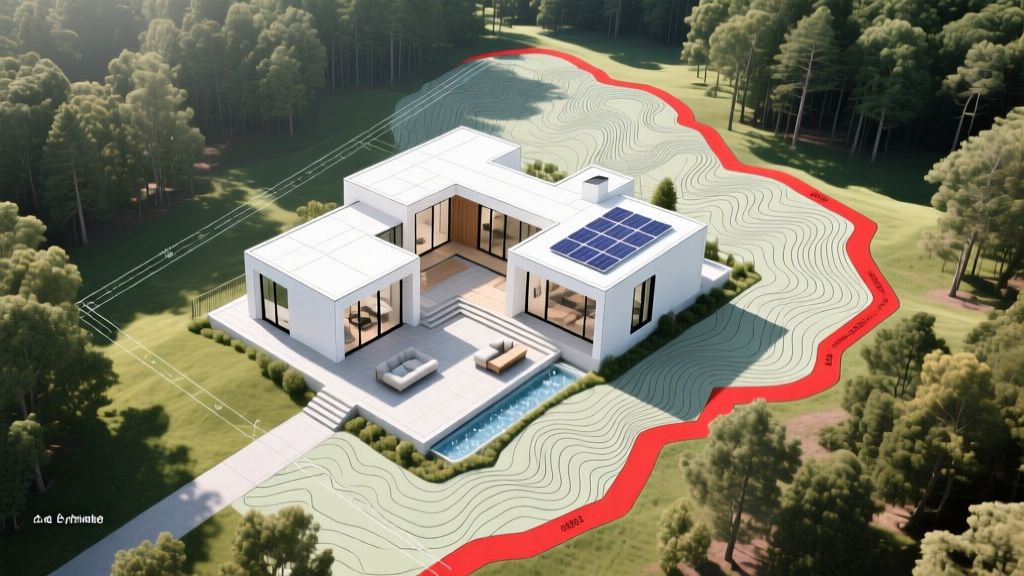
The Size and Scope Calculator Formula
To synthesize these variables into an actionable budget, use the following calculator formula tailored for raw land development:
Total Project Cost = (Land Cost) + (Site Prep Matrix) + (Footprint × Scope Multiplier) + (Soft Costs)
Example Calculation:
Assume you purchase a 2-acre rural lot for $80,000. The site requires clearing, a 400-foot driveway, a 200-foot well, and a conventional septic system. Site prep totals $65,000. You plan to build a 2,400-square-foot semi-custom home ($210/sq. ft.), totaling $504,000. Finally, soft costs (architectural plans, permits, impact fees, and construction loan interest) typically add 12% to the hard construction costs.
- Land: $80,000
- Site Prep: $65,000
- Vertical Build (2,400 × $210): $504,000
- Soft Costs (12% of $504,000): $60,480
- Total Estimated Cost: $709,480
This formula prevents the common error of calculating the build cost in a vacuum and subsequently facing a $60,000 shortfall when the excavator hits bedrock during the septic trenching phase.
Frequently Asked Questions
Is it cheaper to buy land and build or buy an existing home?
In most suburban and urban markets, buying an existing home is cheaper and faster due to economies of scale and pre-existing infrastructure. However, in rural or highly customized scenarios, buying land and building can yield a lower cost per square foot for premium finishes, provided the site preparation costs remain under 15% of the total budget.
How much contingency should I hold for raw land construction?
For improved subdivision lots, a 10% contingency is standard. For raw, unimproved land, you must hold a minimum 20% to 25% contingency in your construction loan. Subterranean surprises, such as hitting shallow bedrock during foundation excavation or discovering a high seasonal water table during septic installation, routinely trigger $15,000 to $30,000 in unplanned engineering and excavation costs.
What are the most expensive site prep variables?
The top three budget-destroying site prep variables are: 1) Long driveway installations requiring culverts and heavy grading, 2) Engineered septic systems mandated by failed perc tests on clay-heavy soils, and 3) Bringing municipal power to the site via underground trenching, which can cost $45 to $85 per linear foot from the nearest utility pole to the meter base.
Written by
David NakamuraDavid Nakamura is a licensed architect (AIA) and construction technology writer focused on sustainable building methods, mass timber engineering, and high-performance building envelopes. He holds a Master of Architecture from the University of Washington and is a certified Passive House Consultant (CPHC). David spent eight years at the Seattle firm Mithun, where he led the design of three LEED Platinum projects, before founding his own practice specializing in net-zero residential design. He serves on the editorial advisory board of GreenBuilder Magazine and has authored peer-reviewed papers on cross-laminated timber (CLT) connections for the Journal of Structural Engineering. In his spare time, David teaches woodworking at Pratt Fine Arts Center and kayaks the Puget Sound.
More from David Nakamura
View all
Construction Cost
Labor Cost to Build a Deck Per Sq Ft: 2026 Installation Guide
Discover the exact labor cost to build a deck per sq ft in 2026. This installation guide breaks down contractor rates, complexity factors, and hidden fees.
Aug 4, 2026

Construction Cost
How Much Does It Cost to Build a 3 Bedroom House? Financing Guide
Learn exactly how much it costs to build a 3 bedroom house and explore 2026 financing options, construction loan types, and budget frameworks for your build.
Aug 4, 2026

Construction Cost
Cost to Build a Tennis Court: 2026 Guide
How much does it cost to build a tennis court in 2026? Breakdowns for asphalt, concrete, and synthetic surfaces plus fencing and lighting.
Jul 30, 2026