How Much Would It Cost to Build a Tiny House? Full Cost Guide
Discover exactly how much it costs to build a tiny house. Detailed breakdown of materials, labor, mechanicals, and hidden expenses for 2026.
Executive Summary: The Real Numbers
When evaluating how much it would cost to build a tiny house, the final price tag depends entirely on your construction method, mobility requirements, and finish level. A 200-square-foot DIY build on wheels typically ranges from $25,000 to $45,000, while a 400-square-foot turnkey model built by a certified professional ranges from $85,000 to $140,000. The primary cost drivers are the chassis, structural insulated panels (SIPs) or advanced framing, and specialized compact mechanical systems. This guide breaks down the exact material costs, labor variables, and hidden expenses you must account for to prevent budget overruns.
- DIY on Wheels (THOW): $30,000 – $50,000
- DIY on Foundation: $25,000 – $40,000
- Professional Turnkey (THOW): $85,000 – $120,000
- Professional Turnkey (Foundation): $95,000 – $150,000+
Chassis and Foundation: Where Your Budget Starts
The decision to build on wheels or a permanent foundation dictates your structural engineering requirements and initial capital outlay. Tiny Houses on Wheels (THOW) require custom-fabricated trailers with specific axle configurations to handle the concentrated dead load of a residential structure.
| Base Type | Specifications | Estimated Cost | Pros & Cons |
|---|---|---|---|
| Bumper-Pull Trailer | 20-24 ft, dual 7k axles (14k GVWR), drop-axle for low floor | $4,500 – $6,500 | Lower cost, easier to permit. Limited to 8.5 ft width and 13.5 ft height. |
| Gooseneck Trailer | 30-40 ft, 16k+ GVWR, integrated deck over truck bed | $7,500 – $11,000 | Allows loft space over the truck bed, superior towing stability. Requires heavy-duty truck. |
| Helical Piers | Engineered steel piers driven to bedload, adjustable brackets | $3,000 – $5,500 | Minimal site disturbance, ideal for sloped lots. Requires specialized installation crew. |
| Monolithic Slab | Reinforced concrete, thickened edges, integrated radiant tubing | $4,500 – $8,000 | Permanent, excellent thermal mass. High site-prep costs, difficult to modify later. |
The Envelope: Framing, Insulation, and Exterior
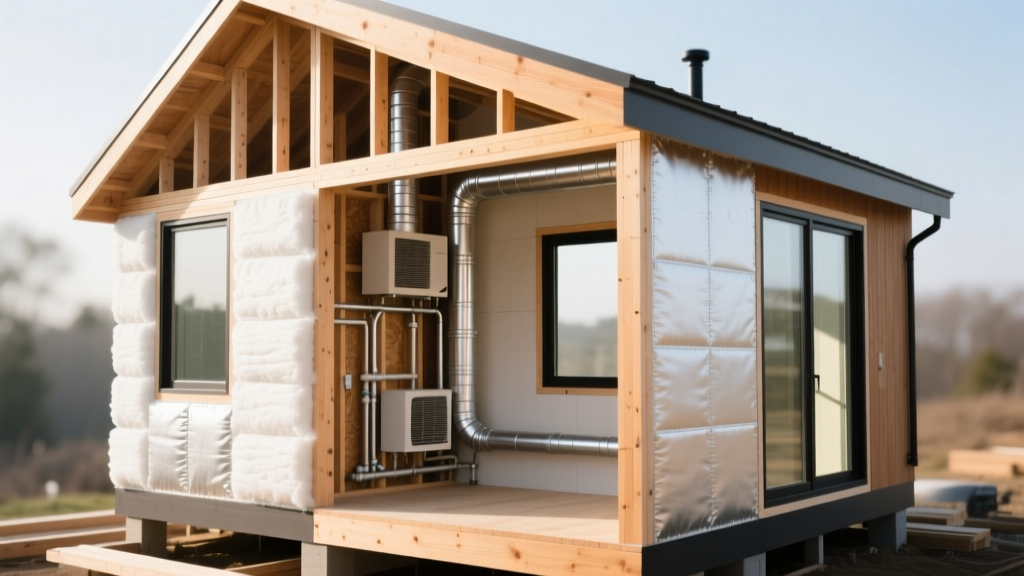
Because tiny houses have a high surface-area-to-volume ratio, thermal bridging and air leakage are magnified. Standard 2x4 stick framing is increasingly being replaced by advanced framing techniques or Structural Insulated Panels (SIPs) to maximize interior square footage and thermal performance.
Framing and Sheathing
For stick-built walls, utilizing 2x6 studs spaced 24 inches on-center reduces lumber use by 15% and allows for deeper insulation cavities. Pairing this with Huber ZIP System sheathing (approximately $1.30 per square foot) eliminates the need for house wrap while providing structural shear strength and a continuous water-resistive barrier. This integrated approach saves roughly 12 hours of labor compared to traditional OSB and Tyvek installations.
Insulation and Vapor Control
In a small, tightly sealed envelope, moisture management is critical. Closed-cell spray foam provides an R-value of R-6.5 per inch and acts as its own vapor retarder, but it costs between $1.50 and $3.00 per board foot. A more cost-effective and breathable alternative is mineral wool batts, such as Rockwool Comfortbatt (R-23 for 2x6 walls), paired with a smart vapor retarder like Intello Plus. According to the U.S. Department of Energy, proper air sealing and continuous insulation are mandatory to prevent condensation within wall cavities, which can lead to rapid structural rot in tiny homes.
Exterior Cladding and Roofing
Weight restrictions on THOW builds dictate exterior choices. Cedar lap siding or Japanese Shou Sugi Ban (charred cedar) weighs roughly 2.5 lbs per square foot, keeping the trailer well under its Gross Vehicle Weight Rating (GVWR). For roofing, 24-gauge standing seam metal roofing ($4.50 to $7.00 per square foot installed) is the industry standard. It sheds snow efficiently, handles high wind uplift, and allows for the integration of concealed fasteners and snow guards.
Mechanicals: HVAC, Plumbing, and Electrical
Downsizing the structure does not proportionally downsize the mechanical budget. Compact, high-efficiency systems carry a premium, but they are non-negotiable for comfort and safety.
- HVAC: A ductless mini-split system, such as the Mitsubishi M-Series 9,000 BTU Hyper-Heat unit ($1,800 to $2,500 installed), provides both heating and cooling. For backup heat or ambient warmth, a direct-vent propane wall heater like the Rinnai EX22CT ($1,400) is a reliable secondary option.
- Plumbing: PEX-A expansion piping (Uponor) is preferred over copper due to its freeze-resistance and flexibility in tight joist bays. For sanitation, a composting toilet like the Nature's Head ($1,100) eliminates the need for black water tanks, whereas a macerating flush system like the Saniflo Sanicompact ($1,300) allows for standard bathroom functionality if sewer hookups are available.
- Ventilation: The Environmental Protection Agency (EPA) emphasizes that tight homes require mechanical ventilation to maintain indoor air quality. A Panasonic WhisperGreen exhaust fan or a balanced Energy Recovery Ventilator (ERV) like the Zehnder ComfoAir 70 ($1,800) is required to prevent CO2 buildup and manage humidity from cooking and breathing.
Labor: DIY vs. Turnkey Builders
Labor typically accounts for 40% to 55% of a professional tiny home build. Understanding the labor matrix helps you decide which phases to tackle yourself and which to subcontract.
DIY Builder Profile
Time Commitment: 800 - 1,200 hours
Skill Requirements: Advanced carpentry, basic electrical/plumbing (with professional sign-off).
Cost Savings: $35,000 - $50,000 in saved labor.
Risk Factor: High. Mistakes in weight distribution or vapor barriers can total the investment.
Turnkey Professional Build
Time Commitment: 40 - 60 hours (design and project management)
Skill Requirements: Project management, vendor negotiation, design software.
Cost Premium: 40% - 55% markup on materials for labor and overhead.
Advantage: RVIA or NOAH certification included, enabling financing and legal park placement.
Hidden Costs That Derail Budgets
First-time builders frequently underestimate the peripheral costs required to make a tiny house legally habitable and fully functional. Factor these into your initial budget:
- Certification and Inspections: If building on wheels, obtaining RVIA (Recreational Vehicle Industry Association) or NOAH (National Organization of Alternative Housing) certification costs between $1,500 and $3,500. Without this, most RV parks and insurance companies will reject your home.
- Off-Grid Solar Integration: A robust off-grid system capable of running a mini-split and induction cooktop requires a Victron MultiPlus II inverter/charger, 800W+ of roof-mounted panels, and a 400Ah LiFePO4 battery bank. Expect to spend $7,500 to $12,000 for a fully integrated, professionally wired setup.
- Land and Site Prep: The National Association of Home Builders notes that land acquisition and site development (clearing, well drilling, septic installation) can easily exceed the cost of the structure itself. A standard engineered septic system costs $8,000 to $15,000, while a well can range from $5,000 to $20,000 depending on bedrock depth.
- Heavy Equipment and Delivery: Moving a completed 12,000 lb THOW requires a commercial towing service. Expect to pay $3.00 to $5.00 per mile, plus pilot car fees if the home exceeds 8.5 feet in width.
Expert Warning: Never compromise on the trailer's GVWR. A common failure mode is builders selecting a 10,000 lb GVWR trailer for a design that ultimately weighs 12,500 lbs once drywall, cabinetry, and water tanks are added. Always spec your trailer axles to handle at least 20% more weight than your calculated dry weight.
Frequently Asked Questions
Is it cheaper to buy or build a tiny house?
Building it yourself is cheaper in raw capital outlay, saving 40% to 50% on labor. However, buying from a certified builder provides warranties, RVIA certification, and access to specialized RV loans, which DIY builds rarely qualify for. If your hourly wage exceeds $40/hour, the time spent building (1,000+ hours) may result in a net financial loss compared to buying turnkey.
How much does it cost to wire a tiny house for electricity?
Electrical rough-in and finish for a 240 sq. ft. home typically costs $2,500 to $4,500. This includes a 50-amp RV shore power inlet, a sub-panel, LED recessed lighting, and GFCI/AFCI breakers required by modern NEC codes for small dwellings.
What is the most expensive part of a tiny house build?
After labor, the chassis (trailer or foundation) and the mechanical systems (HVAC, plumbing, electrical) consume the largest portion of the budget. High-performance windows and doors also represent a disproportionate cost, as custom-sized, low-E glazed units are required to fit specific framing dimensions while maintaining thermal integrity.
Written by
Priya KapoorPriya Kapoor is a real estate market analyst and construction economics researcher with expertise in housing affordability, development feasibility, and infrastructure investment. She holds a Master of Regional Planning from Cornell University and previously worked as a senior analyst at CBRE's Investment Properties group, where she modeled returns for $4B in mixed-use development pipelines. Priya now runs an independent research practice advising developers, municipalities, and REITs on construction cost forecasting and market timing. She publishes the quarterly "BuildMat Market Pulse" report tracking material price indices across 12 commodity categories. Based in Austin, TX, Priya serves on the board of Habitat for Humanity Austin and is a marathon runner.
More from Priya Kapoor
View all
Construction Cost
Cost to Build a 1600 Sq Ft Home in 2026: Full Breakdown
Accurate 2026 cost to build a 1600 sq ft home—material, labor, and regional pricing breakdowns included. Plan your budget with real-time estimates.
Aug 11, 2026

Wood & Lumber
Name the Types of Wood for Pressure Treatment and Preservation
Learn how to name the types of wood best suited for pressure treatment. Compare species treatability, chemical retention levels, and 2026 preservation costs.
Aug 4, 2026

Stone & Masonry
Stone Veneer Suppliers Lindenhurst: 2026 Cost Analysis
Analyze 2026 stone veneer costs in Lindenhurst, NY. Compare local supplier pricing, delivery fees, and Suffolk County installation labor rates.
Aug 4, 2026