Data Center Cost to Build: 5 Money-Saving Strategies
Discover actionable strategies to reduce your data center cost to build. Learn how modular designs, Tier right-sizing, and MEP optimizations save millions.

The True Baseline: Understanding Mission-Critical Construction Economics
Estimating the capital expenditure for a mission-critical facility requires moving beyond standard commercial real estate metrics. While traditional office space is measured in dollars per square foot, the data center cost to build is fundamentally driven by dollars per kilowatt ($/kW) or megawatt ($/MW) of IT load. As of current market conditions, a fully commissioned Tier III facility averages between $9,000 and $13,000 per kW of IT capacity. For a 10MW facility, this translates to a baseline capital outlay of $90 million to $130 million before land acquisition.
Capital Cost Breakdown (Typical 10MW Tier III Facility)
- Electrical Infrastructure (UPS, Generators, Switchgear): 40% - 45%
- Mechanical/Cooling Systems (Chillers, CRAH, Piping): 20% - 25%
- Building Shell & Core (Concrete, Steel, Roofing): 15% - 20%
- Fire Protection, Security, & BMS (Building Management Systems): 10% - 15%
Because electrical and mechanical (MEP) systems consume up to 70% of the total budget, value engineering must focus heavily on power topology and thermal management rather than just architectural finishes. Below are five engineered strategies to compress your data center cost to build without compromising operational reliability.
Strategy 1: Right-Sizing the Tier Classification
The most common capital trap in mission-critical construction is over-engineering for a Tier IV (2N+1) topology when a Tier III (N+1) or even a robust Tier II design suffices. According to the Uptime Institute Tier Certification standards, moving from Tier III to Tier IV requires duplicating every single active and passive component in the power and cooling distribution paths. This redundancy can increase the MEP budget by 30% to 50%.
| Topology | Redundancy | Est. Cost Multiplier | Best Use Case |
|---|---|---|---|
| Tier II | N+1 (Partial) | 0.85x | Internal enterprise apps, dev/test environments |
| Tier III | N+1 (Concurrent Maintainability) | 1.0x (Baseline) | Colocation, SaaS providers, standard cloud workloads |
| Tier IV | 2N+1 (Fault Tolerant) | 1.35x - 1.50x | High-frequency trading, critical healthcare, defense |
Actionable Insight: If your facility hosts standard enterprise workloads or non-critical cloud storage, design for Tier III concurrent maintainability. You can achieve 99.982% availability—translating to roughly 1.6 hours of downtime per year—while saving millions in redundant switchgear and backup chiller capital costs.
Strategy 2: Prefabricated and Modular MEP Skids
Stick-building complex MEP systems on-site leads to schedule overruns, skilled labor shortages, and expensive rework. Transitioning to prefabricated modular infrastructure shifts construction from a chaotic job site to a controlled factory environment.
Skid-Mounted vs. Containerized Solutions
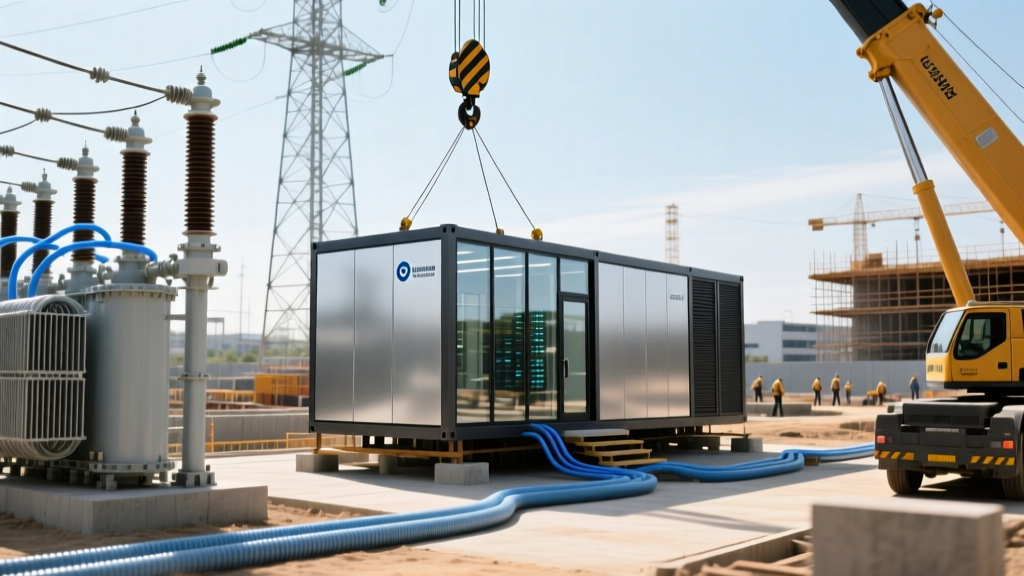
For facilities larger than 2MW, skid-mounted modular systems (such as the Schneider Electric EcoStruxure modular power skids or Vertiv prefabricated cooling loops) offer the best cost-to-performance ratio. These pre-engineered skids integrate UPS modules, switchgear, and battery strings into a single structural frame.
- Time Savings: Factory-assembled skids reduce on-site installation time by 40% to 60%. Since general conditions and construction financing interest accrue daily, shaving four months off a schedule can save $1.5M+ on a $100M project.
- Testing Verification: Modules undergo Factory Acceptance Testing (FAT) at full load before shipping, eliminating the massive cost of on-site commissioning delays and temporary load bank rentals.
Strategy 3: Optimizing Power Topologies for High-Density AI
The explosion of AI compute has radically altered the data center cost to build. Traditional air-cooled racks average 8kW to 15kW. Modern AI clusters utilizing NVIDIA GB200 NVL72 architectures push rack densities past 100kW. Designing traditional CRAH (Computer Room Air Handler) units and raised access floors to cool 100kW racks is financially ruinous and thermodynamically inefficient.
Warning: The Raised Floor Trap
Do not default to a 36-inch raised access floor for high-density zones. The structural steel required to support heavy liquid-cooled racks on a raised floor, combined with the massive under-floor air plenums required for high-CFM delivery, will inflate your structural and mechanical budgets by 15% to 22%.
The Liquid Cooling Pivot: Implement Direct-to-Chip (D2C) liquid cooling for high-density zones. By routing chilled water directly to the server's cold plates, you eliminate the need for massive air movers and raised floors. According to U.S. Department of Energy Data Center Guidelines, transitioning to targeted liquid cooling for high-density pods reduces the mechanical cooling capital footprint by up to 20% while drastically lowering the ongoing Power Usage Effectiveness (PUE) penalty.
Medium Voltage UPS Integration
For facilities exceeding 5MW, specify Medium Voltage (MV) UPS systems (e.g., Eaton 9395P MV or ABB MegaFlex DPA). Traditional low-voltage UPS setups require stepping down utility power to 480V, running it through the UPS, and then stepping it back up via massive distribution transformers. MV UPS systems operate at the utility distribution voltage (e.g., 12.47kV), eliminating the need for multiple step-down/step-up transformers. This saves roughly 8% to 12% on electrical equipment costs and frees up 1,500+ square feet of valuable white space.
Strategy 4: Phased Capital Deployment (Shell & Core)
Building out 100% of a facility's IT capacity on day one traps capital in unutilized, depreciating assets. Modern hyperscalers and colocation providers utilize a 'Shell and Core' approach. This involves constructing the full building envelope, utility interconnections, and central utility plant (CUP) for the ultimate MW capacity, but only fitting out the data halls in 2MW to 4MW phases.
'By deferring the procurement of downstream switchgear, modular UPS blocks, and in-row cooling units until 180 days before a tenant's handover, developers can reduce initial day-one capital requirements by up to 35%, drastically improving the project's internal rate of return (IRR).'
— Adapted from Cushman & Wakefield Data Center Insights on phased development models.
Strategy 5: Upgrading to Lithium-Ion BESS (Battery Energy Storage Systems)
Historically, Valve-Regulated Lead-Acid (VRLA) batteries were the default for UPS ride-through. However, VRLA batteries require massive floor space, heavy structural reinforcement, and aggressive HVAC cooling to prevent thermal runaway, and they must be replaced every 3 to 5 years.
Specifying Lithium-ion battery cabinets (such as those utilizing Samsung SDI or CATL prismatic cells integrated into Vertiv or Schneider UPS platforms) requires a higher initial procurement cost but drastically lowers the total installed cost:
- Footprint Reduction: Li-ion systems occupy 50% to 70% less physical space. In a market where mission-critical white space costs upwards of $1,200 per square foot to build, shrinking the battery room saves hundreds of thousands in shell construction costs.
- Weight Reduction: Li-ion batteries are significantly lighter, allowing engineers to downgrade the structural concrete and steel reinforcement requirements in the battery room slab.
- Thermal Tolerance: Li-ion batteries operate safely at higher ambient temperatures (up to 30°C / 86°F per ASHRAE TC 9.9 thermal guidelines), allowing you to reduce the dedicated precision cooling tonnage required for the battery rooms.
Hidden Cost Traps to Avoid During Pre-Construction
Even with optimized MEP designs, external factors can destroy your budget. Mitigate these specific risks during the site selection and entitlement phases:
- Utility Interconnection Delays: A cheap plot of land is worthless if the local utility requires a $15M substation upgrade and a 36-month lead time for high-voltage transmission. Always secure a binding Utility Service Agreement with guaranteed delivery dates before purchasing land.
- Fiber Diverse Routing Constraints: Ensure the site has access to at least two physically diverse fiber pathways. Trenching new fiber conduits across municipal rights-of-way or under railways can add $500,000+ and months of permitting delays to your budget.
- Water Entitlements for Evaporative Cooling: If your mechanical design relies on adiabatic or evaporative cooling towers to achieve a low PUE, verify municipal water allotments. Many drought-prone jurisdictions are capping industrial water usage, which could force a mid-design pivot to expensive closed-loop dry coolers.
Reducing your data center cost to build requires a departure from legacy design templates. By right-sizing your Tier topology, embracing prefabricated skids, adopting liquid cooling for AI densities, and leveraging advanced battery chemistries, you can deliver a highly resilient, future-proof facility while preserving vital capital for IT deployment.
Written by
Priya KapoorPriya Kapoor is a real estate market analyst and construction economics researcher with expertise in housing affordability, development feasibility, and infrastructure investment. She holds a Master of Regional Planning from Cornell University and previously worked as a senior analyst at CBRE's Investment Properties group, where she modeled returns for $4B in mixed-use development pipelines. Priya now runs an independent research practice advising developers, municipalities, and REITs on construction cost forecasting and market timing. She publishes the quarterly "BuildMat Market Pulse" report tracking material price indices across 12 commodity categories. Based in Austin, TX, Priya serves on the board of Habitat for Humanity Austin and is a marathon runner.
More from Priya Kapoor
View all
Construction Cost
Cost to Build a 1600 Sq Ft Home in 2026: Full Breakdown
Accurate 2026 cost to build a 1600 sq ft home—material, labor, and regional pricing breakdowns included. Plan your budget with real-time estimates.
Aug 11, 2026

Wood & Lumber
Name the Types of Wood for Pressure Treatment and Preservation
Learn how to name the types of wood best suited for pressure treatment. Compare species treatability, chemical retention levels, and 2026 preservation costs.
Aug 4, 2026

Stone & Masonry
Stone Veneer Suppliers Lindenhurst: 2026 Cost Analysis
Analyze 2026 stone veneer costs in Lindenhurst, NY. Compare local supplier pricing, delivery fees, and Suffolk County installation labor rates.
Aug 4, 2026