How Much Did It Cost to Build the Golden Gate Bridge? 2026 Analysis
Discover how much it cost to build the Golden Gate Bridge in 1937 and what the exact 2026 replacement value is using modern construction cost indices.
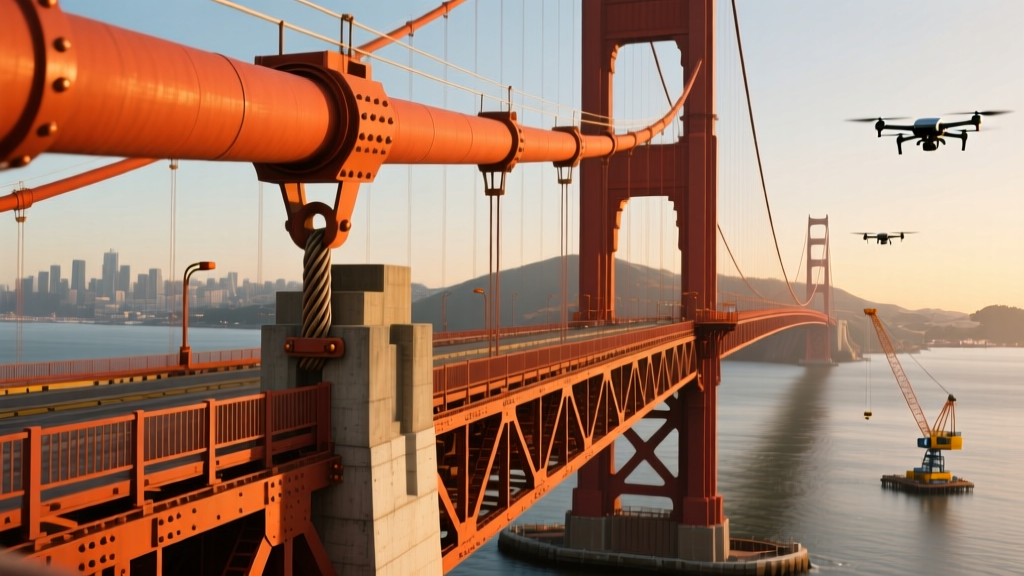
The Original $35 Million Masterpiece: 1937 Cost Breakdown
When civil engineers and estimators analyze historical megastructures, a common question arises: how much did it cost to build the Golden Gate Bridge? Approved by voters in 1930 during the onset of the Great Depression, the bridge was a monumental financial gamble. The original construction contract was awarded for exactly $35,000,000. Completed in May 1937, the project actually finished slightly under budget at $34,998,000, a rarity in modern heavy civil engineering.
To understand the baseline, we must look at the physical quantities required to span the treacherous Golden Gate strait. Chief Engineer Joseph Strauss and his team designed a suspension bridge requiring unprecedented material volumes. According to the American Society of Civil Engineers, the original build consumed 83,000 tons of bridge steel, 1.2 million cubic yards of concrete for the massive anchorages, and over 1.2 million individual rivets.
1937 Line Item Estimates
- Superstructure Steel: ~$8.5 million (approx. $102/ton fabricated)
- Concrete & Anchorages: ~$4.2 million
- Main Cables (Wire): ~$3.8 million (80,000 miles of wire)
- Labor & Field Operations: ~$12.5 million (2.3 million man-hours)
- Safety Net: $130,000 (A revolutionary expense that saved 19 lives)
The Inflation Trap: Why CPI Fails Megastructure Estimating
If you plug $35 million from 1937 into the Bureau of Labor Statistics Inflation Calculator, the Consumer Price Index (CPI) suggests an equivalent purchasing power of roughly $760 million in 2026. However, applying CPI to heavy civil construction is a critical estimating error. CPI measures consumer goods like bread, apparel, and rent. It does not account for the hyper-inflation of specialized construction materials, prevailing wage mandates, and modern environmental compliance.
Instead, professional estimators use the Engineering News-Record (ENR) Construction Cost Index (CCI) or specific heavy civil indices. Since 1937, the cost of heavy infrastructure has outpaced consumer inflation by a factor of nearly 2.5x. When adjusting the original $35 million using historical heavy civil multipliers, the baseline 'apples-to-apples' material and labor cost to build the exact same physical structure in 2026 sits closer to $1.8 billion.
But you cannot legally build the 1937 design today. To find the true 2026 replacement cost, we must factor in modern building codes, which fundamentally alter the material specifications and labor requirements.
Material Cost Comparison: 1937 vs. 2026 Market Rates
The metallurgical and concrete standards of the 1930s are obsolete. A 2026 rebuild would require High-Performance Steel (HPS) and ultra-high-performance concrete (UHPC) to withstand modern seismic and marine corrosion standards.
| Material Component | 1937 Specification & Cost | 2026 Specification & Cost |
|---|---|---|
| Structural Steel (83k tons) | Carbon Steel (~$102/ton) | HPS 70W / Weathering Steel (~$2,400/ton fabricated) |
| Main Suspension Cables | Galvanized carbon wire | Zinc-aluminum alloy coated, dehumidified internal wrap |
| Anchorage Concrete (1.2M cu yd) | Standard Portland cement | Mass concrete with cooling pipes & fly ash ($950/cu yd) |
| Decking System | Heavy steel grid / concrete | Orthotropic steel deck with epoxy asphalt overlay |
The steel cost alone jumps from roughly $8.5 million in 1937 to nearly $200 million in 2026 just for raw fabricated materials, excluding the complex logistics of marine erection.

The Hidden Costs of Modern Engineering and Compliance
Beyond raw materials, the regulatory environment of 2026 introduces massive cost drivers that did not exist during the Great Depression.
Seismic Resilience and Base Isolation
The original bridge was incredibly stiff, designed to resist wind but not optimized for the lateral ground acceleration of a magnitude 8.0+ San Andreas fault rupture. Since 1997, the Golden Gate Bridge District has spent over $900 million on phased seismic retrofits. A ground-up 2026 build would require advanced base isolation bearings, viscous dampers, and ductile detailing at the tower legs. According to the ASCE Report Card for America's Infrastructure, integrating modern seismic lifeline standards adds 18% to 25% to the total structural budget of long-span bridges in California.
Environmental and Marine Mammal Protection
Driving the original concrete fender piers in the 1930s was done with little regard for acoustic pollution. Today, the National Marine Fisheries Service (NMFS) mandates strict underwater noise attenuation to protect migrating gray whales and harbor porpoises. A 2026 project would require bubble curtain systems, hydroacoustic monitoring, and seasonal work restrictions, easily adding $45 million in environmental compliance and delay-related carrying costs.
Labor: The 'Halfway to Hell' Club vs. Modern OSHA
The original safety net cost $130,000 and was considered a luxury. Today, union ironworker prevailing wages under the Davis-Bacon Act, combined with rigorous OSHA fall protection, marine rescue teams, and automated guided vehicles for deck placement, push the labor burden to roughly 45% of the total project cost. The 2.3 million man-hours logged in the 1930s would likely expand to over 4.5 million man-hours today due to safety pacing and quality assurance testing.
Modern Equivalents: How the Golden Gate Compares to Recent Mega-Bridges
To validate our bottom-up estimate, we can compare the theoretical 2026 Golden Gate rebuild against recently completed long-span bridges in North America.
Gerald Desmond Bridge (Long Beach, CA)
Type: Cable-Stayed
Length: 2,000 ft main span
Completed: 2020
Final Cost: $1.5 Billion
Cost per Linear Foot: ~$285,000
Gordie Howe Intl Bridge (Detroit-Windsor)
Type: Cable-Stayed
Length: 2,800 ft main span
Expected: 2025/2026
Final Cost: ~$4.0 Billion (USD)
Cost per Linear Foot: ~$310,000
Golden Gate Bridge (Theoretical 2026 Rebuild)
Type: Suspension
Length: 4,200 ft main span
Expected: 2026
Estimated Cost: $2.9 - $3.4 Billion
Cost per Linear Foot: ~$330,000
Suspension bridges inherently require more material per linear foot than cable-stayed designs due to the massive anchorages and continuous main cables. The Gordie Howe bridge, while featuring a longer main span, benefits from modern cable-stayed efficiency and different geological anchoring conditions. The Golden Gate's specific requirement to anchor into the fractured serpentine rock of the Marin Headlands would require micropile drilling and grouting techniques that drastically inflate substructure costs.
Final Verdict: The True 2026 Price Tag
So, how much did it cost to build the Golden Gate Bridge, and what is its modern equivalent? The historical $35 million price tag was a masterclass in Depression-era efficiency and risk-taking. However, if the bridge were destroyed and required a complete ground-up replacement in 2026, adhering to current Caltrans seismic design criteria, NEPA environmental standards, and modern union labor rates, the estimated construction cost would range between $2.9 billion and $3.4 billion.
This figure does not include the decades-long right-of-way acquisition, the demolition of the existing structure, or the financing costs of issuing municipal bonds in a high-interest-rate environment. It stands as a testament to the fact that while engineering has become vastly safer and more resilient, the financial barrier to entry for connecting communities across major waterways has increased by a factor of nearly 100.
Written by
Elena RodriguezElena Rodriguez is a civil engineer and technical writer specializing in concrete technology, masonry systems, and ASTM/ACI compliance. She earned her B.S. in Civil Engineering from Texas A&M University and spent a decade at a materials testing laboratory, performing over 2,000 concrete compressive strength tests and masonry prism evaluations. Elena is an ACI-certified Field Testing Technician (Grade I) and a member of ASTM Committee C12 on Natural Building Stone. She currently consults on forensic engineering cases involving concrete failures and moisture intrusion. Based in San Antonio, TX, Elena is a proud member of the Society of Women Engineers (SWE) and coaches her daughter's FIRST Robotics team.
More from Elena Rodriguez
View all
Walls & Panels
Cost Analysis: Light Gauge Steel Framing Advantages and Disadvantages
Evaluate light gauge steel framing advantages and disadvantages through a strict cost analysis lens, comparing material, labor, and lifecycle expenses.
Aug 4, 2026

Walls & Panels
Gypsum Board Types: Exact Specifications, Thickness & Dimensions
Compare standard, Type X, and moisture-resistant gypsum board types. Get exact specifications, thicknesses, dimensions, and ASTM standards for your project.
Aug 4, 2026

Fire Resistance
Best Fire-Resistant Outdoor Decking Materials: 2026 Buyer Guide
Discover the best fire-resistant outdoor decking materials for 2026. Compare Class A PVC, aluminum, and hardwood options for WUI compliance and safety.
Aug 4, 2026