How Much Does It Cost to Build a Dam? Earthfill Cost & Savings
Discover how much it costs to build a dam in 2026. Learn expert money-saving strategies for earthfill dam construction, site prep, and spillway design.

The Real Cost Breakdown: How Much Does It Cost to Build a Dam?
When private landowners, farmers, or small municipalities ask how much does it cost to build a dam, the answer hinges on the scale of the impoundment, local geology, and the complexity of the spillway. For standard earthfill dams—by far the most common and cost-effective type for agricultural and residential use—pricing is typically calculated by surface acreage and the cubic yardage of earth moved.
In 2026, rising diesel fuel surcharges and heavy equipment labor rates have pushed baseline excavation costs to between $4.50 and $8.50 per cubic yard. However, strategic planning can drastically reduce your final invoice. Below is the current baseline pricing for earthfill dam construction.
| Dam Size (Surface Acres) | Typical Earthwork Volume | Estimated Cost Range (2026) | Primary Cost Drivers |
|---|---|---|---|
| 0.5 Acre | 3,000 - 6,000 cu yds | $18,000 - $35,000 | Site clearing, basic pipe spillway, clay core |
| 1 Acre | 6,000 - 12,000 cu yds | $35,000 - $65,000 | Haul distance, emergency spillway grading |
| 2 - 3 Acres | 12,000 - 25,000 cu yds | $65,000 - $120,000 | Geotech testing, sheepsfoot compaction, riprap |
| 5+ Acres | 25,000+ cu yds | $125,000 - $250,000+ | USACE permitting, engineered concrete spillways |
Phase 1: Site Selection and Geotechnical Savings
The most expensive mistake in dam construction is choosing a site based solely on topography while ignoring subsurface geology. A narrow valley with a wide basin seems ideal, but if the bedrock is shallow or the soil lacks sufficient clay content, your costs will skyrocket.
Earthmoving costs are dictated by haul distance. To keep your budget intact, identify a "borrow area" (the site where you will excavate the clay for the dam core) within 500 feet of the dam footprint. For every 100 feet beyond that radius, expect excavation and hauling costs to increase by $0.15 to $0.25 per cubic yard. If you must import clay from off-site, trucking costs can easily exceed $12.00 per cubic yard, effectively doubling your embankment budget.
Avoiding the Bedrock Blasting Trap
Before moving a single blade of dirt, invest $1,500 to $3,000 in a geotechnical investigation using soil borings and a Standard Penetration Test (SPT). If your core trench must anchor into bedrock to prevent under-seepage, and that bedrock is highly fractured or too hard to rip with a D8 dozer, you will need to blast. Rock blasting and removal adds $15.00 to $35.00 per cubic yard. Shifting the dam alignment just 50 feet down the valley to find deeper natural clay deposits can save tens of thousands of dollars in explosives and specialized labor.
Phase 2: Embankment and Core Construction Hacks
The impermeable core is the heart of your dam. If the core fails, the dam washes out. While a compacted clay core is the traditional standard, modern synthetic and mineral alternatives offer distinct financial advantages depending on your site's native soil.
Liner and Core Material Comparison Matrix
| Material | Cost per Sq Ft (Installed) | Best Application | Money-Saving Advantage |
|---|---|---|---|
| Compacted Native Clay | $0.80 - $1.50 | Sites with >20% clay content | Cheapest option if material is on-site; no freight costs. |
| Sodium Bentonite | $1.20 - $2.00 | Sandy or gravelly native soils | Eliminates the need to truck in expensive imported clay. |
| HDPE Geomembrane | $2.50 - $4.00 | Porous soils, high-seismic zones | Reduces required embankment width, saving overall earthwork volume. |
| EPDM Rubber Liner | $3.00 - $5.50 | Small, decorative, or fish ponds | Highly flexible; reduces subgrade preparation time and costs. |
If your site lacks adequate clay, applying Sodium Bentonite at a rate of 2 to 3 pounds per square foot, mixed into the top 6 inches of soil and compacted, is vastly cheaper than importing clay from a distant quarry. According to Penn State Extension guidelines on pond construction, proper bentonite application can achieve near-zero seepage rates in soils that would otherwise require a synthetic liner.
Phase 3: Compaction and Moisture Control
Earthfill dams fail most often due to improper compaction. The clay core must be compacted in strict 6-inch to 8-inch lifts (layers). You cannot simply dump clay and push it around with a bulldozer. The soil must be at its Optimum Moisture Content (OMC), typically within 2% of the maximum dry density determined by a Standard Proctor test (ASTM D698).
If the soil is too dry, it will crack and allow water piping; if it is too wet, it will become spongy and fail to achieve the required 90-95% compaction density. Renting a sheepsfoot roller (also known as a padfoot roller) is non-negotiable for clay cores. Smooth drum rollers only compact the surface and leave deep voids. Budget $800 to $1,200 per week for a self-propelled sheepsfoot roller rental to ensure structural integrity without paying for a rework.
Phase 4: Spillway Design on a Budget
The spillway safely routes excess water during heavy rain events. Undersizing it is a catastrophic risk, but over-engineering it is a massive waste of capital.
- Corrugated Metal Pipe (CMP) vs. HDPE: Historically, CMP with concrete anti-seep collars was the standard. Today, High-Density Polyethylene (HDPE) pipe with compacted clay trench dams is preferred. HDPE is smoother (increasing flow capacity by up to 15%), immune to rust, and the trench dams are cheaper to form and pour than traditional concrete collars.
- Drop Inlet (Morning Glory) Spillways: For smaller dams, a concrete drop inlet combined with an HDPE barrel is highly cost-effective. It keeps floating debris away from the pipe entrance, reducing long-term maintenance costs.
- Emergency Spillway Grading: Never rely solely on the primary pipe. An emergency vegetated spillway must be graded into natural, undisturbed soil. Do not build the emergency spillway on the compacted fill of the dam embankment. If it washes out, the dam breaches. Grading it into the natural hillside costs slightly more in earthmoving but prevents total structural loss.
Heavy Machinery: Rent, Buy, or Contract?
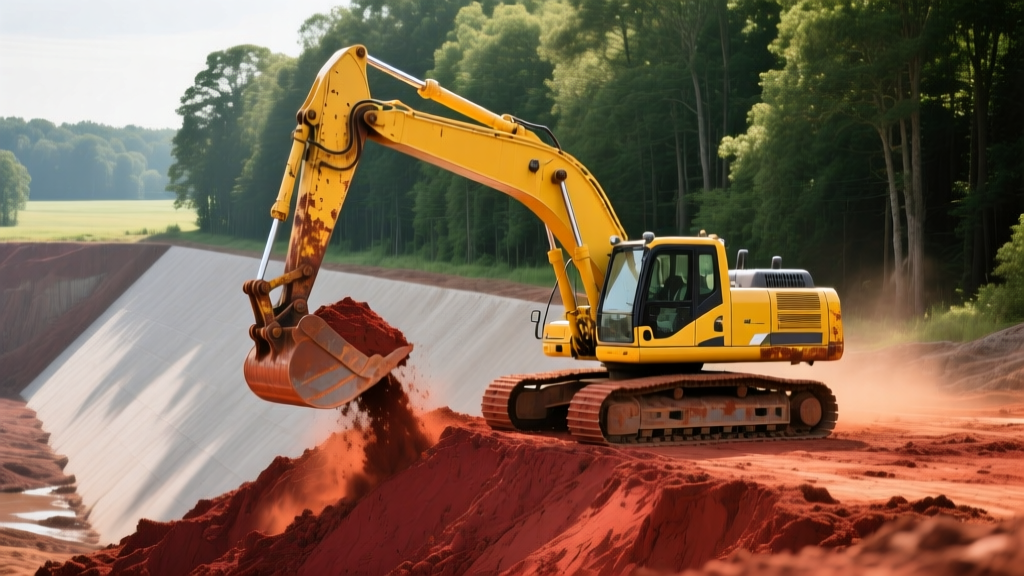
For a 1-acre dam requiring 8,000 cubic yards of earthwork, the project will take roughly 10 to 14 days with the right equipment. The ideal fleet includes a D6 or D8 bulldozer, a motor scraper or pull-pan, an excavator for the core trench, and a sheepsfoot roller.
Contractor vs. DIY Equipment Rental: While renting an excavator and dozer might seem like a way to save $10,000, dam construction requires specialized grading intuition. A professional earthwork contractor carries liability insurance and guarantees the compaction tests. If a DIY-rented dam fails and floods a downstream neighbor's property, the financial ruin will vastly exceed the contractor's premium. Always hire bonded professionals for the final embankment and core compaction.
Regulatory and Permitting Cost Traps
Failing to account for local, state, and federal permitting is where budgets routinely collapse. Depending on your jurisdiction, dam construction may trigger the Clean Water Act Section 404, requiring permits from the U.S. Army Corps of Engineers (USACE) if you are impacting Waters of the United States (WOTUS), including seasonal streams.
According to the FEMA National Dam Safety Program, many states classify dams by their "hazard potential" rather than their physical size. If your dam's failure could result in loss of life or severe damage to downstream infrastructure, it will be classified as High Hazard. High Hazard dams require rigorous, stamped engineering designs by a licensed Professional Engineer (PE), adding $8,000 to $15,000 to your pre-construction costs. Always consult your state's dam safety office before breaking ground to understand your hazard classification.
Furthermore, the US Army Corps of Engineers Dam Safety Program mandates strict inspection protocols for larger impoundments. Factor in $2,000 to $4,000 for environmental impact assessments and permit application fees to ensure your project isn't shut down mid-construction.
Summary Checklist for Maximum ROI
To ensure your dam construction remains financially viable without sacrificing safety, follow this sequence:
- Test the Soil First: Spend $2,000 on geotech borings to avoid $30,000 in bedrock blasting or clay importation.
- Optimize the Borrow Site: Keep excavation within 500 feet of the dam footprint.
- Mandate Proctor Testing: Require your contractor to provide Standard Proctor (ASTM D698) compaction logs for every 8-inch lift.
- Use HDPE and Trench Dams: Upgrade from CMP to HDPE pipe to increase flow and eliminate concrete collar forming costs.
- Secure Permits Early: Engage with state environmental agencies 6 to 12 months before your target construction date to avoid costly work-stoppage fines.
Written by
Marcus ChenMarcus Chen is a licensed structural engineer (PE) and building materials analyst with over 12 years of experience across residential, commercial, and industrial construction. He holds a Master of Science in Civil Engineering from UC Berkeley and spent six years at Thornton Tomasetti before transitioning to independent consulting and technical writing. Marcus specializes in material selection for seismic-prone regions, concrete reinforcement strategies, and lifecycle cost analysis. His work has been cited by the American Concrete Institute (ACI) and the Structural Engineers Association of California (SEAOC). When he is not on a job site or at his desk, you will find him hiking the Sierra Nevada or restoring a 1920s craftsman bungalow in Oakland, CA.
More from Marcus Chen
View all
Construction Cost
How Much Did the Eiffel Tower Cost to Build?
How much did the Eiffel Tower cost to build in 1889? We adjust for inflation and compare its budget to modern skyscraper construction.
Aug 4, 2026

Fire Resistance
What Is a Fire Resistant Material? Testing & Certification Guide
Discover what is a fire resistant material through ASTM and UL testing. Learn how fire ratings, certifications, and assemblies work in construction.
Aug 4, 2026

Construction Cost
How Much Did the Burj Khalifa Cost to Build?
How much did the Burj Khalifa cost to build? We break down the $1.5B project and extract 5 money-saving strategies for your next build.
Jul 30, 2026