Financing the Labor Cost to Build a Bathroom: A Complete Guide
Learn how to accurately estimate and finance the labor cost to build a bathroom, including trade-specific rates, draw schedules, and loan options.
The Financial Reality of Bathroom Labor
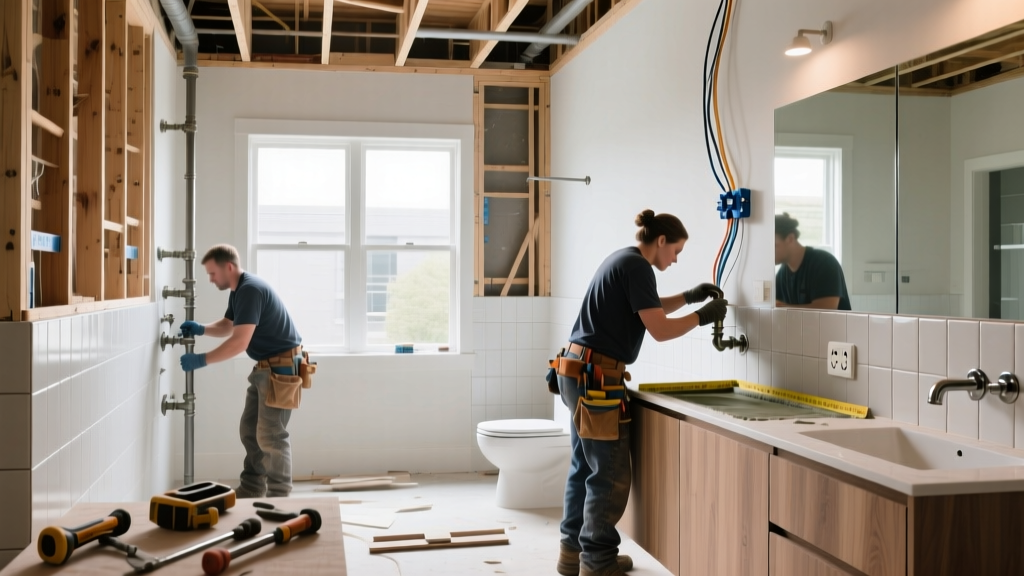
When homeowners budget for a new bathroom, they typically focus on the tangible: the Kohler fixtures, the porcelain tile, and the custom vanity. However, the labor cost to build a bathroom routinely consumes 45% to 60% of the total project budget. Unlike materials, which you can purchase upfront and store, labor is a service rendered over time, requiring a strategic approach to cash flow and financing.
Financing a bathroom build is not just about securing a lump sum; it is about aligning your capital disbursement with the contractor's draw schedule. If your financing vehicle releases funds too slowly, work halts. If it releases too quickly, you lose leverage over unfinished punch-list items. This guide breaks down the exact labor costs by trade and provides a framework for financing the human capital required to execute your build.
Trade-Specific Labor Rates and Hourly Allocations
To finance labor accurately, you must understand who is billing you and at what rate. A standard 50-square-foot primary bathroom requires a coordinated sequence of specialized trades. General contractors typically mark up subcontractor labor by 15% to 20% to cover overhead, insurance, and project management.
| Trade Specialty | Average Hourly Rate | Est. Hours (50 sq. ft.) | Estimated Labor Cost |
|---|---|---|---|
| Demolition & Haul-away | $55 - $75 / hr | 12 - 16 hrs | $660 - $1,200 |
| Rough & Finish Plumbing | $120 - $180 / hr | 24 - 32 hrs | $2,880 - $5,760 |
| Electrical (Lighting/GFCI) | $100 - $150 / hr | 16 - 20 hrs | $1,600 - $3,000 |
| Carpentry & Drywall | $70 - $110 / hr | 30 - 40 hrs | $2,100 - $4,400 |
| Tile Setting & Waterproofing | $85 - $130 / hr | 40 - 60 hrs | $3,400 - $7,800 |
| HVAC (Exhaust & Heat) | $95 - $140 / hr | 8 - 12 hrs | $760 - $1,680 |
Note: Total direct labor for a mid-range 50 sq. ft. bathroom typically ranges from $11,400 to $23,840. When factoring in the GC's 20% margin, the final labor cost to build a bathroom of this size falls between $13,680 and $28,600.
Structuring Your Financing Around Contractor Draws
The most critical mistake homeowners make when financing labor is paying too much upfront. According to the Federal Trade Commission, you should never pay the full cost of a remodeling project upfront. Instead, your financing must be structured around a milestone-based draw schedule.
The 10-40-40-10 Labor Payment Framework
- 10% Deposit: Paid upon contract signing to secure your spot on the contractor's schedule and cover initial permit pulling.
- 40% Rough-In Draw: Disbursed only after demolition, framing, rough plumbing, and rough electrical pass municipal inspections.
- 40% Finishes Draw: Released after drywall is mudded, tile is set, and fixtures are physically installed.
- 10% Retainage: Held until the final municipal inspection is passed, all punch-list items are resolved, and final lien waivers are signed.
Ranking Financing Vehicles for Labor-Intensive Remodels
Not all loans are created equal when it comes to disbursing funds for construction labor. Here is how the primary financing options stack up for bathroom builds.
1. Home Equity Line of Credit (HELOC)
Best for: Homeowners with significant equity who want to pay contractors exactly as milestones are met.
The Mechanism: A HELOC functions like a credit card secured by your home. You can draw $3,000 to pay the plumber on Tuesday, and $4,500 to pay the tile setter on Friday. You only pay interest on the exact amount drawn.
Drawback: Variable interest rates expose you to market fluctuations during a multi-month build. Learn more about HELOC structures via the Consumer Financial Protection Bureau.
2. FHA Title I Property Improvement Loan
Best for: Borrowers with lower equity who need a fixed-rate, unsecured (for loans under $7,500) or secured government-backed loan.
The Mechanism: Insured by the Department of Housing and Urban Development (HUD), these loans are specifically designed for remodeling. The lender pays the contractor directly in draws, which protects the homeowner from mismanaging the funds.
3. Unsecured Personal Loan
Best for: Smaller bathroom builds (e.g., half-baths or powder rooms) where the total labor cost is under $15,000.
The Mechanism: Funds are disbursed as a single lump sum directly to your bank account within 48 hours. This is ideal if you are acting as your own general contractor and need to pay independent day-rate laborers immediately.
Mitigating Risk: Mechanic's Liens and Waivers
When you finance the labor cost to build a bathroom, you are exposed to a specific legal risk: the mechanic's lien. If your general contractor takes your draw payment but fails to pay their subcontractors (like the plumber or tile setter), those subcontractors can place a lien on your home, even if you have already paid the GC in full.
Expert Rule: Never authorize a HELOC draw or loan disbursement for a milestone payment without first collecting a Conditional Lien Waiver for the current payment, and an Unconditional Lien Waiver for the previous payment, signed by both the GC and all subcontractors who worked on that phase.
Hidden Labor Line Items That Derail Budgets
When securing your loan amount, you must pad your labor budget for the invisible work that rarely appears on the initial summary quote. Failing to finance these specific labor subsets is the primary reason bathroom remodels require high-interest credit card bridge financing at the end of the project.
- Permit Expediting and Pulling: GCs charge $250 to $500 in administrative labor just to interface with the local building department, draft the scope of work, and wait in line at the permit office.
- Subfloor Remediation: Once the old tile is demoed, water damage is often revealed. Budget an extra 8 to 12 carpentry hours ($600 - $1,300) for sistering joists or replacing rotted OSB subflooring before the new waterproofing can begin.
- Dust Containment and Zip-Walling: High-end contractors charge for the 4 to 6 hours of labor required to build negative-air pressure enclosures and seal off your HVAC returns to prevent drywall dust from migrating through the house.
- Change Order Minimums: If you decide to move a shower valve three inches after the rough-in inspection, plumbers will not charge their standard hourly rate. They charge a 'truck roll' or change-order minimum, typically $350 to $500, regardless of how long the physical pipe move takes.

The Labor-to-Material Multiplier Framework
If you are in the early planning stages and have not yet received contractor bids, you can use the Labor-to-Material Multiplier to estimate your financing needs. In the current construction economy, the ratio of labor to materials for a fully tiled, custom bathroom is approximately 1.2:1.
This means if you have priced out your materials (fixtures, tile, vanity, lighting) and the total receipt is $12,000, you should anticipate the labor cost to build the bathroom to be roughly $14,400. Your total project cost will be $26,400, plus a 15% contingency ($3,960). When applying for your construction loan or HELOC, use this $30,360 figure as your absolute ceiling to ensure your financing covers the inevitable scope creep.
Written by
Priya KapoorPriya Kapoor is a real estate market analyst and construction economics researcher with expertise in housing affordability, development feasibility, and infrastructure investment. She holds a Master of Regional Planning from Cornell University and previously worked as a senior analyst at CBRE's Investment Properties group, where she modeled returns for $4B in mixed-use development pipelines. Priya now runs an independent research practice advising developers, municipalities, and REITs on construction cost forecasting and market timing. She publishes the quarterly "BuildMat Market Pulse" report tracking material price indices across 12 commodity categories. Based in Austin, TX, Priya serves on the board of Habitat for Humanity Austin and is a marathon runner.
More from Priya Kapoor
View all
Construction Cost
Cost to Build a 1600 Sq Ft Home in 2026: Full Breakdown
Accurate 2026 cost to build a 1600 sq ft home—material, labor, and regional pricing breakdowns included. Plan your budget with real-time estimates.
Aug 11, 2026

Wood & Lumber
Name the Types of Wood for Pressure Treatment and Preservation
Learn how to name the types of wood best suited for pressure treatment. Compare species treatability, chemical retention levels, and 2026 preservation costs.
Aug 4, 2026

Stone & Masonry
Stone Veneer Suppliers Lindenhurst: 2026 Cost Analysis
Analyze 2026 stone veneer costs in Lindenhurst, NY. Compare local supplier pricing, delivery fees, and Suffolk County installation labor rates.
Aug 4, 2026