How Much Did Hoover Dam Cost to Build? Complete Cost Breakdown
Discover how much the Hoover Dam cost to build in 1936, adjusted for modern inflation, with a detailed breakdown of materials, labor, and engineering.

The Original Price Tag: Answering How Much Did Hoover Dam Cost to Build
When analyzing historical mega-projects, the question of how much did Hoover Dam cost to build requires looking past the simple sticker price to understand the economic reality of the 1930s. Authorized under the Boulder Canyon Project Act of 1928, the dam was constructed during the depths of the Great Depression. The original contract, awarded to Six Companies, Inc. in 1931, was set at $48,890,955. With adjustments and additional government expenditures for appurtenant works, the final construction cost for the dam and its initial power plant infrastructure settled at approximately $49,000,000.
Quick Cost Snapshot (1936)
- Dam Construction Contract: $48,890,955
- Total Boulder Canyon Project Authorization: $165,000,000
- Concrete Used (Dam Only): 3.25 million cubic yards
- Peak Workforce: 5,251 employees (1934)
- Construction Timeline: 5 years (1931–1936)
While $49 million was the direct cost to build the physical dam structure, the broader Boulder Canyon Project—which included the Black Canyon survey, land acquisition, transmission lines, and downstream levee improvements—carried a much larger authorized budget of $165 million. According to the U.S. Bureau of Reclamation, the project was entirely self-financing, designed to be paid back to the federal treasury with interest over 50 years through the sale of hydroelectric power.
Adjusting for Inflation: What Would Hoover Dam Cost Today?
To truly understand the scale of the investment, we must adjust the 1936 figures for inflation. However, applying a standard Consumer Price Index (CPI) calculator to construction projects yields a misleadingly low number. Construction economics inflate at a different rate than consumer goods due to changes in labor laws, safety regulations, environmental compliance, and material extraction costs.
The Dual-Inflation Calculation
If we use the Bureau of Labor Statistics CPI Inflation Calculator, $49 million in 1936 equates to roughly $1.08 billion in today's purchasing power. But you cannot build a mega-dam today using consumer purchasing power metrics. We must apply the Engineering News-Record (ENR) Construction Cost Index (CCI), which tracks the actual cost of labor and building materials.
| Metric | 1936 Cost | Modern Equivalent | Inflation Factor |
|---|---|---|---|
| Consumer Price Index (CPI) | $49,000,000 | ~$1.08 Billion | ~22x |
| Construction Cost Index (CCI) | $49,000,000 | ~$3.4 Billion | ~70x |
| Modern Mega-Dam Benchmark | N/A | $4.5 - $6.0 Billion | Includes soft costs |
Using construction-specific inflation, the hard costs of materials and labor translate to roughly $3.4 billion today. However, if a contractor were to bid on a Hoover Dam equivalent today, the final price tag would likely exceed $5 billion. This premium accounts for modern 'soft costs' that did not exist in the 1930s: multi-year Environmental Impact Statements (EIS), OSHA-mandated safety protocols, unionized labor negotiations, and advanced seismic engineering retrofits.
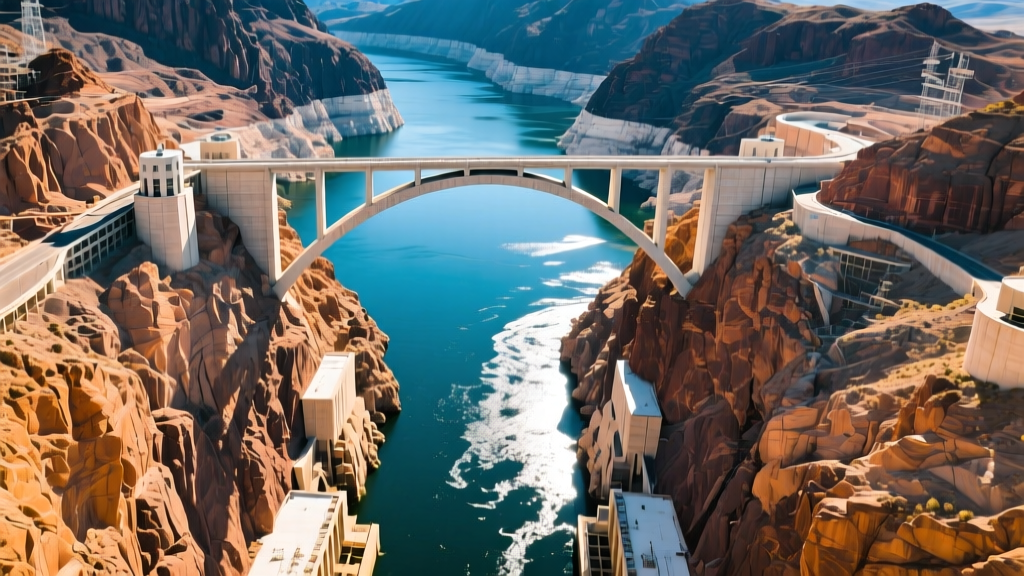
Detailed Cost Breakdown: Where Did the $49 Million Go?
The physical construction required moving mountains and rerouting a massive river. The cost distribution highlights the sheer volume of raw materials required before modern supply chain optimizations existed.
Material Volumes and Costs
- Concrete: The dam contains 3.25 million cubic yards of concrete. The entire project utilized 4.34 million cubic yards. In the 1930s, cement cost roughly $2.50 per barrel. Today, mass-pour low-heat Portland cement would cost exponentially more per ton, not including the logistics of transporting it to a remote desert canyon.
- Steel and Iron: Approximately 45 million pounds of steel were used for the penstocks, gates, and valves. The massive 30-foot diameter steel penstocks alone required specialized fabrication that pushed the metallurgical limits of the era.
- The Cooling System (Hidden Cost): A massive, often-overlooked expense was the refrigeration plant. Engineers calculated that if the concrete were poured in a single continuous block, it would take 125 years to cool and would crack catastrophically. They built a massive ammonia-compression ice plant to chill the water pumped through a network of 582 miles of 1-inch cooling pipes embedded in the concrete. This temporary infrastructure consumed nearly 8% of the total project budget.
Human Capital: Labor Costs and the Human Toll
Labor in the 1930s was abundant and cheap due to the Great Depression, but the working conditions at Black Canyon were brutal. Six Companies, Inc. employed over 21,000 distinct workers over the life of the project, though the peak on-site workforce never exceeded 5,251.
1930s Wage Rates vs. Modern Equivalents
Common Laborer: $0.50 per hour (Approx. $11.00/hr today via CPI)
Skilled Trades (Carpenters, Electricians): $0.75 to $1.00 per hour
High Scalers (Cliff Workers): $1.40 per hour (Hazard pay)
Note: Modern federal prevailing wage laws (Davis-Bacon Act) would mandate union-scale wages for a federal project today, pushing average hourly labor costs on a similar site well past $45-$65 per hour, drastically altering the labor-to-material cost ratio.
The human cost was also tallied in lives lost. Officially, 96 workers died in construction-related accidents (falls, drownings, equipment strikes). Dozens more died from pneumonia and heat exhaustion, though company doctors often misclassified these to avoid worker compensation payouts. Today, stringent OSHA regulations would require fall protection, climate-controlled rest breaks, and advanced ventilation in the diversion tunnels, adding millions to the project's safety overhead but saving countless lives.
Comparing Hoover Dam to Modern Mega-Projects
To contextualize how much the Hoover Dam cost to build, it is highly instructive to compare its inflation-adjusted price tag to modern hydroelectric mega-dams. Modern dams cost significantly more, not just because of inflation, but due to the complexity of modern environmental mitigation and land resettlement.
| Project Name | Location | Completion Year | Actual / Adjusted Cost | Primary Cost Drivers |
|---|---|---|---|---|
| Hoover Dam | USA | 1936 | $49M ($3.4B CCI adj.) | Raw materials, extreme heat, diversion tunnels |
| Itaipu Dam | Brazil/Paraguay | 1984 | $15B - $18B | Massive earthmoving, bi-national treaties |
| Three Gorges | China | 2012 | ~$28B - $37B | Resettlement of 1.3M people, ship locks |
'The Hoover Dam was built in an era before the National Environmental Policy Act (NEPA). Today, the environmental impact studies, endangered species mitigation (like the Delta Smelt), and indigenous land negotiations for a project of this scale on the Colorado River would take longer and cost more than the physical concrete pouring.' — Historical Infrastructure Analysis
Financing and ROI: How the Dam Paid for Itself
The most remarkable aspect of the Hoover Dam's cost is not how much it was, but how it was funded. The federal government did not use taxpayer dollars to fund the $49 million construction. Instead, the Boulder Canyon Project Act established a framework where the dam would be paid for entirely by the users of its water and electricity.
- Bond Issuance: The U.S. Treasury issued bonds to cover the initial construction outlays.
- Power Contracts: Before the dam was even finished, the Bureau of Reclamation secured 50-year contracts with municipalities (like Los Angeles and Pasadena) and utility companies to buy the generated hydroelectric power.
- Water Fees: Agricultural districts in California and Arizona paid fees for the regulated water delivery.
- Payoff: By 1987, exactly 50 years after the final handover, the Hoover Dam had generated enough revenue from power and water sales to pay back the original $165 million project authorization, plus $114 million in accrued interest, entirely clearing the federal ledger.
FAQ: Hoover Dam Construction Economics
Did the Hoover Dam finish under budget?
Yes, remarkably so. Six Companies, Inc. finished the primary dam structure ahead of schedule and slightly under the original $48.8 million contract price, despite the unprecedented engineering challenges. The company was highly motivated by a massive bonus structure for early completion and severe financial penalties for delays. However, the broader Boulder Canyon Project, including infrastructure and land acquisition, eventually utilized most of its $165 million authorization.
How much does it cost to maintain Hoover Dam today?
Maintenance, upgrades, and operational costs are funded entirely by power revenues. Recent major overhauls, such as the multi-year turbine uprating project to increase generation efficiency and the installation of advanced seismic monitoring systems, cost tens of millions of dollars. Annual routine maintenance and operational staffing typically run between $10 million and $15 million, a fraction of the revenue generated by its 2,080-megawatt capacity.
Could a private company build the Hoover Dam today?
From a purely financial and engineering standpoint, yes. Modern private consortiums build mega-dams globally. However, in the United States, the regulatory hurdles, water rights litigation, and environmental compliance costs make private financing of a new Colorado River mega-dam economically unviable. The risk premium required by private investors would push the cost of capital far beyond what municipal power contracts could support.
Written by
Priya KapoorPriya Kapoor is a real estate market analyst and construction economics researcher with expertise in housing affordability, development feasibility, and infrastructure investment. She holds a Master of Regional Planning from Cornell University and previously worked as a senior analyst at CBRE's Investment Properties group, where she modeled returns for $4B in mixed-use development pipelines. Priya now runs an independent research practice advising developers, municipalities, and REITs on construction cost forecasting and market timing. She publishes the quarterly "BuildMat Market Pulse" report tracking material price indices across 12 commodity categories. Based in Austin, TX, Priya serves on the board of Habitat for Humanity Austin and is a marathon runner.
More from Priya Kapoor
View all
Construction Cost
Cost to Build a 1600 Sq Ft Home in 2026: Full Breakdown
Accurate 2026 cost to build a 1600 sq ft home—material, labor, and regional pricing breakdowns included. Plan your budget with real-time estimates.
Aug 11, 2026

Wood & Lumber
Name the Types of Wood for Pressure Treatment and Preservation
Learn how to name the types of wood best suited for pressure treatment. Compare species treatability, chemical retention levels, and 2026 preservation costs.
Aug 4, 2026

Stone & Masonry
Stone Veneer Suppliers Lindenhurst: 2026 Cost Analysis
Analyze 2026 stone veneer costs in Lindenhurst, NY. Compare local supplier pricing, delivery fees, and Suffolk County installation labor rates.
Aug 4, 2026