Cost to Build a Shipping Container House vs Traditional Framing
Compare the true cost to build a shipping container house versus traditional stick framing, including hidden expenses, insulation, and structural mods.

The Real Cost to Build a Shipping Container House: Beyond the Hype
The narrative that shipping containers offer a drastically cheaper alternative to traditional wood framing is a persistent myth in modern construction. While the raw steel box appears inexpensive at first glance, transforming a corrugated steel cargo unit into a code-compliant, thermally efficient residence introduces highly specialized expenses. When evaluating the true cost to build a shipping container house, you must look past the purchase price of the steel shell and account for structural reinforcement, thermal bridging mitigation, and heavy equipment logistics.
This guide provides a direct, line-item cost comparison between a 2,000-square-foot shipping container home (using six 40-foot High Cube units) and a comparable 2,000-square-foot traditional stick-built home. We break down the exact material grades, labor rates, and hidden structural requirements that dictate the final budget.
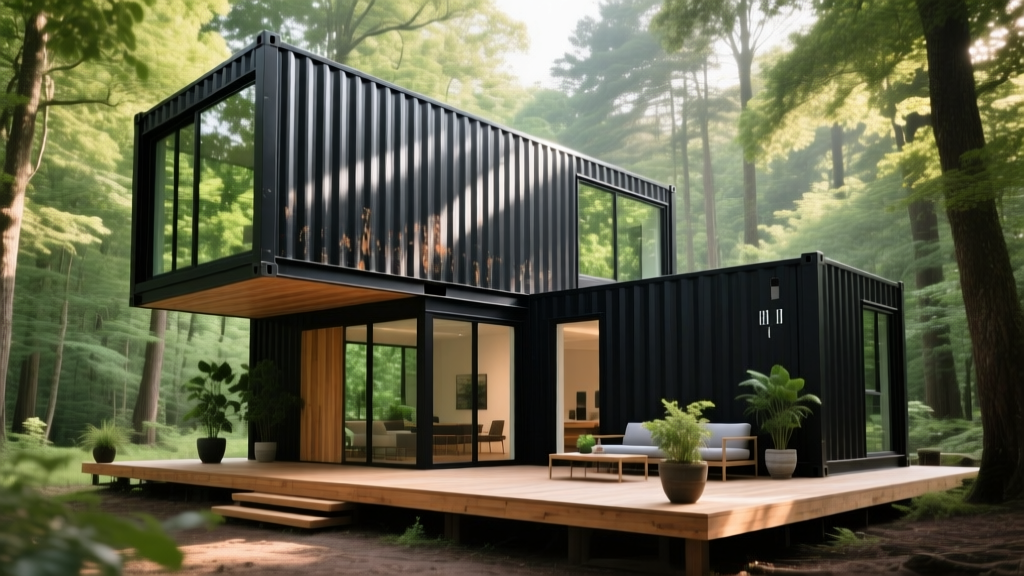
Base Material Costs: Steel Shells vs. Lumber Packages
To build a 2,000-square-foot home using shipping containers, you typically need six 40-foot High Cube (HC) containers, each providing roughly 320 square feet of floor space (totaling 1,920 square feet before interior wall framing). The condition of the containers you purchase will heavily influence your baseline budget and subsequent prep work.
| Material Type | Unit Cost (Approx.) | Quantity for 2,000 sq ft | Total Shell Cost |
|---|---|---|---|
| 40ft HC 'One-Trip' (New) | $5,000 - $6,500 | 6 | $30,000 - $39,000 |
| 40ft HC 'Cargo-Worthy' (Used) | $2,800 - $3,800 | 6 | $16,800 - $22,800 |
| Traditional Wood Framing Package | $9.00 - $12.00 per sq ft | 2,000 sq ft | $18,000 - $24,000 |
According to industry tracking by Container xChange, the price of one-trip containers has stabilized, but they remain a premium product. Notice that purchasing six new 'One-Trip' containers actually costs more than the entire wood framing package for a traditional home. Used 'Cargo-Worthy' containers offer upfront savings, but they require extensive rust remediation, floorboard replacement (original marine plywood is often treated with toxic pesticides), and dent repair, which rapidly erodes the initial discount.
The Hidden Structural Costs: Cutting, Welding, and Reinforcement
A shipping container is essentially a monocoque structure; its structural integrity relies entirely on the continuous corrugated Corten steel skin. The moment you cut a hole for a window, door, or to join two containers, you compromise the structural load path. You must replace the lost structural strength by welding steel headers and bucks around every opening.
Reinforcement Cost Breakdown
- Steel Tubing: You will need 2x4x1/4-inch ASTM A500 Grade B steel tubing for headers and bucks. This material costs approximately $18 to $25 per linear foot.
- Welding Labor: Certified structural welders charge between $95 and $160 per hour. Framing out the cutouts for a standard 2,000-square-foot layout (roughly 15 windows and 4 doors) typically requires 40 to 60 hours of welding labor.
- Consumables and Equipment: Welding wire, shielding gas, cutting discs, and grinder rentals add roughly $1,200 to $1,800 to the project.
In contrast, framing a window opening in a traditional stick-built home requires a standard 2x6 or 2x8 wood header, two trimmer studs, and a few nails. The material cost is under $30, and a carpenter can frame it in 20 minutes. The structural modification phase is where the cost to build a shipping container house begins to significantly outpace traditional methods.
Insulation and Climate Control: Solving the Thermal Bridge
Steel is a massive thermal conductor. Without proper insulation, a steel container will rapidly transfer exterior heat and cold to the interior, leading to severe condensation, mold growth, and unmanageable HVAC costs. The U.S. Department of Energy emphasizes that continuous insulation is required to break thermal bridges in steel-framed structures.
Batt insulation or rigid foam boards cannot be easily fitted into the deep corrugations of the container walls. Therefore, 2-pound density closed-cell spray polyurethane foam (ccSPF) is the industry standard for container homes. It adheres directly to the corrugated steel, seals air leaks, and provides a high R-value per inch while acting as a vapor barrier.
| Insulation Type | R-Value per Inch | Cost per Board Foot (1 Inch) | Viability for Container Walls |
|---|---|---|---|
| 2lb Closed-Cell Spray Foam | R-6.5 to R-7.0 | $1.60 - $2.50 | Excellent (Fills corrugations, stops condensation) |
| Rigid Polyiso Board | R-5.8 to R-6.5 | $0.90 - $1.30 | Poor (Leaves air gaps in corrugations) |
| Fiberglass Batt | R-3.1 to R-3.4 | $0.40 - $0.70 | Unacceptable (High risk of trapped moisture/rust) |
To achieve a code-compliant R-20 wall assembly using closed-cell spray foam, you need roughly 3 inches of foam. For a 2,000-square-foot home, insulating the interior walls and ceiling of six containers will cost between $14,000 and $22,000. Traditional stick-built homes can achieve R-20 using standard fiberglass batts for roughly $2,500 to $3,500.
Foundation, Craning, and Site Logistics
Placing six 40-foot shipping containers requires heavy machinery and precise site preparation. Unlike a lumber package that arrives on a standard flatbed and is unloaded by hand or with a small forklift, containers require mobile cranes.
- Crane Mobilization: Bringing a 50-ton mobile crane to a residential site typically incurs a mobilization fee of $600 to $1,200, plus an hourly rate of $225 to $350.
- Rigging and Placement: Setting six containers, aligning them within a quarter-inch tolerance for welding, and securing them to the foundation usually takes 6 to 10 hours. Expect crane and rigging costs to total $3,000 to $5,500.
- Transport Permits: If your site is on a narrow, rural, or heavily trafficked road, transporting 8.5-foot-wide containers may require escort vehicles and oversize load permits, adding $800 to $2,000 to the logistics budget.
Stick framing requires none of this heavy equipment. The lumber is dropped at the curb, and the framing crew carries it to the foundation.
Final Cost Comparison Matrix: Container vs. Stick-Built
The following matrix compares the estimated costs for the structural shell, insulation, and site logistics for a 2,000-square-foot build in a moderate-cost region. This excludes interior finishes, plumbing, and electrical, which are roughly equivalent in cost for both methods.
| Cost Category | Shipping Container Home (6x 40ft HC) | Traditional Stick-Built Home |
|---|---|---|
| Shell Materials | $30,000 - $39,000 (One-Trip) | $18,000 - $24,000 |
| Structural Reinforcement (Cutouts) | $6,500 - $10,000 | $800 - $1,500 |
| Wall & Ceiling Insulation (R-20) | $14,000 - $22,000 (Spray Foam) | $2,500 - $4,000 (Batt) |
| Heavy Equipment & Craning | $3,000 - $5,500 | $0 |
| Exterior Rust Prevention / Primer | $3,500 - $5,000 | $0 (Handled by house wrap/siding) |
| Total Shell & Envelope Cost | $57,000 - $81,500 | $21,300 - $29,500 |
Data from the National Association of Home Builders (NAHB) consistently shows that traditional wood framing remains one of the most cost-effective methods for residential envelopes. The container home envelope costs roughly 2.5 to 3 times more to execute properly.
When Does a Container Home Actually Make Financial Sense?
If the cost to build a shipping container house is generally higher than traditional framing, why do people build them? The financial justification shifts when you change the architectural requirements.
The Decision Framework
Choose a Shipping Container Home if:
- You require extreme impact resistance: If you are building in a high-risk hurricane zone (HVHZ) or a region prone to tornadoes, the Corten steel shell provides inherent impact and wind-uplift resistance that requires expensive engineering to replicate in wood.
- You are building modular, stackable structures: If your design involves heavy cantilevers or stacking units off-center, the steel chassis of a container provides a pre-engineered structural beam that saves money on commercial-grade steel I-beam fabrication.
- You want an exposed industrial aesthetic: If the design calls for exposed corrugated steel interiors and exteriors, you save thousands on drywall, interior paint, and exterior siding.
Choose Traditional Stick Framing if:
- You are on a strict budget: Wood framing is cheaper, faster, and requires no specialized welders or crane operators.
- You need complex rooflines: Cutting and welding steel to accommodate dormers, valleys, and complex hip roofs is prohibitively expensive. Wood trusses are vastly superior for complex roof geometries.
- You are building in a highly regulated HOA: Many Homeowners Associations and local zoning boards have strict aesthetic covenants that explicitly ban corrugated steel exteriors, forcing you to frame out and clad the container, completely defeating the purpose of using it.
Written by
David NakamuraDavid Nakamura is a licensed architect (AIA) and construction technology writer focused on sustainable building methods, mass timber engineering, and high-performance building envelopes. He holds a Master of Architecture from the University of Washington and is a certified Passive House Consultant (CPHC). David spent eight years at the Seattle firm Mithun, where he led the design of three LEED Platinum projects, before founding his own practice specializing in net-zero residential design. He serves on the editorial advisory board of GreenBuilder Magazine and has authored peer-reviewed papers on cross-laminated timber (CLT) connections for the Journal of Structural Engineering. In his spare time, David teaches woodworking at Pratt Fine Arts Center and kayaks the Puget Sound.
More from David Nakamura
View all
Construction Cost
Labor Cost to Build a Deck Per Sq Ft: 2026 Installation Guide
Discover the exact labor cost to build a deck per sq ft in 2026. This installation guide breaks down contractor rates, complexity factors, and hidden fees.
Aug 4, 2026

Construction Cost
How Much Does It Cost to Build a 3 Bedroom House? Financing Guide
Learn exactly how much it costs to build a 3 bedroom house and explore 2026 financing options, construction loan types, and budget frameworks for your build.
Aug 4, 2026

Construction Cost
Cost to Build a Tennis Court: 2026 Guide
How much does it cost to build a tennis court in 2026? Breakdowns for asphalt, concrete, and synthetic surfaces plus fencing and lighting.
Jul 30, 2026