How Much Would It Cost to Build a Hotel in 2026? Detailed Breakdown
Discover exactly how much it costs to build a hotel in 2026. Detailed per-key breakdown, hard and soft cost analysis, and tier-specific budgeting data.
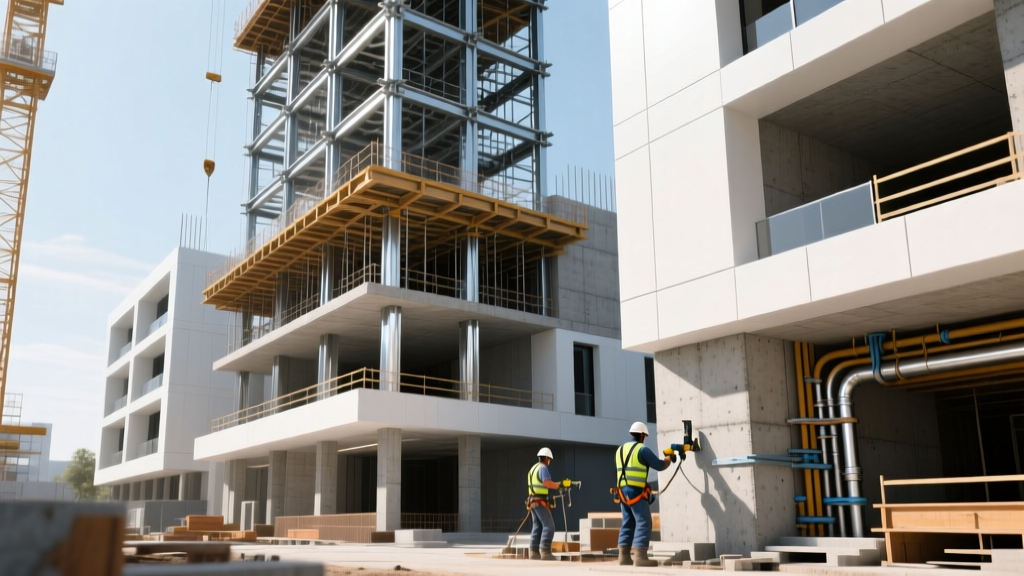
When developers and investors ask how much would it cost to build a hotel, the answer requires moving beyond simple commercial square-footage metrics. Unlike standard office or retail builds, hospitality construction is governed by the 'per-key' (per-room) paradigm, heavily influenced by brand standards, acoustic requirements, and complex MEP (Mechanical, Electrical, and Plumbing) integrations. In 2026, volatile material supply chains and elevated labor rates have shifted baseline costs upward, making granular budget forecasting essential for securing viable construction loans.
The Per-Key vs. Per-Square-Foot Paradigm
While general contractors often estimate commercial shells at $250 to $400 per square foot, hotel underwriters and franchise evaluators rely on the cost per key. A standard midscale hotel room (e.g., Holiday Inn Express) requires roughly 300 to 350 square feet of guest space, but the gross building area includes corridors, lobbies, back-of-house (BOH) operations, and mechanical shafts. The gross-to-net ratio typically ranges from 1.35 to 1.5. Therefore, a $200,000 per-key budget translates to roughly $450 to $600 per gross square foot, depending on the tier and amenity footprint.
2026 Quick Cost Snapshot (Per Key)
- Midscale / Limited Service: $165,000 – $230,000
- Upscale / Select Service: $280,000 – $420,000
- Upper Upscale / Full Service: $450,000 – $750,000
- Luxury / Boutique: $900,000 – $1,800,000+
Data synthesized from HVS Global Hospitality Services and Urban Land Institute (ULI) development tracking reports.
Hard Costs Breakdown: Where the Budget Goes
Hard costs encompass the physical construction of the asset. For a 120-key upscale select-service hotel (e.g., Hampton Inn, Fairfield by Marriott), the hard costs typically represent 65% to 75% of the total project budget. Below is a detailed allocation matrix based on 2026 national averages for an upscale prototype.
| Construction Phase | Cost Per Key (USD) | % of Hard Costs | Key Variables & Specifications |
|---|---|---|---|
| Sitework & Foundations | $18,000 - $28,000 | 8% | Soil bearing capacity, utility tap fees, retention ponds |
| Superstructure & Shell | $45,000 - $65,000 | 22% | Light-gauge steel vs. concrete podium, EIFS vs. brick veneer |
| MEP Systems | $55,000 - $85,000 | 30% | HVAC type (PTAC vs. VRF), plumbing risers, fire suppression |
| Interior Finishes | $35,000 - $50,000 | 18% | Acoustic drywall, commercial carpet/LVT, bathroom tile |
| Elevators & Vertical Transport | $8,000 - $15,000 | 5% | Traction vs. hydraulic, cab finishes, smart dispatch |
| FF&E (Furniture, Fixtures) | $22,000 - $45,000 | 12% | Casegoods, beds, lobby seating, window treatments |
| Contingency (Hard) | $12,000 - $18,000 | 5% | Unforeseen site conditions, material escalation |
Deep Dive: MEP Systems and Acoustic Engineering
The most significant cost variance between hotel tiers lies in MEP and acoustic engineering. These systems dictate guest satisfaction and are heavily scrutinized during brand quality assurance (QA) inspections.
HVAC: PTAC vs. VRF Systems
Midscale and limited-service hotels predominantly utilize PTAC (Packaged Terminal Air Conditioner) units. A commercial-grade PTAC unit costs between $900 and $1,400 installed. While cheap upfront, they generate high noise levels and incur steep long-term energy costs. Upscale and luxury properties in 2026 are almost exclusively specifying VRF (Variable Refrigerant Flow) systems or 4-pipe chiller/boiler central plants. VRF systems cost $45 to $85 per square foot but reduce energy consumption by up to 30% and operate below 35 decibels, meeting strict luxury brand standards.
Acoustic STC Ratings
Sound Transmission Class (STC) ratings measure a partition's ability to block airborne sound. Standard residential walls achieve an STC of 35. Hotel building codes mandate a minimum STC of 50 between guest rooms. Achieving STC 50 requires 5/8-inch Type X gypsum board on both sides of staggered-stud framing, filled with R-13 mineral wool insulation. Luxury brands demand STC 60+, which necessitates double-layer drywall, resilient channels, and acoustic sealant at all perimeter joints. Upgrading from STC 50 to STC 60 adds approximately $1,800 to $2,500 per partition wall, significantly impacting the overall interior finish budget.
Site Work and Foundation Variables
Before vertical construction begins, site preparation can derail a budget if geotechnical risks are ignored. According to the American Hotel & Lodging Association (AHLA), site work anomalies are a primary cause of pre-construction delays. If soil bearing capacity is insufficient for a 5-story concrete podium structure, engineers must specify deep foundations. Driving steel H-piles or installing helical piers can add $150,000 to $400,000 to the foundation budget. Furthermore, municipal utility tap fees for commercial water and sewer connections have surged in major metropolitan areas, occasionally exceeding $12,000 per key just for connection rights.
Soft Costs and Franchise Fees
Soft costs account for 15% to 25% of the total project capital. These are non-physical expenses required to execute the build.
- Architectural & Engineering (A&E) Fees: Typically 6% to 10% of hard costs. For a $30M upscale build, expect to pay $1.8M to $3M for full A&E services, including interior design and MEP engineering.
- Franchise Initial Fees: Major brands (Marriott, Hilton, IHG) charge an initial franchise fee ranging from $60,000 to $120,000, plus a per-key development fee (often $500 to $1,200 per room).
- Property Improvement Plans (PIP): If acquiring an existing flag or building on a constrained urban infill lot, brand PIP requirements may mandate specific corridor widths, elevator cab sizes, or back-of-house laundry capacities that deviate from standard prototypes, driving up architectural revision costs.
- Financing & Carry Costs: Construction loan interest rates in 2026 remain elevated. A 18-month construction period on a $40M loan at a 7.5% variable rate will accumulate roughly $4.5M in capitalized interest before the hotel even opens its doors.
Warning: The FF&E Procurement Trap
Do not conflate FF&E (Furniture, Fixtures, and Equipment) with OS&E (Operating Supplies and Equipment). FF&E includes beds, casegoods, and lobby seating. OS&E includes linens, glassware, hangers, and cleaning carts. Developers frequently budget $30,000 per key for FF&E but forget to allocate the $4,000 to $8,000 per key required for OS&E and initial pre-opening inventory, resulting in severe cash flow shortages weeks before the grand opening.
Hidden Cost Drivers and Edge Cases
Even seasoned hospitality developers encounter edge cases that inflate the final GMP (Guaranteed Maximum Price). Anticipating these specific friction points is critical for an accurate 2026 pro forma.
- Brand Standard Upgrades: Brands frequently update their prototype designs mid-development. If a brand mandates a switch from standard quartz countertops to engineered porcelain slabs during the construction document (CD) phase, the change-order premium can exceed $150,000 for a 150-key property.
- Parking Ratios and Structured Parking: Urban boutique hotels often require subterranean or podium structured parking. While surface parking costs $5,000 to $8,000 per space, structured parking costs $35,000 to $65,000 per space, drastically altering the land-use efficiency and ROI.
- Prevailing Wage Requirements: If the project utilizes municipal tax abatements, TIF (Tax Increment Financing), or is located in a jurisdiction with prevailing wage mandates, labor costs for MEP trades will increase by 20% to 35% compared to open-shop suburban builds.
Financial Modeling: Synthesizing the Capital Stack
Understanding how much would it cost to build a hotel is only half the equation; aligning those costs with a viable capital stack is the other. In 2026, senior debt lenders typically require a 35% to 40% equity injection for ground-up hospitality construction, down from the 45% required during the immediate post-pandemic volatility. However, lenders will heavily scrutinize the developer's contingency reserves. A robust financial model must include a minimum 10% hard cost contingency and a 5% soft cost contingency. By meticulously tracking per-key metrics, specifying MEP systems that align with the target ADR (Average Daily Rate), and securing fixed-price procurement contracts for FF&E early in the design phase, developers can insulate their projects from the margin compression that plagues poorly scoped hospitality builds.
Written by
Marcus ChenMarcus Chen is a licensed structural engineer (PE) and building materials analyst with over 12 years of experience across residential, commercial, and industrial construction. He holds a Master of Science in Civil Engineering from UC Berkeley and spent six years at Thornton Tomasetti before transitioning to independent consulting and technical writing. Marcus specializes in material selection for seismic-prone regions, concrete reinforcement strategies, and lifecycle cost analysis. His work has been cited by the American Concrete Institute (ACI) and the Structural Engineers Association of California (SEAOC). When he is not on a job site or at his desk, you will find him hiking the Sierra Nevada or restoring a 1920s craftsman bungalow in Oakland, CA.
More from Marcus Chen
View all
Construction Cost
How Much Did the Eiffel Tower Cost to Build?
How much did the Eiffel Tower cost to build in 1889? We adjust for inflation and compare its budget to modern skyscraper construction.
Aug 4, 2026

Fire Resistance
What Is a Fire Resistant Material? Testing & Certification Guide
Discover what is a fire resistant material through ASTM and UL testing. Learn how fire ratings, certifications, and assemblies work in construction.
Aug 4, 2026

Construction Cost
How Much Did the Burj Khalifa Cost to Build?
How much did the Burj Khalifa cost to build? We break down the $1.5B project and extract 5 money-saving strategies for your next build.
Jul 30, 2026