How Much Cost to Build a House: A Complete Financing Guide
Discover how much cost to build a house impacts your loan. Learn construction loan draw schedules, interest reserves, and appraisal gap strategies.

The Real Answer to 'How Much Cost to Build a House?'
When asking how much cost to build a house, most prospective owners focus entirely on hard costs: lumber, concrete, roofing, and labor. However, from a financing perspective, the true cost of a custom build includes soft costs, land acquisition, carrying costs, and contingency reserves. According to recent U.S. Census Bureau construction data, the median sales price of new single-family homes reflects both the structure and the lot, but custom builds operate on a completely different financial matrix than production tract housing.
For a mid-to-high-end custom home in 2026, hard construction costs typically range from $250 to $450 per square foot, depending on regional labor rates and finish levels. However, lenders require you to budget an additional 20% to 25% on top of hard costs for soft costs (architectural fees, engineering, permits, impact fees) and financial carrying costs. If your contractor bids $400,000 for the physical build, your total project cost will likely exceed $500,000 once land, permits, and loan interest reserves are factored in.
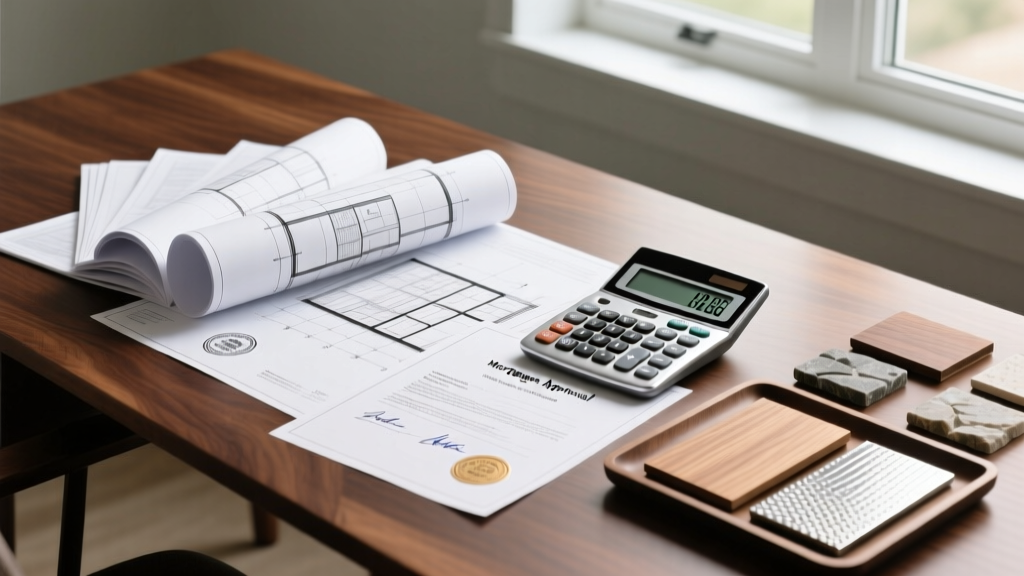
Construction Loan vs. Traditional Mortgage: The Financing Matrix
You cannot use a standard 30-year fixed mortgage to fund a house that does not yet exist. The Consumer Financial Protection Bureau (CFPB) outlines that construction loans are fundamentally different, acting as short-term, high-risk credit lines that convert to permanent mortgages or require separate refinancing. Below is a structural comparison of your primary financing vehicles.
| Feature | Construction-to-Permanent (C2P) | Stand-Alone Construction Loan | HELOC / Home Equity (Tear-Downs) |
|---|---|---|---|
| Structure | Single close; converts to 30-yr mortgage | Two closes; requires separate refinance | Draw against existing land equity |
| Closing Costs | One set of origination and title fees | Two sets of fees (adds 2-4% to total cost) | Minimal closing costs, variable rate |
| Interest Rate | Locked at initial closing for the permanent phase | Variable during build; market rate at refinance | Variable, tied to Prime Rate |
| Best For | Buyers building on vacant land wanting rate certainty | Complex builds exceeding 12-18 months | Owners tearing down an existing primary residence |
The 6-Draw Schedule: How Lenders Release Your Funds
Lenders do not disburse a $500,000 construction loan on day one. Funds are released in tranches, known as 'draws,' tied to verifiable completion milestones. A third-party inspector must verify the work before the bank releases the next payment to the general contractor. A standard 6-draw schedule for a custom build looks like this:
- Draw 1: Site Prep & Foundation (15%) - Covers clearing, grading, excavation, and pouring the foundation. Funds released after the foundation passes municipal inspection.
- Draw 2: Framing & Dried-In (25%) - The largest single draw. Covers floor joists, wall framing, roof trusses, and sheathing. The house must be 'dried-in' (windows, doors, and roof installed) to protect the interior.
- Draw 3: Rough Mechanicals (20%) - HVAC ductwork, plumbing supply/waste lines, and electrical wiring. Requires separate municipal rough-in inspections for each trade.
- Draw 4: Insulation & Drywall (15%) - Wall insulation, hanging drywall, taping, and mudding.
- Draw 5: Interior Finishes & Cabinets (15%) - Trim, doors, cabinet installation, countertops, and flooring.
- Draw 6: Final Completion & Landscaping (10%) - Appliances, final grading, driveway paving, and the issuance of the Certificate of Occupancy (CO).
Hidden Financing Costs That Derail Custom Builds
When calculating how much cost to build a house, borrowers frequently underestimate the financial carrying costs inherent to construction loans. These three line items routinely create budget shortfalls:
1. The Interest Reserve
During the 9-to-14-month construction phase, you only pay interest on the money actually drawn, not the total loan amount. However, lenders require you to escrow an 'interest reserve' upfront to ensure payments are made even if you lose your income during the build.
Calculation Example: On a $400,000 loan at an 8% interest rate, assuming an average 50% draw balance over 12 months, your total interest will be roughly $16,000. The lender will deduct this $16,000 from your total loan amount on day one, meaning you only have $384,000 left to actually build the house.
2. Origination and Inspection Fees
Construction loans carry higher origination fees than standard mortgages, typically 1.5 to 2.5 points (1.5% to 2.5% of the loan amount). Additionally, every draw request triggers a third-party inspection fee, usually $150 to $250 per visit. Over 6 to 8 draws, budget at least $1,500 for inspection administration.
3. The 10% Contingency Requirement
Most construction lenders mandate a 10% contingency reserve built into the loan. If your contractor's bid is $400,000, the lender requires the total loan to cover $440,000 in hard costs. If you do not use this contingency, it is applied to your principal balance at the end of the construction phase; if you do use it, the lender requires detailed invoices and change orders to release those specific funds.
The Appraisal Gap: The Biggest Risk in Custom Financing
The most critical failure point in custom home financing is the 'appraisal gap.' When you apply for a construction loan, the lender orders an appraisal based on your architectural plans and a 'comparable sales' (comps) analysis of recently sold homes in your area.
To mitigate this, work with an architect who designs specifically for your neighborhood's price ceiling. Overbuilding for the zip code guarantees an appraisal shortfall that the bank will not cover.
Actionable Framework: Calculating Your Maximum Build Budget
Do not start with a contractor's estimate; start with your maximum borrowing capacity. Use this reverse-engineering framework to determine your exact build budget:
- Determine Max Monthly Payment: Calculate 28% of your gross monthly income (the standard front-end Debt-to-Income ratio limit for conventional loans).
- Subtract Taxes and Insurance: Estimate annual property taxes (typically 1% to 1.5% of the projected home value) and builder's risk/homeowner's insurance. Subtract these from your max monthly payment.
- Calculate Max Permanent Loan Amount: Use a standard mortgage amortization formula with current 30-year fixed rates to find your maximum permanent loan size.
- Gross Up for LTV: Divide your max loan amount by 0.80 (assuming a 20% down payment) to find your maximum total project cost.
- Subtract Land and Soft Costs: Deduct the purchase price of your lot, architectural fees, and the interest reserve. The remaining number is your absolute maximum hard construction bid.
By securing your financing parameters before interviewing general contractors, you eliminate the risk of designing a $600,000 house when your financial profile only supports a $475,000 build. Understanding the mechanics of construction draws, interest reserves, and appraisal limitations is the only way to accurately answer how much cost to build a house without facing catastrophic mid-project budget shortfalls.
Written by
Priya KapoorPriya Kapoor is a real estate market analyst and construction economics researcher with expertise in housing affordability, development feasibility, and infrastructure investment. She holds a Master of Regional Planning from Cornell University and previously worked as a senior analyst at CBRE's Investment Properties group, where she modeled returns for $4B in mixed-use development pipelines. Priya now runs an independent research practice advising developers, municipalities, and REITs on construction cost forecasting and market timing. She publishes the quarterly "BuildMat Market Pulse" report tracking material price indices across 12 commodity categories. Based in Austin, TX, Priya serves on the board of Habitat for Humanity Austin and is a marathon runner.
More from Priya Kapoor
View all
Construction Cost
Cost to Build a 1600 Sq Ft Home in 2026: Full Breakdown
Accurate 2026 cost to build a 1600 sq ft home—material, labor, and regional pricing breakdowns included. Plan your budget with real-time estimates.
Aug 11, 2026

Wood & Lumber
Name the Types of Wood for Pressure Treatment and Preservation
Learn how to name the types of wood best suited for pressure treatment. Compare species treatability, chemical retention levels, and 2026 preservation costs.
Aug 4, 2026

Stone & Masonry
Stone Veneer Suppliers Lindenhurst: 2026 Cost Analysis
Analyze 2026 stone veneer costs in Lindenhurst, NY. Compare local supplier pricing, delivery fees, and Suffolk County installation labor rates.
Aug 4, 2026