How Much Do Materials Cost to Build a House in 2026?
Calculate exactly how much materials cost to build a house in 2026. Use our size and scope matrix for precise per-square-foot budgeting and planning.
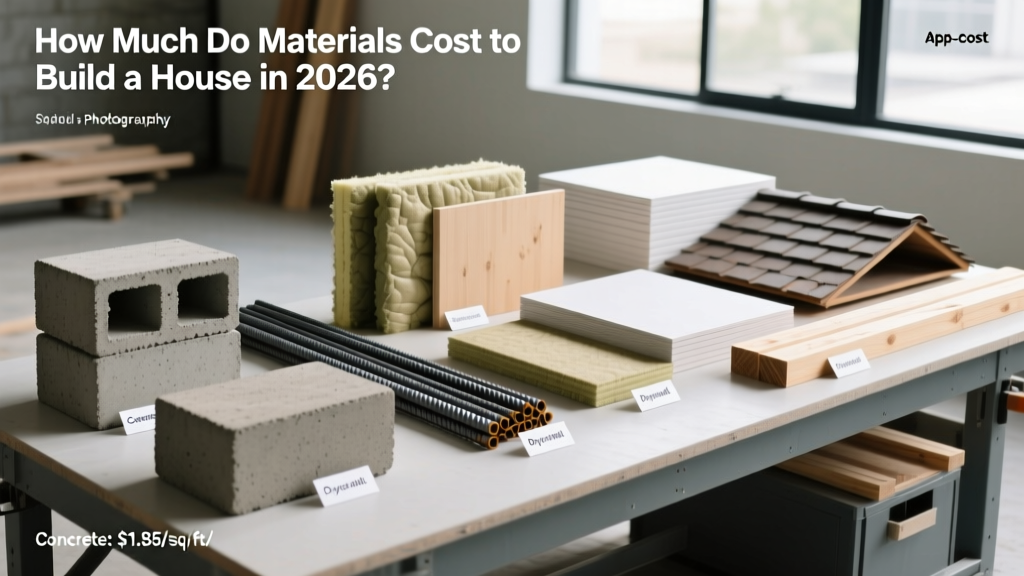
The 2026 Material Cost Baseline: What You Are Actually Paying For
When planning a custom build or a major spec development, the most critical question is always financial: how much do materials cost to build a house? In 2026, the national average for materials-only (excluding labor, land, and permits) ranges from $65 to $135 per square foot. According to the National Association of Home Builders (NAHB), materials typically account for 40% to 50% of the total construction budget, with the remainder absorbed by labor, overhead, and profit margins.
However, relying on a single national average is a fast track to budget overruns. Material costs are highly elastic, responding to the specific size of your footprint, the architectural complexity, and the finish scope you select. To build an accurate budget, you must decouple the "shell" materials from the "finish" materials and apply a size-and-scope multiplier.
Sizing Up Your Build: The Square Footage Multiplier Matrix
Economies of scale apply to residential construction, but only up to a point. While a larger home requires more lumber, drywall, and roofing, the fixed costs of materials like HVAC units, water heaters, and kitchen cabinetry do not scale linearly. Below is a baseline matrix to help you calculate the raw material costs based on your planned square footage.
| Home Size (Sq. Ft.) | Standard Scope ($/sq ft) | Premium Scope ($/sq ft) | Total Material Estimate (Standard) |
|---|---|---|---|
| 1,500 | $75 - $85 | $120 - $140 | $112,500 - $127,500 |
| 2,000 | $70 - $82 | $115 - $135 | $140,000 - $164,000 |
| 2,500 | $68 - $80 | $110 - $130 | $170,000 - $200,000 |
| 3,000+ | $65 - $78 | $105 - $125 | $195,000 - $234,000 |
Note: These figures assume a slab-on-grade or standard crawl space foundation. Walk-out basements and deep frost-wall foundations will add $15,000 to $35,000 in raw concrete and rebar materials.
Scope Modifiers: How Finish Levels Skew the Calculator
The widest variable in any material cost calculator is the "scope of finish." Two identical 2,000-square-foot floor plans can have a $70,000 discrepancy in material costs based purely on brand selection and performance ratings. Here is how specific material swaps impact your bottom line in 2026.
Exterior Cladding and Roofing
- Siding: Builder-grade vinyl siding (e.g., CertainTeed MainStreet) costs roughly $3.50 to $5.00 per square foot installed. Upgrading to fiber cement (James Hardie Artisan series) pushes material costs to $8.00 to $11.00 per square foot. For a 2,500 sq. ft. exterior envelope, this swap adds approximately $12,000 to your material ledger.
- Roofing: Standard architectural asphalt shingles (Owens Corning Duration) run about $1.20 per square foot for materials. Standing seam metal roofing (Englert 24-gauge) costs between $4.50 and $6.50 per square foot. While metal offers a 50-year lifespan, it triples your initial roofing material budget.
Mechanicals and Energy Efficiency
The Department of Energy's Building Technologies Office continues to push for stricter residential energy standards. In 2026, code-compliant HVAC systems and insulation packages are more expensive than they were five years ago.
"Builders transitioning from standard fiberglass batts (R-13) to closed-cell spray foam (R-7 per inch) for walls and rooflines should expect a 300% increase in their insulation material line item. However, this allows for the downsizing of the HVAC tonnage, which can offset the insulation cost by $3,000 to $5,000 on the equipment side."
The Hidden Scope Creep: Structural Complexity Factors
Material calculators often fail to account for the geometry of the house. A simple rectangular footprint is the most material-efficient design. Every time you add an outside corner, a dormer, or a roof valley, you increase your "waste factor" and require specialized flashing, trim, and framing hardware. A complex roofline with a 10/12 pitch requires significantly more scaffolding materials, safety gear, and specialized trusses than a simple 4/12 gable roof, easily adding 15% to your framing and roofing material costs.
Step-by-Step: Running Your Own Material Scope Calculation
To determine exactly how much materials cost to build a house for your specific project, follow this four-step framework:
- Calculate the Base Shell: Multiply your total square footage by $45 (the 2026 baseline for foundation, framing, sheathing, and basic roofing). This gives you the cost to make the structure "weathertight."
- Factor in the Envelope: Add your exterior cladding, windows, and doors. Budget $12/sq ft for standard vinyl and aluminum-clad wood windows (e.g., Pella 250 Series), or $22/sq ft for premium fiberglass and triple-pane glass (e.g., Marvin Essential).
- Estimate Interior Rough-Ins: Allocate $18 to $25 per square foot for plumbing pipes (PEX vs. Copper), electrical wire, and HVAC ductwork. Note that copper piping and rigid metal ductwork will push you to the higher end of this spectrum.
- Apply the Finish Multiplier: Finally, add your interior finishes (drywall, flooring, cabinets, trim). Standard finishes add $20/sq ft; luxury finishes (hardwood, custom millwork, quartzite counters) add $50+/sq ft.
Regional Material Variance: Where Your Dollar Stretches Further
According to U.S. Census Bureau construction data, regional supply chain dynamics heavily influence material pricing. In the Pacific Northwest, engineered lumber and structural timber remain highly competitive due to local milling. Conversely, in the Southeast, concrete and masonry materials are cheaper, but specialized roofing materials designed for high-wind hurricane zones (like impact-resistant metal panels) carry a 20% premium. Always adjust your baseline calculator by +/- 10% depending on your proximity to major manufacturing hubs and ports.
Frequently Asked Questions
Do material costs include the 10% waste factor?
No. When calculating how much materials cost to build a house, you must manually add a 10% to 15% waste factor for cut-offs and breakage. Framing lumber and drywall typically require a 10% overage, while complex tile layouts and hardwood flooring require 15% to 20%.
Are appliances considered part of the material budget?
Generally, major appliances (refrigerators, washers, dryers) are categorized as FF&E (Furniture, Fixtures, and Equipment) rather than raw building materials. However, built-in appliances like HVAC units, water heaters, and sometimes dishwashers or built-in microwaves are included in the mechanical material estimates.
How do shipping and delivery fees impact the final material cost?
LTL (Less Than Truckload) freight and flatbed delivery fees can add 4% to 8% to your total material invoice. Sourcing heavy materials like concrete, brick, and dimensional lumber from suppliers within a 50-mile radius of your job site is critical to keeping these logistical costs from destroying your budget.
Written by
Marcus ChenMarcus Chen is a licensed structural engineer (PE) and building materials analyst with over 12 years of experience across residential, commercial, and industrial construction. He holds a Master of Science in Civil Engineering from UC Berkeley and spent six years at Thornton Tomasetti before transitioning to independent consulting and technical writing. Marcus specializes in material selection for seismic-prone regions, concrete reinforcement strategies, and lifecycle cost analysis. His work has been cited by the American Concrete Institute (ACI) and the Structural Engineers Association of California (SEAOC). When he is not on a job site or at his desk, you will find him hiking the Sierra Nevada or restoring a 1920s craftsman bungalow in Oakland, CA.
More from Marcus Chen
View all
Construction Cost
How Much Did the Eiffel Tower Cost to Build?
How much did the Eiffel Tower cost to build in 1889? We adjust for inflation and compare its budget to modern skyscraper construction.
Aug 4, 2026

Fire Resistance
What Is a Fire Resistant Material? Testing & Certification Guide
Discover what is a fire resistant material through ASTM and UL testing. Learn how fire ratings, certifications, and assemblies work in construction.
Aug 4, 2026

Construction Cost
How Much Did the Burj Khalifa Cost to Build?
How much did the Burj Khalifa cost to build? We break down the $1.5B project and extract 5 money-saving strategies for your next build.
Jul 30, 2026