How Much Did Icon of the Seas Cost to Build? Complete Cost Guide
Discover exactly how much Icon of the Seas cost to build. We break down the $2 billion price tag by materials, LNG propulsion, and interior outfitting.

The Headline Figure: How Much Did Icon of the Seas Cost to Build?
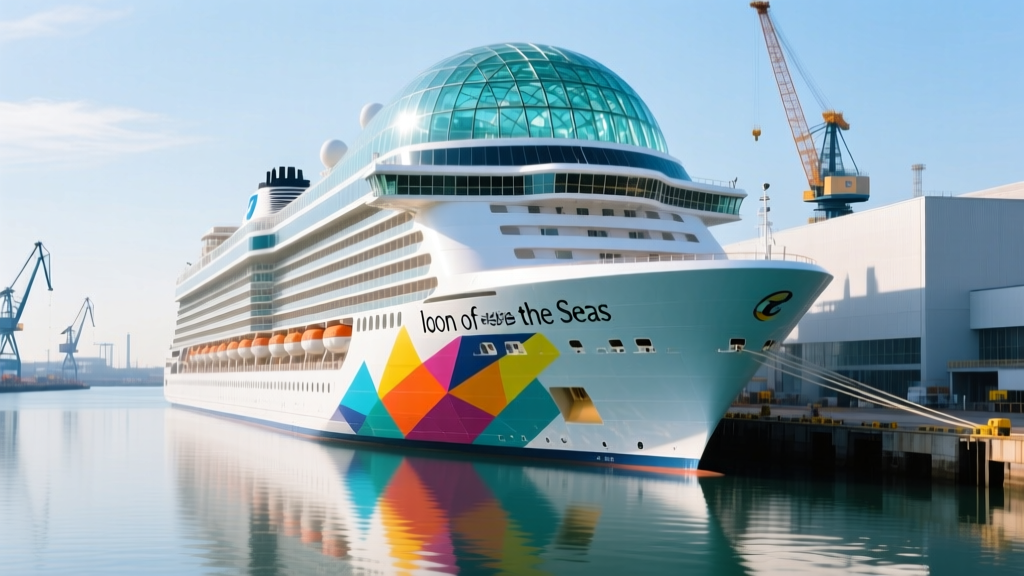
When Royal Caribbean Group commissioned the world’s largest cruise ship, the maritime construction industry watched closely. The final capital expenditure for Icon of the Seas settled at an estimated $2.0 billion to $2.2 billion USD. To put this into a construction estimating perspective, this price tag exceeds the cost of many modern commercial skyscrapers, large-scale sports stadiums, and even some mid-sized suspension bridges.
Constructed at the Meyer Turku shipyard in Finland, the vessel represents a masterclass in complex supply chain management, advanced marine engineering, and high-end architectural outfitting. For construction estimators and project managers, analyzing the cost drivers of a 250,800-gross-tonnage mega-structure provides invaluable insights into scaling material procurement and specialized labor.
Project Snapshot: Icon of the Seas
- Total Estimated Cost: $2.0B – $2.2B USD
- Shipyard: Meyer Turku, Finland
- Gross Tonnage: 250,800 GT
- Steel Cutting to Delivery: ~36 months
- Primary Power: LNG (Liquefied Natural Gas) dual-fuel engines
Deconstructing the $2 Billion Price Tag
Estimating the cost of a maritime mega-project requires moving beyond standard commercial building metrics. While a high-rise building might cost $400 to $600 per square foot, a cruise ship’s cost is calculated per gross tonnage and heavily weighted by marine-specific regulatory compliance, propulsion systems, and dynamic load-bearing requirements.
1. Raw Materials and Hull Fabrication (~25% of Total Cost)
The hull and superstructure of Icon of the Seas required approximately 35,000 to 40,000 metric tons of marine-grade steel, primarily AH36 and DH36 high-tensile steel. Unlike standard structural steel used in terrestrial construction, marine steel must withstand extreme dynamic torsion, saltwater corrosion, and sub-zero temperatures.
- Material Cost: Marine-grade steel plates typically range from $900 to $1,300 per metric ton depending on global market fluctuations.
- Fabrication & Block Assembly: The ship was constructed using modular block assembly. Over 100 massive steel blocks were prefabricated and welded together in the dry dock, requiring millions of man-hours of specialized marine welding.
- Coatings: The hull is treated with advanced silicone-based foul-release coatings (such as those from Hempel or Jotun) to reduce hydrodynamic drag. These specialized marine coatings cost upwards of $150 per liter applied.
2. LNG Propulsion and Mechanical Systems (~30% of Total Cost)
The most significant cost premium over previous Oasis-class ships was the integration of a Liquefied Natural Gas (LNG) propulsion system. Transitioning from heavy fuel oil to LNG requires complex cryogenic storage and dual-fuel engine arrays.
| System Component | Specifications | Estimated Cost Impact |
|---|---|---|
| LNG Containment Tanks | 3 x 350m³ Type C cryogenic tanks | $60M - $80M |
| Dual-Fuel Engines | Wärtsilä 14V46DF arrays (approx. 300MW total) | $120M - $150M |
| Azipod Propulsion Units | 3 x 20MW azimuthing electric pods | $45M - $60M |
| Fuel Gas Supply System (FGSS) | Regasification, heating, and pressure management | $25M - $35M |
3. Interior Outfitting and Architectural Marvels (~35% of Total Cost)
While the hull keeps the ship afloat, the interior outfitting drives the final 35% of the budget. Icon of the Seas features eight distinct "neighborhoods," requiring the logistical equivalent of building a luxury resort, a water park, and a commercial theater simultaneously inside a floating steel box.
The AquaDome, a signature architectural feature at the forward upper decks, is a masterpiece of structural glass and steel. The dome utilizes hundreds of custom-curved, marine-rated architectural glass panels. Marine glass must meet strict SOLAS (Safety of Life at Sea) fire-rating and impact-resistance standards, pushing the cost per square meter to $1,500–$2,500, significantly higher than terrestrial commercial curtain wall glass.
Estimator's Note: HVAC and plumbing in marine construction cost 3x to 4x more than commercial real estate. Every pipe, duct, and wire must be secured against 45-degree rolling and severe vibration, requiring specialized marine hangers, flexible couplings, and redundant watertight bulkhead penetrations.
4. Technology, Navigation, and Safety (~10% of Total Cost)
Modern maritime vessels are essentially floating data centers. The integration of advanced navigational radar, dynamic positioning systems, automated fire suppression (water mist and CO2 systems), and passenger-facing RFID technology accounts for roughly $200 million of the total build cost.
Comparative Cost Matrix: Icon of the Seas vs. Global Mega-Projects
To contextualize the $2 billion investment, it is helpful to compare the ship’s construction cost against other notable global mega-structures. This matrix highlights how maritime construction concentrates immense capital into a highly compact, mobile footprint.
| Project | Type | Approx. Cost (USD) | Cost per Usable Volume/Ton |
|---|---|---|---|
| Icon of the Seas | Cruise Ship (250k GT) | $2.0 Billion | ~$8,000 per Gross Ton |
| Gerald R. Ford (CVN-78) | Aircraft Carrier | $13.3 Billion | N/A (Military Spec) |
| Burj Khalifa | Skyscraper (Dubai) | $1.5 Billion | ~$12,000 per sq meter |
| SoFi Stadium | Sports Venue (LA) | $5.5 Billion | ~$1,800 per sq foot |
Financing and ROI: The Economics of a $2B Asset
Understanding how much Icon of the Seas cost to build also requires looking at how such an asset is financed. Royal Caribbean does not typically pay $2 billion out of pocket. Instead, they utilize a mix of export credit agency (ECA) financing, maritime bonds, and corporate debt. Because the ship was built in Finland, European ECAs often back the loans, providing favorable interest rates to support the local shipyard's workforce.
From a revenue perspective, Icon of the Seas carries up to 7,600 passengers at maximum capacity. With average cruise fares for this vessel ranging from $1,500 to over $5,000 per passenger per week, the ship generates massive weekly cash flow, allowing the parent company to service the debt while targeting a 5-to-7-year break-even horizon on the initial capital expenditure, according to Royal Caribbean's investor relations disclosures.
Key Takeaways for Construction Estimators
Analyzing the Icon of the Seas build cost provides several critical takeaways for professionals in terrestrial construction estimating:
- Regulatory Premiums Drive Costs: Just as seismic retrofitting drives up costs in California, SOLAS and IMO maritime regulations exponentially increase the cost of basic materials (e.g., fire-rated marine glass vs. standard commercial glass).
- Modular Construction is Mandatory: The shipyard's reliance on 100+ prefabricated mega-blocks mirrors the growing trend in modular hospital and data center construction on land. Early integration of MEP (Mechanical, Electrical, Plumbing) systems into structural blocks is the only way to meet aggressive timelines.
- The Energy Transition is Expensive: The shift to LNG propulsion added hundreds of millions to the budget. Estimators working on terrestrial projects must similarly account for the premium of integrating geothermal, hydrogen-ready boilers, or massive EV-charging infrastructure into new commercial builds.
Frequently Asked Questions
How long did it take to build Icon of the Seas?
The construction timeline spanned roughly three years. The initial steel cutting ceremony took place in June 2021, the keel was laid in 2022, and the vessel was officially delivered to Royal Caribbean in late 2023 before its maiden voyage in January 2024.
What is the most expensive single component of the ship?
While the steel hull requires massive volume, the integrated LNG propulsion and power generation system (including the dual-fuel engines, Azipods, and cryogenic fuel gas supply system) represents the highest concentrated cost, easily exceeding $250 million in combined equipment and installation labor.
How much steel was used in the construction?
Estimates place the total steel weight at approximately 35,000 to 40,000 metric tons. This includes the high-tensile hull plating, internal structural bulkheads, and the complex steel lattice supporting the upper-deck architectural features like the AquaDome and the Category 6 water park.
Written by
David NakamuraDavid Nakamura is a licensed architect (AIA) and construction technology writer focused on sustainable building methods, mass timber engineering, and high-performance building envelopes. He holds a Master of Architecture from the University of Washington and is a certified Passive House Consultant (CPHC). David spent eight years at the Seattle firm Mithun, where he led the design of three LEED Platinum projects, before founding his own practice specializing in net-zero residential design. He serves on the editorial advisory board of GreenBuilder Magazine and has authored peer-reviewed papers on cross-laminated timber (CLT) connections for the Journal of Structural Engineering. In his spare time, David teaches woodworking at Pratt Fine Arts Center and kayaks the Puget Sound.
More from David Nakamura
View all
Construction Cost
Labor Cost to Build a Deck Per Sq Ft: 2026 Installation Guide
Discover the exact labor cost to build a deck per sq ft in 2026. This installation guide breaks down contractor rates, complexity factors, and hidden fees.
Aug 4, 2026

Construction Cost
How Much Does It Cost to Build a 3 Bedroom House? Financing Guide
Learn exactly how much it costs to build a 3 bedroom house and explore 2026 financing options, construction loan types, and budget frameworks for your build.
Aug 4, 2026

Construction Cost
Cost to Build a Tennis Court: 2026 Guide
How much does it cost to build a tennis court in 2026? Breakdowns for asphalt, concrete, and synthetic surfaces plus fencing and lighting.
Jul 30, 2026