Cost to Build a House in Idaho: 2026 Size & Scope Guide
Calculate the cost to build a house in Idaho with our 2026 size and scope guide. Break down pricing by square footage, finishes, and regional site factors.
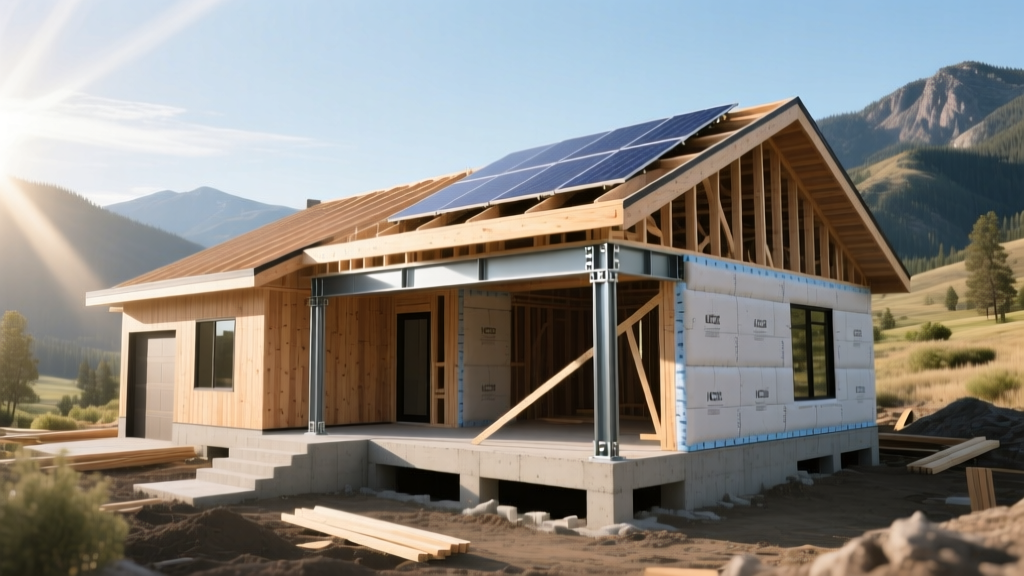
The 2026 Idaho Construction Baseline
Estimating the cost to build a house in Idaho requires moving beyond statewide averages. In 2026, Idaho’s construction market is defined by hyper-local variables: severe labor premiums in the Treasure Valley, stringent Wildland-Urban Interface (WUI) codes in the northern foothills, and challenging soil profiles that dictate foundation engineering. According to the National Association of Home Builders, site preparation and foundation costs now account for nearly 18% of total build costs in regions with complex topography, a figure that heavily impacts Idaho’s diverse landscape.
This size and scope calculator framework deconstructs your project into base footprint costs, finish multipliers, and regional site adjustments, allowing you to model your specific build with precision.
Size Calculator: Base Cost per Square Foot
Construction costs do not scale linearly. A 3,000-square-foot home does not cost exactly twice as much as a 1,500-square-foot home. High-cost zones (kitchens, primary bathrooms, mechanical rooms, and garage foundations) remain relatively fixed regardless of the overall footprint, while low-cost zones (bedrooms, hallways, and living areas) dilute the average cost per square foot as the home grows.
| Home Size (Sq Ft) | Base Cost Range (Builder-Grade) | Average Cost Per Sq Ft | Economies of Scale Factor |
|---|---|---|---|
| 1,200 - 1,500 | $235,000 - $315,000 | $190 - $210 | 1.0x (Baseline) |
| 1,600 - 2,000 | $295,000 - $400,000 | $175 - $200 | 0.92x |
| 2,100 - 2,500 | $360,000 - $485,000 | $165 - $194 | 0.86x |
| 2,600 - 3,500 | $440,000 - $630,000 | $155 - $180 | 0.81x |
| 3,600+ | $600,000+ | $150 - $175 | 0.76x |
Note: Base costs assume a standard slab-on-grade foundation, asphalt shingle roofing, vinyl/LVP flooring, and builder-grade cabinetry. They exclude land acquisition and site development.
Scope Multipliers: Finishes and Complexity
Once your base footprint cost is established, apply a scope multiplier based on your architectural complexity and interior finish level. Roof pitch, exterior articulation (bump-outs, dormers), and material selections drastically alter the final ledger.
The Finish Tier Matrix
- Tier 1: Builder Standard (Multiplier: 1.0x)
Materials: LVP flooring, laminate countertops, fiberglass shower inserts, standard vinyl windows, LP SmartSide or vinyl siding. HVAC: Standard 90% AFUE gas furnace and 14 SEER AC. - Tier 2: Semi-Custom (Multiplier: 1.25x - 1.40x)
Materials: Engineered hardwood or large-format porcelain tile, quartz countertops, tiled shower pans with frameless glass, fiberglass or wood-clad windows, James Hardie fiber cement siding. HVAC: 96% AFUE furnace, 16 SEER AC, and mandatory ERV/HRV for tight building envelopes. - Tier 3: Full Custom / Luxury (Multiplier: 1.60x - 2.20x+)
Materials: Site-finished solid hardwood, natural stone or high-end Dekton surfaces, custom frameless cabinetry, Marvin or Andersen architectural windows, standing seam metal roofing, and integrated smart-home infrastructure. HVAC: Geothermal or multi-zone ductless mini-splits with zoned ERV.
Regional Site Variables (The Idaho Factor)
Idaho’s geography demands specific engineering solutions. Failing to account for these regional variables is the primary cause of budget overruns in the state.
If you are building in Meridian, Kuna, or South Boise, you are likely building on vertisols (expansive clay). Standard shallow footings will crack as the soil swells and shrinks with moisture changes. Engineers typically mandate post-tensioned slab foundations or drilled concrete piers extending 15 to 25 feet into stable bedrock. Expect to add $12,000 to $22,000 to your foundation budget compared to standard soil profiles.
Frost Line and Foundation Depths
The required depth of your footings is dictated by the local frost line, which varies wildly across the state. Deeper footings require more excavation, more concrete, and heavier rebar schedules.
- Treasure Valley (Boise, Nampa, Caldwell): Frost line is typically 24" to 30". Standard foundation costs apply.
- Northern Idaho (Coeur d’Alene, Sandpoint): Frost line reaches 48" to 60". Footings must be poured below this depth, increasing concrete volume and excavation time by up to 40%.
- Eastern Idaho (Idaho Falls, Rexburg): Frost line can exceed 60" in high-elevation zones. Full basements are often more cost-effective here than deep crawlspace foundations, as the excavation depth is already required for frost protection.
Wildland-Urban Interface (WUI) Mandates
Building in the Boise Foothills, Kootenai County timber zones, or McCall requires strict adherence to WUI codes to mitigate wildfire risk. The University of Idaho Extension notes that WUI compliance is critical for both safety and insurance underwriting in these zones. Mandatory upgrades include:
- Class A fire-rated roofing (concrete tile, slate, or standing seam metal).
- 1/8" non-combustible mesh over all soffit and crawlspace vents to block wind-blown embers.
- Non-combustible exterior siding (stucco, brick, or fiber cement) extending to the ground.
- 5-foot non-combustible hardscape perimeter around the structure.
Cost Impact: WUI compliance typically adds $8,500 to $14,000 to a 2,500-square-foot build.
Step-by-Step Calculation Walkthrough
Let’s model a specific scenario to demonstrate the calculator in action.
Project Profile: 2,400 sq ft single-story home in Meridian, ID. Semi-custom finishes. Expansive soil profile.
- Base Size Cost: 2,400 sq ft falls into the 2,100-2,500 tier. Using the mid-point average of $179/sq ft = $429,600.
- Apply Scope Multiplier: Semi-custom finishes carry a 1.30x multiplier. $429,600 x 1.30 = $558,480.
- Add Regional Adjustments:
- Post-tension slab engineering for expansive clay: +$16,000
- Upgraded 96% HVAC and ERV system: +$4,500
- Permitting and utility hookups (Ada County 2026 rates): +$11,500
- Total Estimated Construction Cost: $590,480 (Excluding land and landscaping).
This yields an all-in construction cost of roughly $246 per square foot, a realistic figure for a mid-tier custom build in the Treasure Valley in 2026.
Edge Cases and Hidden Cost Traps
When finalizing your budget, audit your site plan for these common Idaho-specific hidden costs:
- Foothills Rock Blasting: If your lot is in the Boise or Coeur d’Alene foothills, hitting basalt or granite during excavation for footings or basements is highly probable. Rock blasting or mechanical hammering can add $15,000 to $35,000 to site prep.
- Well and Septic vs. City Sewer: Rural builds in Canyon or Owyhee counties require perc tests and septic installations. An engineered mound septic system (required if the water table is high or soil percolation is poor) costs between $18,000 and $28,000, compared to a standard gravity system at $8,000 to $12,000.
- Snow Load Engineering: Northern and Eastern Idaho jurisdictions require roof trusses engineered for heavy snow loads (often 50 to 70 PSF). Upgrading from standard 30 PSF trusses to 70 PSF trusses adds $3,500 to $6,000 to the framing package.
- Impact Fees: Check local municipal impact fees. Cities like Nampa and Caldwell have aggressively raised water and sewer connection fees to fund infrastructure for rapid population growth, sometimes adding $8,000+ per single-family lot.
For exact local code requirements and impact fee schedules, always consult your local jurisdiction, such as the City of Boise Building Codes Department or your specific county planning office, before finalizing your pro forma.
Written by
Priya KapoorPriya Kapoor is a real estate market analyst and construction economics researcher with expertise in housing affordability, development feasibility, and infrastructure investment. She holds a Master of Regional Planning from Cornell University and previously worked as a senior analyst at CBRE's Investment Properties group, where she modeled returns for $4B in mixed-use development pipelines. Priya now runs an independent research practice advising developers, municipalities, and REITs on construction cost forecasting and market timing. She publishes the quarterly "BuildMat Market Pulse" report tracking material price indices across 12 commodity categories. Based in Austin, TX, Priya serves on the board of Habitat for Humanity Austin and is a marathon runner.
More from Priya Kapoor
View all
Construction Cost
Cost to Build a 1600 Sq Ft Home in 2026: Full Breakdown
Accurate 2026 cost to build a 1600 sq ft home—material, labor, and regional pricing breakdowns included. Plan your budget with real-time estimates.
Aug 11, 2026

Wood & Lumber
Name the Types of Wood for Pressure Treatment and Preservation
Learn how to name the types of wood best suited for pressure treatment. Compare species treatability, chemical retention levels, and 2026 preservation costs.
Aug 4, 2026

Stone & Masonry
Stone Veneer Suppliers Lindenhurst: 2026 Cost Analysis
Analyze 2026 stone veneer costs in Lindenhurst, NY. Compare local supplier pricing, delivery fees, and Suffolk County installation labor rates.
Aug 4, 2026