How Much Did the TRON Ride Cost to Build? Complete Cost Breakdown
Discover how much the TRON ride cost to build. We break down the $150M+ construction expenses, canopy structures, track systems, and infrastructure.

The True Cost of TRON Lightcycle / Run
When commercial estimators and theme park enthusiasts ask how much the TRON ride cost to build, the answer requires looking far beyond the steel track and ride vehicles. The TRON Lightcycle / Run at Walt Disney World’s Magic Kingdom is a masterclass in complex, multi-disciplinary construction. Industry analyses and capital expenditure reports estimate the total cost of the Florida installation at $150 million to $200 million. This figure encompasses the ride system, the iconic digital canopy, the enclosed show building, and the massive site infrastructure overhauls required to integrate a modern mega-coaster into a 50-year-old theme park.
Estimated Total CapEx: $150,000,000 – $200,000,000
Cost Per Foot of Track: ~$47,000 – $63,000 (excluding canopy)
Primary Ride Manufacturer: Vekoma (LSM Launch Coaster)
Canopy Footprint: ~120,000+ square feet of tensile membrane
Capital Expenditure Breakdown: Where the $150 Million Went
Building a flagship amusement ride is not just about purchasing a coaster; it is about constructing a highly specialized commercial facility. The budget for TRON was allocated across several highly specialized construction and engineering disciplines. Below is an estimated capital expenditure matrix based on modern commercial theme park construction metrics.
| Construction Phase | Estimated Cost | Key Cost Drivers |
|---|---|---|
| Site Prep & Deep Foundations | $25M – $30M | Karst topography, high water table, utility rerouting |
| Parametric Steel Canopy & Membrane | $45M – $55M | Custom gridshell, ETFE/PTFE foil, wind-load engineering |
| Track & Ride System (Vekoma) | $40M – $45M | LSM launch track, custom motorcycle restraints, control systems |
| Show Building & Queue Architecture | $25M – $30M | Climate-controlled interiors, themed facades, concrete work |
| Theming, AV, & Lighting Integration | $15M – $20M | Programmable LED arrays, show action equipment, audio zones |
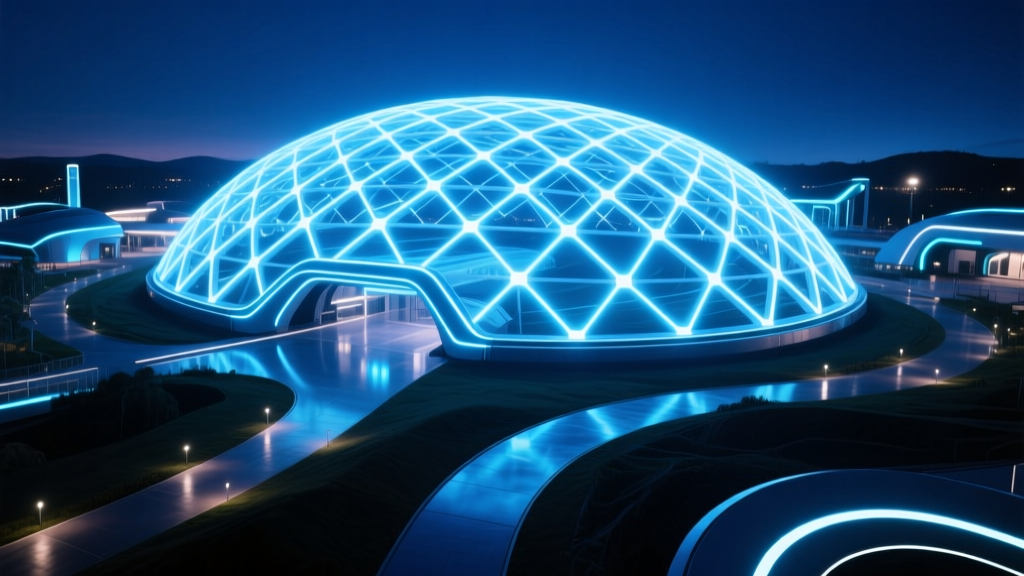
The Canopy: A Structural Engineering Marvel
The most visually striking and financially significant component of the Florida installation is the "Digital Canopy." Unlike traditional roller coaster queues or simple shade structures, this canopy is a massive, free-form parametric gridshell. It serves as both an architectural landmark and a functional weather shield for the ride vehicles and track.
Material Costs and Fabrication
The canopy relies on a complex network of curved steel box sections covered by a tensile membrane. To achieve the translucent, glowing effect required by the intellectual property, engineers utilized ETFE (Ethylene Tetrafluoroethylene) and PTFE (Polytetrafluoroethylene) foil cushions. In the 2026 commercial construction market, standard ETFE cushion systems cost between $85 and $140 per square foot. However, the 3D-curved, non-repeating geometric panels required for TRON push fabricated and installed costs well over $220 per square foot.
Wind Load and Code Compliance
Central Florida is highly susceptible to severe weather. Under the ASTM F2291 Standard Practice for Design of Amusement Rides and Devices, as well as the stringent Florida Building Code (FBC), open-air tensile structures must be engineered to withstand extreme wind uplift and hurricane-force lateral loads. The canopy acts as a massive sail. To prevent catastrophic failure, the structural steel columns are anchored to massive concrete pile caps, and the connection nodes feature heavily reinforced moment connections capable of handling dynamic torsional stress during severe squalls.
Ride System and Vehicle Engineering
The physical roller coaster was manufactured by Vekoma Rides Manufacturing, a premier Dutch coaster builder. The Florida iteration features 3,169 feet of track and utilizes a Linear Synchronous Motor (LSM) launch system. LSM technology requires immense electrical infrastructure, including heavy-duty capacitors, water-cooling systems for the stator packs, and specialized substations to handle the massive instantaneous power draw during the launch sequence.
The ride vehicles themselves represent a significant engineering expense. Unlike traditional over-the-shoulder restraint coasters, TRON utilizes a motorcycle-style riding position. This requires a highly complex pneumatic clamping system that secures the rider's back and calves. Designing a restraint system that accommodates a wide variance in human anthropometry while maintaining strict safety clearances requires millions of dollars in R&D, physical crash testing, and sensor integration before a single vehicle rolls off the assembly line.
Infrastructure and Site Preparation Costs
One of the most frequently overlooked expenses in mega-coaster construction is site preparation. The Magic Kingdom was built in the late 1960s on reclaimed swampland characterized by a high water table and unpredictable karst topography (limestone riddled with sinkholes and voids).
- Deep Foundation Systems: Standard shallow spread footings are insufficient for the dynamic loads of a launching coaster and a massive steel canopy. Contractors had to drive precast concrete piles and use augercast piles deep into the bedrock or the dense Hawthorn Group formation to ensure zero differential settlement.
- Utility Rerouting: The construction site was located near the heart of the park's existing backstage infrastructure. Millions were spent relocating high-voltage electrical lines, chilled water mains, and fiber-optic networks before vertical construction could even begin.
- Monorail and PeopleMover Integration: The ride's footprint intersected with the paths of the WEDway PeopleMover and the Walt Disney World Monorail. Structural engineers had to design custom clearance envelopes and reinforce existing monorail beams to ensure the new coaster structure did not compromise the legacy transit systems.
Shanghai vs. Florida: A Tale of Two TRONs
To truly understand the cost of the Florida build, it is valuable to compare it to its predecessor: TRON Lightcycle Power Run at Shanghai Disneyland, which opened in 2016. While the ride systems are nearly identical, the construction costs and structural requirements diverged significantly.
| Feature | Shanghai Disneyland (2016) | Magic Kingdom, Florida (2023) |
|---|---|---|
| Estimated Ride Cost | ~$100M - $120M | ~$150M - $200M |
| Canopy Material | Standard PTFE / Fiberglass | Advanced ETFE Foil Cushions |
| Site Constraints | Greenfield site (new park build) | Brownfield (retrofitting active park) |
| Inflation & Supply Chain | Pre-pandemic material costs | Post-2020 steel and labor premiums |
The Florida project suffered from the inflationary pressures of the early 2020s. Structural steel prices, specialized electrical components for the LSM launch, and skilled labor shortages drove the final capital expenditure significantly higher than the Shanghai original. Furthermore, retrofitting a new attraction into an operating, crowded theme park requires expensive phased construction, night-shift labor premiums, and complex logistical staging that greenfield projects simply do not face.
What This Means for Commercial Entertainment Construction
For commercial builders, structural engineers, and cost estimators, the TRON project provides several critical takeaways regarding modern entertainment construction:
Estimator's Note: When pricing parametric architectural structures, never use standard commercial roofing metrics. The engineering hours required to model non-repeating 3D steel nodes and custom-cut tensile membranes often exceed the physical material costs. Always allocate a minimum 25% contingency for custom fabrication overruns.
Furthermore, the integration of high-draw electrical systems (like LSM launches) requires early coordination with local utility providers. Upgrading substations and running dedicated high-voltage feeds can add millions to a project's budget if not identified during the initial feasibility and site-survey phases.
FAQ: TRON Construction Insights
How long did it take to build the TRON ride in Florida?
From initial site clearing and foundation work to the final testing and commissioning, the physical construction process took approximately four to five years, heavily delayed by global supply chain disruptions and pandemic-related construction halts.
What type of foundation is used for roller coasters in swamps?
In Central Florida, engineers typically rely on deep-driven precast concrete piles or continuous flight auger (CFA) piles that bypass the unstable surface soils and bear directly on the deep limestone bedrock, ensuring the track remains perfectly level despite the dynamic forces of the trains.
Is the canopy structurally attached to the roller coaster track?
No. Best practice in amusement ride engineering dictates that the ride track support structure and the architectural canopy must be entirely independent. This prevents the wind loads and vibrations of the canopy from transferring into the track, which could alter the ride's dynamic profile and cause premature wear on the train wheels.
Written by
David NakamuraDavid Nakamura is a licensed architect (AIA) and construction technology writer focused on sustainable building methods, mass timber engineering, and high-performance building envelopes. He holds a Master of Architecture from the University of Washington and is a certified Passive House Consultant (CPHC). David spent eight years at the Seattle firm Mithun, where he led the design of three LEED Platinum projects, before founding his own practice specializing in net-zero residential design. He serves on the editorial advisory board of GreenBuilder Magazine and has authored peer-reviewed papers on cross-laminated timber (CLT) connections for the Journal of Structural Engineering. In his spare time, David teaches woodworking at Pratt Fine Arts Center and kayaks the Puget Sound.
More from David Nakamura
View all
Construction Cost
Labor Cost to Build a Deck Per Sq Ft: 2026 Installation Guide
Discover the exact labor cost to build a deck per sq ft in 2026. This installation guide breaks down contractor rates, complexity factors, and hidden fees.
Aug 4, 2026

Construction Cost
How Much Does It Cost to Build a 3 Bedroom House? Financing Guide
Learn exactly how much it costs to build a 3 bedroom house and explore 2026 financing options, construction loan types, and budget frameworks for your build.
Aug 4, 2026

Construction Cost
Cost to Build a Tennis Court: 2026 Guide
How much does it cost to build a tennis court in 2026? Breakdowns for asphalt, concrete, and synthetic surfaces plus fencing and lighting.
Jul 30, 2026