How Much Does It Cost to Build a Pool in 2026? Detailed Breakdown
Discover exactly how much it costs to build a pool in 2026. Detailed breakdown of gunite, fiberglass, excavation, and decking expenses.

The 2026 National Average & Cost Tiers
Calculating the exact price of an inground swimming pool requires moving past generic national averages. While the baseline national average to build a standard inground pool sits at $73,500 in 2026, actual project costs routinely range from $48,000 for a basic vinyl-liner kit installation to over $160,000 for custom architectural gunite designs. The final invoice is dictated by shell material, soil composition, mechanical efficiency upgrades, and hardscape integration.
Entry-Level (Vinyl/Fiberglass Kits): $48,000 – $65,000
Mid-Range (Standard Gunite/Fiberglass): $70,000 – $110,000
High-End (Custom Architectural/Infinity): $125,000 – $250,000+
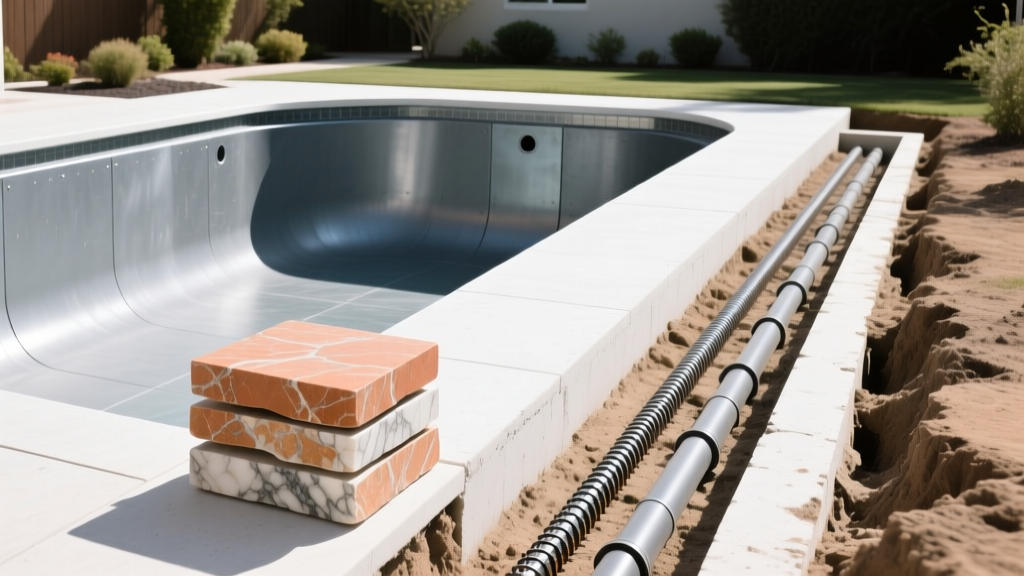
Material Matrix: Gunite vs. Fiberglass vs. Vinyl
The pool shell accounts for 45% to 60% of the total construction budget. Each material presents distinct structural lifespans, installation timelines, and long-term maintenance profiles.
| Feature | Gunite (Concrete) | Fiberglass | Vinyl Liner |
|---|---|---|---|
| Base Cost (16x32 ft) | $85,000 – $120,000 | $65,000 – $95,000 | $48,000 – $70,000 |
| Installation Time | 60 – 90 Days | 30 – 45 Days | 30 – 50 Days |
| Structural Lifespan | 50+ Years | 25 – 30 Years | Frame: 25+ / Liner: 7-10 |
| 10-Year Maintenance | $3,500 (Acid washes, replastering prep) | $1,200 (Gelcoat polishing) | $5,500 (Liner replacement) |
| Design Flexibility | Unlimited (Custom shapes, depths) | Limited to manufacturer molds | Moderate (Standard geometries) |
Excavation & Site Prep: The Hidden Variables
Earthwork is where pool budgets frequently experience their first major overrun. Contractors typically quote excavation based on 'normal soil' assumptions. When heavy machinery encounters unexpected subsurface conditions, change orders are issued immediately.
- Expansive Clay & Heavy Rock: Excavating in dense clay requires wider over-digging to prevent wall collapse before the shell is shot. Hitting bedrock or large boulders necessitates hydraulic hammer attachments on excavators, adding $2,500 to $6,000 to the site prep budget.
- High Water Table & Dewatering: If the excavation fills with groundwater, contractors must deploy well-point dewatering systems. Running diesel trash pumps continuously during the steel and plumbing phases can add $1,800 to $3,500 in equipment and fuel surcharges.
- Spoil Haul-Away: A standard 16x32 pool generates roughly 60 cubic yards of dirt. If the site lacks space for backfilling, trucking and dump fees will cost between $1,200 and $2,800 depending on local landfill tipping fees.
Mechanical & Plumbing Upgrades That Drive Costs
The equipment pad dictates your monthly utility bills and water chemistry stability. Upgrading from builder-grade single-speed pumps to modern smart systems requires higher upfront capital but yields rapid operational ROI.
Filtration & Circulation
Department of Energy (DOE) regulations mandate the use of variable-speed pumps for new residential pool construction. The Pentair IntelliFlo3 VSF is the current industry benchmark, costing approximately $1,600 to $2,100 fully installed. Unlike single-speed pumps that draw 2,000 watts continuously, variable-speed models operate at 300-500 watts for daily filtration, reducing electrical consumption by up to 80%.
Sanitation Systems
Traditional liquid chlorine injection is being replaced by Saltwater Chlorine Generators (SWCG). A Hayward AquaRite system for a 20,000-gallon pool costs $1,400 to $1,800 installed. While SWCGs require a $600 cell replacement every 4-5 years, they eliminate the recurring $80-$120 monthly cost of purchasing and transporting liquid chlorine.
Heating Infrastructure
Extending the swim season requires dedicated heating. Gas heaters (e.g., Hayward Universal H-Series) cost around $3,500 installed and heat water rapidly, but natural gas or propane costs can exceed $400 per month in colder climates. Electric heat pumps (e.g., Pentair UltraTemp) cost $4,500 to $5,500 installed; they heat slower but operate at a fraction of the monthly cost by extracting ambient heat from the air.
Hardscaping & Decking Cost Per Square Foot
The pool coping (the capstone bordering the waterline) and the surrounding deck drastically alter the visual weight and total cost of the project. Budgeting for hardscaping requires calculating both material and specialized labor rates.
| Decking Material | Installed Cost (Per Sq. Ft.) | Durability & Heat Retention |
|---|---|---|
| Broom-Finished Concrete | $12 – $16 | High durability; high heat retention in direct sun |
| Stamped Concrete | $18 – $26 | Requires resealing every 2 years; moderate heat |
| Travertine Pavers | $32 – $45 | Excellent; naturally porous and stays cool to the touch |
| Porcelain Pavers | $40 – $55 | Impervious to freeze-thaw; low heat retention |
Never install decking without securing the coping first. Bullnose precast concrete coping costs $18 to $25 per linear foot, while natural stone coping (like bluestone or limestone) ranges from $35 to $60 per linear foot. The coping acts as the structural bridge between the pool bond beam and the deck; failing to properly mortar and seal this joint leads to catastrophic water intrusion behind the pool shell.
Permitting, Zoning, and Safety Barriers
Municipal permitting is a non-negotiable line item. Expect to pay $400 to $1,200 in local building and electrical permits. More importantly, your design must comply with the Pool & Hot Tub Alliance (PHTA) guidelines and local adaptations of the International Swimming Pool and Spa Code (ISPSC).
This includes strict adherence to ASTM F2286 standards for barrier heights, gate latching mechanisms, and anti-entrapment drain covers (Virginia Graeme Baker Act compliance). If your property features steep slopes or retaining walls, engineering stamps for the pool's structural integrity may add $1,500 to $3,000 to the soft costs.
Long-Term ROI and Property Value Impact
Building a pool is primarily a lifestyle investment rather than a pure financial one. According to the National Association of Realtors (NAR) Remodeling Impact Report, an inground pool typically recovers about 50% to 60% of its construction cost upon resale, depending on the regional climate and neighborhood demographics. In Sunbelt markets like Texas, Florida, and Arizona, the ROI can approach 70%, whereas in northern climates with short swim seasons, the financial recoup drops significantly. However, the 'joy score' and immediate utility value reported by homeowners remain exceptionally high.
Step-by-Step Budgeting Framework for Homeowners
To prevent budget shock, allocate your total capital using this proven percentage breakdown based on 2026 industry data from Angi's construction cost database:
- Shell & Excavation (45%): The physical hole, steel reinforcement, plumbing rough-in, and concrete/vinyl/fiberglass structure.
- Equipment & Electrical (15%): Pumps, heaters, sanitation, control panels, and trenching power from the main house panel.
- Decking & Coping (20%): The hardscape perimeter and primary lounging areas.
- Water Features & Lighting (10%): Sheer descents, bubbler fountains, LED niche lights, and fiber optics.
- Landscaping Restoration (5%): Grading, sod replacement, and irrigation repair disrupted by heavy machinery.
- Contingency Fund (5%): Reserved strictly for subsurface surprises, rock removal, or municipal inspection revisions.
By securing detailed, line-item bids from at least three licensed contractors and cross-referencing their equipment specifications and decking allowances, you can accurately forecast the true cost of your backyard aquatic project.
Written by
Priya KapoorPriya Kapoor is a real estate market analyst and construction economics researcher with expertise in housing affordability, development feasibility, and infrastructure investment. She holds a Master of Regional Planning from Cornell University and previously worked as a senior analyst at CBRE's Investment Properties group, where she modeled returns for $4B in mixed-use development pipelines. Priya now runs an independent research practice advising developers, municipalities, and REITs on construction cost forecasting and market timing. She publishes the quarterly "BuildMat Market Pulse" report tracking material price indices across 12 commodity categories. Based in Austin, TX, Priya serves on the board of Habitat for Humanity Austin and is a marathon runner.
More from Priya Kapoor
View all
Construction Cost
Cost to Build a 1600 Sq Ft Home in 2026: Full Breakdown
Accurate 2026 cost to build a 1600 sq ft home—material, labor, and regional pricing breakdowns included. Plan your budget with real-time estimates.
Aug 11, 2026

Wood & Lumber
Name the Types of Wood for Pressure Treatment and Preservation
Learn how to name the types of wood best suited for pressure treatment. Compare species treatability, chemical retention levels, and 2026 preservation costs.
Aug 4, 2026

Stone & Masonry
Stone Veneer Suppliers Lindenhurst: 2026 Cost Analysis
Analyze 2026 stone veneer costs in Lindenhurst, NY. Compare local supplier pricing, delivery fees, and Suffolk County installation labor rates.
Aug 4, 2026