Estimating the Modern Cost to Build Panama Canal Today
Discover the 2026 estimated cost to build Panama Canal from scratch, breaking down earthwork, concrete, lock mechanics, and mega-project risk premiums.

The Ultimate Mega-Project: Recalculating the Canal
When the original Panama Canal opened in 1914, the final price tag was roughly $375 million—an astronomical sum that equates to about $11.5 billion today when adjusted for basic inflation. However, basic inflation fails to capture the realities of modern construction, environmental compliance, and advanced engineering. If a global consortium were to commission the exact same transit corridor from scratch in 2026, the cost to build Panama Canal would be dictated by modern unit rates, Neo-Panamax dimensional requirements, and stringent ecological offsets.
Using a bottom-up Size & Scope Calculator methodology, we can model the material volumes, labor rates, and heavy equipment depreciation required to carve a 50-mile interoceanic waterway through the Continental Divide. This analysis relies on real-world baseline data from the 2016 Third Set of Locks expansion and current 2026 heavy civil construction indices.
Phase 1: Earthwork and the Gaillard Cut Excavation
The most grueling physical component of the canal is the Gaillard Cut (formerly the Culebra Cut), an 8-mile trench carved through the continental divide. The original excavation moved roughly 100 million cubic yards of material, but continuous widening and the 2016 expansion pushed the total historical volume well over 200 million cubic yards.
Modern Excavation Unit Costs
To replicate this scope today, estimators must account for the specific geology of the Chagres Formation, which includes highly abrasive volcanic rock, shale, and sandstone prone to landslides when saturated. Modern heavy civil excavation relies on 120-ton articulated haul trucks and 15-cubic-yard hydraulic excavators, supported by precision GPS-guided blasting.
- Hard Rock Excavation (Blast and Load): $35 to $48 per cubic yard (CY) in 2026, factoring in explosive permits, vibration monitoring, and fuel surcharges.
- Soft Material & Dredging: $18 to $24 per CY, utilizing modern cutter-suction dredgers for the Atlantic and Pacific approach channels.
- Landslide Mitigation & Slope Stabilization: Over $1.2 billion in soil nailing, rock bolting, and deep-well dewatering systems to prevent the historic mudslides that plagued the original French and American efforts.
Phase 2: Marine-Grade Concrete and Lock Chambers
The canal operates via a system of locks that lift ships 85 feet above sea level to Gatun Lake. The 2016 expansion introduced the Neo-Panamax locks (Agua Clara and Cocoli), which serve as our most accurate modern proxy for lock construction costs. These chambers are massive: 1,400 feet long, 180 feet wide, and 60 feet deep.
Mass Concrete Thermal Management
Pouring the estimated 5.5 million cubic yards of reinforced concrete required for a dual-lane, three-step lock system on both oceans presents a severe thermal cracking risk. In 2026, marine-grade concrete mixes (minimum 5,000 psi compressive strength with high slag cement for sulfate resistance) cost between $1,400 and $1,750 per CY installed.
However, the raw material cost is only half the battle. To prevent thermal fracturing during mass pours, modern specifications mandate:
- Chilled Water and Ice Slurry: Replacing mixing water with flaked ice to lower the initial pour temperature to below 50°F (10°C).
- Embedded Cooling Pipes: Circulating chilled water through a network of 1-inch HDPE pipes embedded within the concrete walls for up to 30 days post-pour.
- Continuous Thermal Monitoring: Fiber-optic temperature sensors cast directly into the structural elements to monitor the heat of hydration in real-time.
Factoring in formwork, rebar (epoxy-coated and stainless steel in splash zones), and thermal management, the installed cost for the lock chambers and approach walls reaches approximately $9.6 billion.
Phase 3: Lock Gates and Water Saving Basins
The original canal uses miter gates, but the modern standard for locks of this magnitude relies on massive rolling gates. Each Neo-Panamax rolling gate weighs up to 3,500 tons, measures 190 feet long, and floats in its chamber for maintenance. Manufacturing, transporting via heavy-lift vessel, and installing 16 of these custom-fabricated steel gates costs roughly $75 million per gate, totaling $1.2 billion.
Water Saving Basins (WSB)
Modern environmental regulations would never permit the unmitigated discharge of 52 million gallons of fresh water per transit. A 2026 build would mandate Water Saving Basins—three lateral reservoirs connected to each lock chamber that capture and reuse 60% of the water required per transit. Constructing these reinforced concrete basins, alongside the massive 20-foot-diameter culvert valves and SCADA-controlled hydraulic actuators, adds $1.8 billion to the mechanical and civil scope.
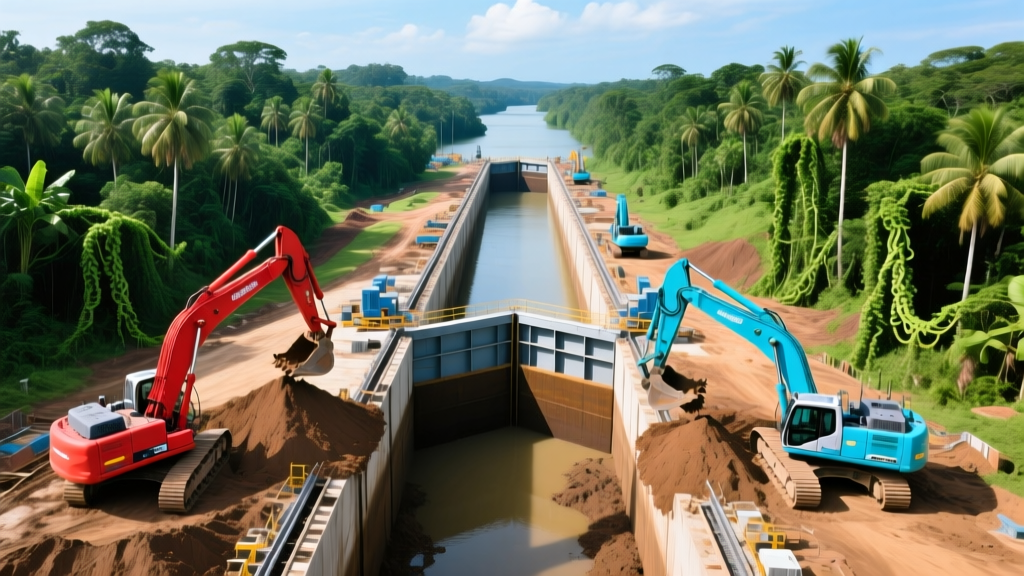
Comprehensive Cost Breakdown Matrix
The following table synthesizes the direct construction costs based on 2026 heavy civil engineering indices, referencing data from the Autoridad del Canal de Panamá (ACP) expansion benchmarks and current global material rates.
| Project Scope Category | Volume / Quantity | Estimated 2026 Cost (USD) |
|---|---|---|
| Excavation & Earthwork | 260,000,000 CY | $8,320,000,000 |
| Concrete & Reinforcement | 5,500,000 CY | $9,625,000,000 |
| Rolling Gates & Valves | 16 Gates / 64 Valves | $1,850,000,000 |
| Dams (Gatun & Madden) | 3 Earthen/Rockfill Dams | $3,400,000,000 |
| Water Saving Basins & SCADA | 18 Basins / Control Systems | $1,800,000,000 |
| Environmental & Social Offsets | Reforestation / Relocation | $2,500,000,000 |
| Total Direct Base Costs | $27,495,000,000 |
The Mega-Project Risk Premium
No estimate for a project of this magnitude is complete without applying Reference Class Forecasting. According to research on mega-project economics by the Oxford Saïd Business School, infrastructure projects exceeding $1 billion routinely suffer from optimism bias, scope creep, and geological surprises.
"Mega-projects are inherently risky. The iron law of mega-projects dictates that they are over budget, over time, over and over again. A robust estimator must apply a risk premium based on the specific geological and geopolitical realities of the site."
For an interoceanic canal situated in a high-rainfall, seismically active tropical zone, historical data suggests a minimum contingency and risk premium of 45% to 60% over the direct base costs. This accounts for:
- Geotechnical Unknowns: Unforeseen fault lines or subterranean aquifers encountered during deep lock chamber excavation.
- Supply Chain Volatility: Global shortages in Portland cement, structural steel, and specialized marine dredging fleets.
- Schedule Delays: The impact of extreme weather events (e.g., El Niño-driven torrential seasons) on critical-path earthworks.
Applying the Contingency Multiplier
Applying a conservative 50% risk and contingency multiplier to our $27.49 billion direct cost base yields an additional $13.74 billion. Furthermore, financing costs (interest during a projected 12-year construction period) at a 6% blended sovereign/corporate rate add roughly $6.5 billion in capitalized interest.
Final Verdict: The 2026 Price Tag
When aggregating the direct civil, mechanical, and environmental costs with the necessary mega-project risk premiums and financing charges, the total estimated cost to build Panama Canal from scratch in 2026 lands between $46.5 billion and $52.0 billion.
This figure underscores why the 2016 expansion—which 'only' cost $5.4 billion by leveraging the existing canal footprint, Gatun Lake, and the original Culebra Cut—was a masterclass in value engineering. Building an entirely new interoceanic transit corridor today is not merely a construction project; it is a macroeconomic undertaking that rivals the GDP of mid-sized nations, demanding the absolute limits of modern heavy civil engineering.
Summary of Estimating Methodology
This calculation utilizes a bottom-up parametric model based on 2026 RSMeans heavy civil data, adjusted for Panamanian tropical logistics factors (1.15x multiplier for labor and equipment degradation). For further reading on the historical engineering marvels that established the original baseline, refer to the American Society of Civil Engineers (ASCE) historic landmark archives.
Written by
James ThorntonJames Thornton is a construction industry veteran with 25 years of hands-on experience in wood framing, lumber grading, and residential building codes. He started as a framing carpenter in rural Oregon, earned his ICC Residential Building Inspector certification, and eventually became a senior plan reviewer for the City of Portland Bureau of Development Services. James holds a B.S. in Wood Science & Technology from Oregon State University and is a certified lumber grader through the West Coast Lumber Inspection Bureau (WCLIB). He has inspected over 3,000 residential construction sites and authored the city's internal guide on advanced framing techniques (2x6 at 24" O.C.). James lives in Bend, OR, where he builds custom timber-frame cabins and competes in lumberjack sports.
More from James Thornton
View all
Insulation
Best Home Insulation Materials: Complete 2026 Guide
Compare top home insulation materials for 2026. Find R-values, installed costs per square foot, and best uses for fiberglass, spray foam, and mineral wool.
Aug 4, 2026

Sustainable Building
Certify Your Green Building Material for LEED and WELL
Step-by-step guide to certifying a green building material for LEED v5 and WELL v2. Master EPDs, HPDs, and VOC limits for 2026 project specifications.
Aug 4, 2026

Stone & Masonry
Veneer Stacked Stone Panels: Interior Design & Style Showcase
Discover how veneer stacked stone panels transform interiors. Explore modern design profiles, material pairings, and technical installation specs.
Aug 4, 2026