How Much Does a Wind Farm Cost to Build? 2026 Breakdown
Discover how much a wind farm costs to build in 2026. Detailed breakdown of utility-scale turbine, land, grid, and soft costs per megawatt.

The Baseline: Average Cost Per Megawatt in 2026
When evaluating how much a wind farm costs to build, developers must look beyond the sticker price of the turbines. In 2026, the total capital expenditure (CapEx) for a utility-scale onshore wind farm ranges from $1.3 million to $1.85 million per megawatt (MW) of installed capacity. For a standard 100 MW project—typically comprising 15 to 20 modern 5 MW to 7 MW turbines—total upfront costs sit between $130 million and $185 million.
According to data from the National Renewable Energy Laboratory (NREL) Annual Technology Baseline, while turbine manufacturing efficiencies have improved, rising costs in raw materials (steel, copper, and rare earth magnets) and complex grid interconnection requirements have kept overall project costs relatively flat compared to the early 2020s. Below is a detailed, component-level breakdown of where that capital is deployed.
Turbine Procurement and Hard Costs
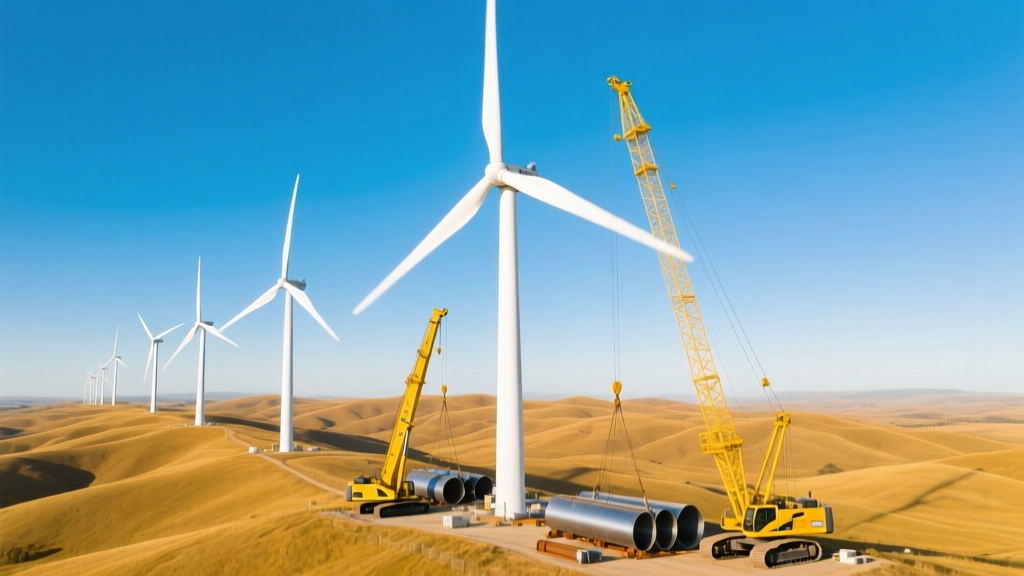
The wind turbine generator (WTG) itself represents the single largest line item, accounting for roughly 65% to 70% of total project CapEx. Modern utility-scale onshore turbines, such as the GE Vernova 5.5-158 or Vestas V172-7.2 MW EnVentus, feature hub heights exceeding 120 meters and rotor diameters over 160 meters.
WTG Component Cost Breakdown (Per 5.5 MW Turbine)
| Component | Estimated Cost (2026) | Key Material Drivers |
|---|---|---|
| Nacelle & Drivetrain | $2,100,000 - $2,400,000 | Neodymium magnets, forged steel |
| Blades (Set of 3) | $850,000 - $1,100,000 | Carbon fiber, epoxy resins, balsa |
| Tower Sections (4-5) | $700,000 - $950,000 | High-strength structural steel |
| Transport & Logistics | $150,000 - $250,000 | Fuel, specialized trailers, escorts |
Balance of Plant (BOP) and Civil Engineering
The Balance of Plant encompasses all civil and structural work required to physically support the turbines and allow construction access. BOP typically consumes 15% to 20% of the total budget.
Foundations and Crane Pads
A 5.5 MW turbine generates immense overturning moments. Standard gravity spread foundations require massive volumes of material. Expect to pour 600 to 800 cubic yards of 5,000 PSI concrete and install 80 to 110 tons of Grade 60 epoxy-coated rebar per foundation. At current material and labor rates, a single foundation costs between $400,000 and $550,000.
Additionally, the main assembly crane pad must be engineered to support ground bearing pressures of up to 3,500 psf to accommodate 1,000-ton crawler cranes like the Liebherr LR 11300. Soil stabilization using geogrids or lime-treated subgrades is frequently required, adding $40,000 to $75,000 per pad.
Access Roads
Heavy-haul access roads must be built to a minimum width of 20 feet with a 12-inch compacted aggregate base. Construction costs average $120 to $180 per linear foot, heavily dependent on topography and the need for culverts or temporary bridges over waterways.
Electrical Infrastructure and Grid Interconnection
Generating power is only half the battle; moving it to the grid is where many projects face severe budget overruns. Electrical costs account for 10% to 15% of CapEx.
- Collection System: Turbines are daisy-chained using a 34.5 kV underground medium-voltage cable network. Directional boring and trenching cost approximately $45 to $75 per foot.
- Project Substation: A step-up substation (e.g., 34.5 kV to 138 kV or 345 kV) including power transformers, switchgear, and SCADA integration ranges from $6 million to $14 million depending on MVA capacity.
- Transmission Line Tie-In: Building the high-voltage spur line to the nearest point of interconnection (POI) can cost $150,000 to $300,000 per mile.
Soft Costs: Permitting, Land, and Financing
Soft costs make up the remaining 5% to 10% of the budget but dictate the project's timeline. These include:
- Land Leases: Developers typically pay landowners $5,000 to $10,000 per turbine annually, plus a percentage of gross revenue (usually 2% to 4%). Upfront option payments and easement acquisitions require significant early capital.
- Environmental & Avian Studies: Pre-construction wildlife monitoring, including the installation of X-band avian radar systems and acoustic bat detectors, costs $200,000 to $400,000 over a 2-year study period.
- Financing & Legal: Tax equity structuring, Power Purchase Agreement (PPA) negotiations, and construction loan interest reserves typically add 4% to 7% to the total project cost.
Onshore vs. Offshore Wind Farm Cost Matrix
While onshore wind remains the most cost-effective renewable resource, offshore wind is scaling rapidly despite higher CapEx. The Lazard Levelized Cost of Energy Analysis highlights the stark contrast in capital intensity between the two environments.
| Metric | Utility Onshore Wind | Fixed-Bottom Offshore Wind |
|---|---|---|
| CapEx per MW (2026) | $1.3M - $1.85M | $3.8M - $5.5M |
| Turbine Capacity | 4 MW - 7 MW | 12 MW - 18 MW |
| Foundation Type | Concrete Gravity Spread | Steel Monopile / Jacket |
| Grid Connection | Overhead / Underground HVAC | Subsea HVDC Export Cables |
| Capacity Factor | 35% - 45% | 45% - 60% |
Strategic Takeaways for Developers
Understanding how much a wind farm costs to build requires a granular approach to site-specific variables. To protect margins in the 2026 market, developers must prioritize early geotechnical investigations to accurately price foundation engineering and secure crane pad bearing capacities. Furthermore, engaging with the local ISO regarding interconnection queue network upgrades during the site-selection phase—rather than after land acquisition—is the single most effective strategy to prevent catastrophic CapEx overruns. By locking in turbine supply agreements (TSAs) 24 to 36 months ahead of the Notice to Proceed (NTP), developers can hedge against raw material volatility and secure favorable logistics routing.
Written by
Sarah WhitfieldSarah Whitfield is a chartered quantity surveyor (MRICS) and construction cost analyst with 15 years of experience in material pricing, procurement strategy, and project budgeting. She earned her degree in Construction Management from the University of Reading (UK) and has worked on projects ranging from $2M custom homes to $180M mixed-use developments across North America and Europe. Sarah currently leads cost estimating for BuildMat Insight, maintaining a proprietary database of 4,000+ material price points updated quarterly. She is a frequent contributor to RSMeans cost data panels and has presented at the International Cost Engineering Council (ICEC) congress. Based in Denver, CO, Sarah is an avid trail runner and volunteer mentor for Women in Construction.
More from Sarah Whitfield
View all
Wood & Lumber
What Are the Different Types of Wood? A Builder's Guide
Compare structural softwoods, finish hardwoods, and engineered lumber. Analyze Janka ratings, MOE values, and 2026 pricing for construction.
Aug 4, 2026

Walls & Panels
Steel Framing vs Wood Framing: Corrosion and Moisture Defense
Compare steel framing vs wood framing for moisture resistance. Learn about galvanized coatings, condensation risks, and corrosion protection strategies.
Jul 21, 2026

Stone & Masonry
How to Cut Stone Veneer: Wet Saw vs Grinder Comparison
Compare the best tools for cutting stone veneer. We review wet saws, angle grinders, and chop saws to help you achieve clean, chip-free cuts.
Jul 21, 2026