How Much Did Obama's Basketball Court Cost to Build? Full Breakdown
Discover how much did Obama's basketball court cost to build and explore the 2026 pricing guide for constructing a luxury residential basketball court.

The Presidential Precedent: White House vs. Private Estate
When homeowners research luxury outdoor amenities, a common question arises: how much did obama's basketball court cost to build? To answer this accurately, we must separate the White House grounds from the former President's private residential projects. The famous White House basketball court was not actually built from scratch by Barack Obama. In 2006, the George W. Bush administration spent approximately $10,000 to $15,000 to paint basketball lines over the existing White House tennis court. Obama, an avid player, utilized this multi-use court extensively, later adding portable, professional-grade stanchions and modular flooring for specific events, which added roughly $20,000 in temporary equipment costs.
However, the true "Obama basketball court" cost refers to the private sports complex at his Martha's Vineyard estate, purchased in 2019. While the exact line-item cost for the court remains private, the overall estate renovation and sports pavilion construction exceeded $3 million. For private citizens looking to replicate a presidential-grade, high-performance backyard basketball court in 2026, the budget requires a deep understanding of civil engineering, material science, and professional sports surfacing.
Historical Cost Snapshot
- White House Tennis-to-Basketball Line Conversion (2006): ~$12,000
- Premium Portable Stanchions & Modular Tiles (White House): ~$25,000
- Martha's Vineyard Private Estate Sports Pavilion: Part of a $3M+ renovation
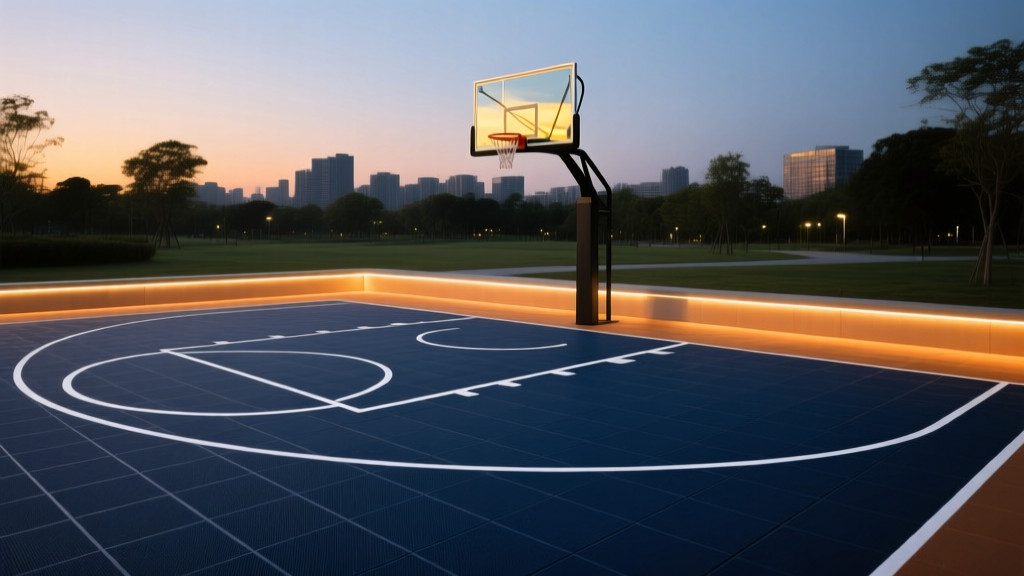
2026 Cost Breakdown: Building a High-End Residential Court
Constructing a luxury, full-sized residential basketball court (approximately 4,700 square feet, matching NBA dimensions of 50' x 94') in 2026 requires a significant capital investment. Unlike standard driveway hoops, an executive-grade court demands post-tensioned concrete, advanced drainage, and professional surfacing. According to current industry data from HomeGuide's 2026 outdoor construction metrics, high-end custom courts range from $65,000 to $115,000 depending on site conditions.
| Project Phase | Material & Labor Details | Estimated Cost (Full Court) |
|---|---|---|
| Site Prep & Excavation | Clearing, grading, and 1% slope engineering for drainage | $8,000 - $14,000 |
| Post-Tensioned Concrete | 6-inch PT slab with compacted aggregate base | $22,000 - $35,000 |
| Modular Sport Surface | Polypropylene copolymer interlocking tiles (e.g., Sport Court) | $14,000 - $21,000 |
| Pro Hoop Systems (x2) | In-ground, 72-inch tempered glass backboards with breakaway rims | $7,000 - $12,000 |
| Lighting & Fencing | LED perimeter poles (Musco-style) and 10ft chain-link with windscreen | $12,000 - $22,000 |
| Total Estimated Cost | Turnkey Executive Full-Size Court | $63,000 - $104,000 |
Surface Materials: Modular Tiles vs. Poured Acrylic
The surface you choose dictates the biomechanical feedback of the court, the maintenance schedule, and the ultimate lifespan of the investment. The White House Historical Association notes that the executive grounds prioritize multi-use functionality and rapid drainage, which heavily influences material selection for high-profile estates.
1. Polypropylene Modular Tiles (The Executive Standard)
Brands like Sport Court and SnapSports utilize suspended polypropylene copolymer tiles. These tiles feature a grid substructure that allows water to pass directly through, eliminating puddling. More importantly, they are engineered to meet ASTM F2772 standards for shock absorption, reducing lateral torque on players' knees and ankles. In 2026, premium modular tiles cost between $3.00 and $4.50 per square foot installed. They require zero annual resurfacing and can be pressure-washed, making them the premier choice for private estates.
2. Post-Tensioned Concrete with Acrylic Coating
If you prefer the aesthetic and feel of a traditional outdoor court, an acrylic coating system (like Plexipave) applied directly over concrete is the alternative. However, standard rebar-reinforced concrete will inevitably develop control joints and hairline cracks due to frost heave and soil settling, which ruins the ball bounce. Luxury estates exclusively use post-tensioned (PT) concrete. PT slabs use high-strength steel cables tensioned after the concrete cures, compressing the slab and allowing it to span up to 60 feet without control joints. This creates a perfectly smooth, monolithic surface. Acrylic resurfacing must be reapplied every 5 to 7 years at a cost of $4,500 to $8,000.
Never allow a contractor to pour a perfectly flat concrete slab. A luxury outdoor court must be engineered with a 1% slope (a 1-inch drop over every 8 feet) to ensure water runoff. Without this, hydrostatic pressure will build up beneath modular tiles or cause acrylic coatings to delaminate and blister within a single freeze-thaw cycle.
Hidden Costs and Site Preparation Pitfalls
Where do residential basketball court budgets fail? The errors rarely occur in the hoop selection; they occur in the dirt. When evaluating your property, anticipate the following hidden costs:
- Tree Root Mitigation ($2,500 - $6,000): If building near mature trees, roots will destroy a standard slab. You must install a deep root barrier (typically 36-inch high-density polyethylene) along the perimeter of the court.
- Electrical Trenching ($3,000 - $5,500): Running dedicated 220V lines for professional LED court lighting and smart-home integration from your main panel to the court site.
- Acoustic Baffling ($4,000 - $8,000): The sound of a basketball echoing off a glass backboard can reach 85 decibels. High-end estates often install acoustic dampening fencing or plant dense everwind barriers to mitigate noise complaints and comply with local municipal noise ordinances.
- Permitting and HOA Variances ($1,500 - $4,000): Many zoning boards classify lighted sports courts as commercial-grade structures due to light pollution. Budget for photometric plans to prove your LED fixtures have zero spill-over into neighboring properties.
Executive Installation Timeline
Building a presidential-grade court is not a weekend project. It requires heavy civil engineering. Expect the following timeline from breaking ground to the first tip-off:
- Weeks 1-2: Surveying and Excavation. Land clearing, soil testing, and grading the sub-base to the precise 1% slope.
- Weeks 3-4: Forming and PT Cable Layout. Setting the forms, laying the gravel base, and positioning the post-tensioning cables and rebar grid.
- Week 5: The Pour and Tensioning. Pouring the concrete. Within 7 days, the hydraulic jacks tension the steel cables, and the grout is pumped into the cable sleeves.
- Weeks 6-7: Curing and Hoop Setting. The concrete must cure for 28 days to reach full PSI strength, but the core-drilling and epoxy-setting of the in-ground hoop sleeves happen around day 14.
- Week 8: Surface Installation. Snapping the modular tiles together, cutting the perimeter edges, and painting custom logos or key-area graphics.
Frequently Asked Questions
Does a luxury basketball court increase property value?
Yes, but with caveats. A high-end, professionally engineered court appeals to a niche luxury buyer demographic. Appraisers typically recoup 40% to 60% of the construction cost in added home value, provided the court is integrated into the landscape design rather than dominating the primary sightlines of the backyard.
Can I build a court on a sloped lot?
Yes, but it requires a retaining wall system. Building a level 4,700 sq. ft. pad on a sloped lot requires cutting into the hill and installing engineered concrete retaining walls, which can add $15,000 to $30,000 to the site preparation budget.
What is the best lighting for nighttime play?
Avoid traditional metal halide fixtures. In 2026, the standard is dedicated LED sports lighting (such as Musco or Qualite) mounted on 20-foot poles. A 4-pole LED system provides uniform 30-foot-candle illumination, eliminating the harsh shadows and "strobe" effect of older lighting, while consuming 60% less electricity.
Written by
Priya KapoorPriya Kapoor is a real estate market analyst and construction economics researcher with expertise in housing affordability, development feasibility, and infrastructure investment. She holds a Master of Regional Planning from Cornell University and previously worked as a senior analyst at CBRE's Investment Properties group, where she modeled returns for $4B in mixed-use development pipelines. Priya now runs an independent research practice advising developers, municipalities, and REITs on construction cost forecasting and market timing. She publishes the quarterly "BuildMat Market Pulse" report tracking material price indices across 12 commodity categories. Based in Austin, TX, Priya serves on the board of Habitat for Humanity Austin and is a marathon runner.
More from Priya Kapoor
View all
Construction Cost
Cost to Build a 1600 Sq Ft Home in 2026: Full Breakdown
Accurate 2026 cost to build a 1600 sq ft home—material, labor, and regional pricing breakdowns included. Plan your budget with real-time estimates.
Aug 11, 2026

Wood & Lumber
Name the Types of Wood for Pressure Treatment and Preservation
Learn how to name the types of wood best suited for pressure treatment. Compare species treatability, chemical retention levels, and 2026 preservation costs.
Aug 4, 2026

Stone & Masonry
Stone Veneer Suppliers Lindenhurst: 2026 Cost Analysis
Analyze 2026 stone veneer costs in Lindenhurst, NY. Compare local supplier pricing, delivery fees, and Suffolk County installation labor rates.
Aug 4, 2026