Financing the Cost to Build an Indoor Tennis Court
Discover how to finance the cost to build an indoor tennis court. Compare residential equity loans, commercial SBA options, and 2026 construction budgets.

The average indoor tennis court construction cost ranges from $120,000 to $250,000 per court for an air-supported structure, and $400,000 to $850,000 per court for a rigid steel building. This guide is designed for tennis club owners, municipal recreation directors, and private sports investors evaluating capital expenditures for indoor facilities in 2026. Securing accurate estimates and viable financing is the primary hurdle for these stakeholders. We break down material costs, structural options, and actionable financing strategies to help you budget accurately.
Key Takeaways
- Air-supported structures (bubbles): $120,000 to $250,000 per court.
- Rigid steel buildings: $400,000 to $850,000 per court.
- Court dimensions: Minimum 120 feet by 60 feet per standard United States Tennis Association guidelines.
- Primary financing routes: Small Business Administration loans, municipal bonds, and public-private partnerships.
Average Indoor Tennis Court Construction Costs
The total indoor tennis court construction cost depends heavily on the enclosure type. An air-supported structure, commonly known as a tennis bubble, utilizes pressurized air to support a fabric membrane. These structures cost between $120,000 and $250,000 per court.
Rigid steel or pre-engineered metal buildings offer permanent, climate-controlled environments. The construction cost for these permanent structures ranges from $400,000 to $850,000 per court. Permanent buildings require deeper foundations and more extensive mechanical systems.
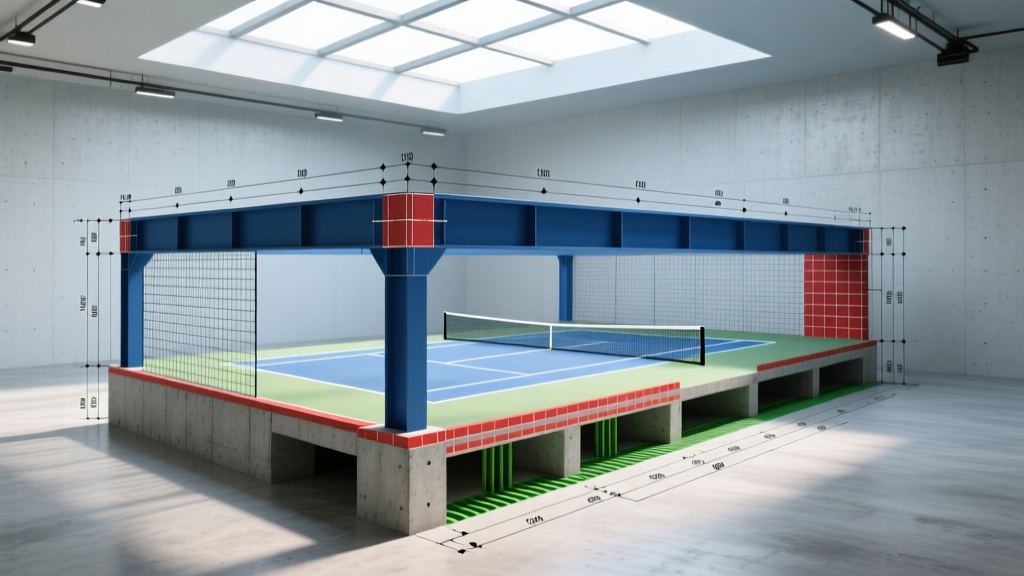
Rigid Steel Buildings vs. Air-Supported Structures
An air-supported structure is a lightweight, pressurized fabric dome used to cover outdoor sports courts during winter months. It relies on continuous air pressure from mechanical blowers to maintain its shape and structural integrity against snow and wind.
Rigid buildings utilize structural steel frames and insulated metal panels. They support heavy HVAC loads and withstand extreme snow loads without continuous air pressure. According to the United States Tennis Association facility guidelines, permanent structures provide superior acoustic control and lighting consistency.
Hidden Expenses and Site Preparation
Base construction quotes rarely include critical site work. Earthwork, grading, and utility trenching typically add $40,000 to $90,000 per court to the final budget. Poor soil conditions may require deep pier foundations, increasing concrete costs by 15% to 20%.
Indoor lighting and climate control represent significant secondary expenses. The International Tennis Federation recommends a minimum illumination of 500 lux for recreational play and 1000 lux for competitive tournaments. Installing high-efficiency LED lighting systems costs approximately $15,000 to $25,000 per court.
Heating, ventilation, and air conditioning systems for rigid buildings add $80,000 to $150,000 per court. Air-supported structures typically rely on direct-fired gas make-up air units, which are cheaper to install but cost more to operate during peak winter months.
Financing Options for Indoor Tennis Facilities
Funding an indoor tennis facility requires matching the capital structure to the entity type. Private club owners generally rely on commercial debt, while municipalities utilize tax-exempt bonds. Understanding these pathways accelerates the groundbreaking process.
Commercial Loans and Small Business Administration Financing
Private investors and club operators frequently use Small Business Administration 7(a) loans to finance construction. These loans offer up to $5,000,000 with extended repayment terms of up to 25 years for real estate acquisitions and construction.
Conventional commercial construction loans require a 20% to 30% down payment and transition into a permanent mortgage upon project completion. Lenders evaluate the debt-service coverage ratio, requiring a minimum ratio of 1.25x based on projected court rental revenues and membership dues.
Municipal Bonds and Public-Private Partnerships
A public-private partnership is a cooperative arrangement between a government agency and a private-sector company to finance, build, and operate public recreation facilities. The municipality typically provides the land, while the private partner funds construction in exchange for operational rights.
Municipalities can issue tax-exempt general obligation bonds to fund public indoor courts. These bonds leverage the local government's taxing power, resulting in interest rates that are typically 1.5% to 2.5% lower than conventional commercial debt.
Cost Breakdown and Decision Matrix
Use the following decision matrix to align your structural choice with your budget and operational goals. This framework clarifies the trade-offs between initial capital expenditure and long-term operational costs.
| Feature | Air-Supported Structure (Bubble) | Rigid Steel Building |
|---|---|---|
| Initial Cost per Court | $120,000 - $250,000 | $400,000 - $850,000 |
| Construction Timeline | 3 to 5 months | 9 to 14 months |
| Lifespan | 15 to 20 years (membrane) | 50+ years (structure) |
| Winter Heating Cost | High (continuous air heating) | Moderate (insulated envelope) |
| Best Use Case | Seasonal coverage, tight budgets | Year-round premium clubs, tournaments |
Frequently Asked Questions
How much does an indoor tennis bubble cost?
An indoor tennis bubble costs between $120,000 and $250,000 per court. This estimate includes the fabric membrane, mechanical blowers, anchoring system, and basic lighting, but excludes site preparation and concrete slab pouring.
What is the cheapest way to build an indoor tennis court?
The cheapest method is installing an air-supported structure over an existing outdoor hard court. This avoids the massive expense of new foundation work and structural steel, reducing the total project cost by up to 60% compared to a rigid building.
How do you finance a sports facility?
You can finance a sports facility through Small Business Administration loans, commercial construction loans, municipal bonds, or private equity syndication. The optimal choice depends on whether the facility is privately owned or publicly operated.
Conclusion and Next Steps
Calculating the precise indoor tennis court construction cost requires evaluating your structural preference, site conditions, and mechanical requirements. Air-supported structures offer rapid deployment and lower upfront costs, while rigid buildings provide permanent, climate-controlled environments for premium programming.
Your immediate next step is to commission a geotechnical soil survey for your target site. This $3,000 to $5,000 investment will definitively establish your foundation requirements, allowing general contractors to provide binding, fixed-price construction bids.
Written by
David NakamuraDavid Nakamura is a licensed architect (AIA) and construction technology writer focused on sustainable building methods, mass timber engineering, and high-performance building envelopes. He holds a Master of Architecture from the University of Washington and is a certified Passive House Consultant (CPHC). David spent eight years at the Seattle firm Mithun, where he led the design of three LEED Platinum projects, before founding his own practice specializing in net-zero residential design. He serves on the editorial advisory board of GreenBuilder Magazine and has authored peer-reviewed papers on cross-laminated timber (CLT) connections for the Journal of Structural Engineering. In his spare time, David teaches woodworking at Pratt Fine Arts Center and kayaks the Puget Sound.
More from David Nakamura
View all
Construction Cost
Labor Cost to Build a Deck Per Sq Ft: 2026 Installation Guide
Discover the exact labor cost to build a deck per sq ft in 2026. This installation guide breaks down contractor rates, complexity factors, and hidden fees.
Aug 4, 2026

Construction Cost
How Much Does It Cost to Build a 3 Bedroom House? Financing Guide
Learn exactly how much it costs to build a 3 bedroom house and explore 2026 financing options, construction loan types, and budget frameworks for your build.
Aug 4, 2026

Construction Cost
Cost to Build a Tennis Court: 2026 Guide
How much does it cost to build a tennis court in 2026? Breakdowns for asphalt, concrete, and synthetic surfaces plus fencing and lighting.
Jul 30, 2026