How Much Would It Cost to Build a Pickleball Court? 2026 Guide
Discover how much it would cost to build a pickleball court in 2026. Breakdown of concrete, asphalt, fencing, and lighting expenses for budget planning.

Executive Budget Summary
For a standard 30x60 foot outdoor recreational pickleball court, expect to pay between $28,000 and $45,000 for a basic asphalt build, and $55,000 to $85,000+ for a post-tensioned concrete build with premium cushioned acrylics and LED lighting. Indoor conversions or complex grading scenarios can push costs well past $100,000.
The Quick Answer: Average Cost Ranges
When determining how much would it cost to build a pickleball court, the final price tag depends entirely on your base material, site conditions, and finish tier. The sport's explosive growth has stabilized supply chains for specialized netting and acrylics, but concrete and labor rates remain elevated in 2026. Below is the baseline pricing for a single, outdoor 30x60 foot court (1,800 square feet of playing surface plus mandatory runoff areas).
- Basic Residential (Asphalt Base): $28,000 – $42,000
- Mid-Tier HOA/Club (Concrete Base): $45,000 – $65,000
- Premium Tournament (Post-Tensioned Concrete + LED): $70,000 – $110,000+
These figures assume a relatively flat, clear site. If your property requires extensive clearing, retaining walls, or complex drainage engineering, site preparation alone can add $10,000 to $25,000 to the initial budget.
Site Preparation and Base Material Costs
The most critical decision in your budget plan is the sub-base. According to facility guidelines published by USA Pickleball, the playing surface must be perfectly level, with a slope of no more than 1 inch in 10 feet to ensure proper water runoff without affecting ball bounce.
Asphalt vs. Concrete: A Cost and Longevity Matrix
| Feature | Asphalt Base | Standard Concrete | Post-Tensioned Concrete |
|---|---|---|---|
| Material & Install Cost | $4.50 – $7.00 / sq ft | $8.00 – $12.00 / sq ft | $13.00 – $18.00 / sq ft |
| Total Base Cost (1,800 sq ft) | $8,100 – $12,600 | $14,400 – $21,600 | $23,400 – $32,400 |
| Lifespan Before Cracking | 5 – 10 Years | 15 – 20 Years | 30+ Years |
| Surface Prep Required | Acid etch & crack fill | Shot-blasting / Acid etch | Shot-blasting / Acid etch |
Expert Insight: Avoid standard rebar-reinforced concrete if your soil has high clay content or poor drainage. Standard concrete will inevitably develop structural cracks that telegraph through the acrylic surface, ruining the playability. Post-tensioned concrete uses high-strength steel cables tensioned after the pour, compressing the slab and virtually eliminating structural cracking. For commercial or multi-court facilities, post-tensioning is non-negotiable.
Acrylic Surfacing and Coating Systems
Raw concrete or asphalt is unplayable; it lacks the necessary friction coefficient and shock absorption. You must apply a specialized multi-layer acrylic coating system. Industry standards like SportMaster or Plexipave are engineered specifically for paddle sports.
- Non-Cushioned System (5-7 Coats): $2.50 – $4.00 per sq ft. Includes resurfacer, color coats, and textured finish lines. Total: $4,500 – $7,200.
- Cushioned System (10-14 Coats): $5.00 – $8.50 per sq ft. Incorporates multiple layers of rubber granules suspended in acrylic for shock absorption, reducing player fatigue and joint stress. Total: $9,000 – $15,300.
The textured finish is critical. The contractor must mix specific volumes of 60-mesh to 80-mesh silica sand into the color coats to achieve the proper PPA (Pickleball Professionals Association) approved surface speed. Too much sand, and the court plays slow and eats up balls; too little, and the court becomes a slipping hazard when damp.
Fencing, Netting, and Perimeter Security
Pickleballs are lightweight and travel at high speeds, making robust containment mandatory. Budget for a 10-foot high perimeter fence. Do not use standard 2.5-inch chain link; pickleballs will frequently wedge themselves into the larger gaps. Specify a 2-inch or 1.5-inch mesh, 9-gauge galvanized or vinyl-coated chain link.
- 10ft Chain Link Fencing (Vinyl-Coated, 2" mesh): $35 – $55 per linear foot.
- Perimeter for 30x60 court: 180 linear feet = $6,300 – $9,900.
- Windbreaks (Mesh Privacy Screens): $3 – $5 per sq ft. Essential for blocking wind interference and containing stray balls.
- Center Net and Posts: $400 – $1,200 for tournament-grade aluminum posts with internal winch mechanisms and UV-stabilized Kevlar-blend nets.
Lighting and Electrical Infrastructure
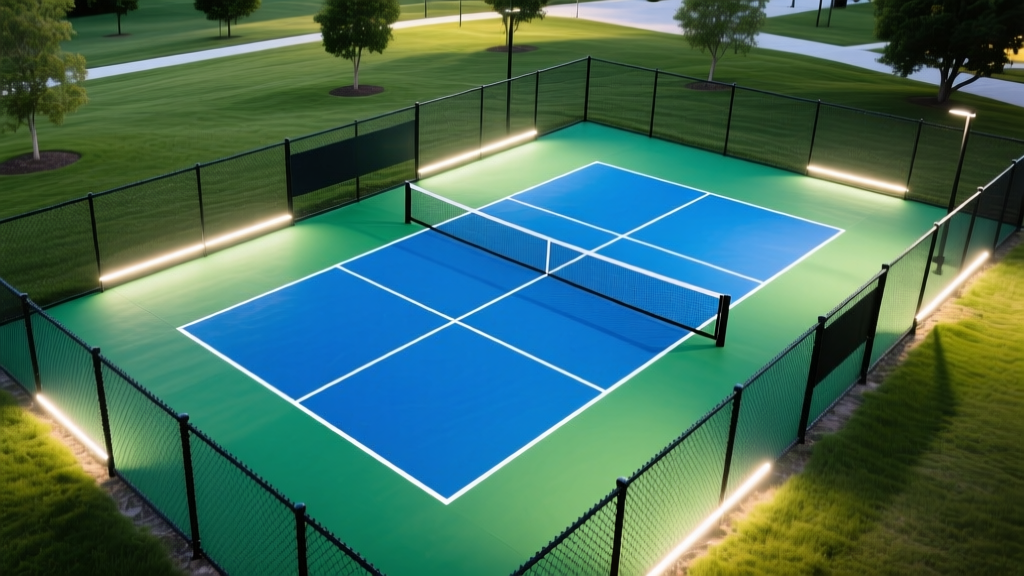
If you plan to play after dusk, lighting is a major budget line item. Recreational play requires a minimum of 50 foot-candles of illumination, while tournament play demands 100 foot-candles with high uniformity to prevent shadows.
LED vs. Metal Halide Breakdown
Metal halide fixtures are obsolete for new builds due to high maintenance and warm-up times. Modern LED court lighting systems (such as those from Musco or Qualite) offer instant on/off capabilities and 50,000+ hour lifespans. A standard 4-pole LED setup, mounted at 20 to 24 feet high with specialized asymmetric optics to prevent light spill into neighboring properties, costs between $12,000 and $22,000 fully installed, including trenching for electrical conduits and panel upgrades.
Hidden Costs: Grading, Permits, and Drainage
Budgeting solely for the court dimensions is a common financial trap. Site work often consumes 20% to 30% of the total project cost. According to real estate and zoning data tracked by Realtor.com, adding specialized recreational structures requires strict adherence to local setback laws and HOA covenants, which can trigger expensive variance applications.
- Land Clearing and Grading: $2,500 – $8,000 depending on tree removal and soil export.
- French Drains and Swales: $1,500 – $4,000. Water must be directed away from the sub-base; standing water under asphalt will cause heaving and frost damage in colder climates.
- Permits and Engineering: $1,000 – $3,500 for soil testing, civil engineering stamps, and municipal building permits.
Step-by-Step Budget Allocation Framework
To maintain financial control, structure your capital allocation using this percentage-based framework for a standard $60,000 mid-tier build:
- Sitework & Grading (15% | $9,000): Clearing, leveling, and drainage installation.
- Base Construction (35% | $21,000): Pouring the 5-inch reinforced concrete slab and curing.
- Fencing & Containment (15% | $9,000): Setting posts, hanging 2-inch mesh, and installing windbreaks.
- Surfacing & Striping (20% | $12,000): Applying the multi-layer cushioned acrylic system and USAPA-standard line taping.
- Lighting & Electrical (10% | $6,000): Trenching, pole setting, and fixture aiming (assuming partial DIY or basic recreational LED setup).
- Contingency Fund (5% | $3,000): Reserved for unforeseen soil issues or material price spikes.
Frequently Asked Questions
Can I build a pickleball court on an existing tennis court?
Yes, this is the most cost-effective route. A standard tennis court (60x120 feet) can comfortably fit four dedicated pickleball courts. The primary costs will be resurfacing the existing acrylic, applying new multi-color line striping ($2,500 – $4,000), and installing dedicated pickleball net posts. Ensure the existing asphalt or concrete base is structurally sound; if the tennis court has severe alligator cracking, overlaying it will not solve the underlying base failure.
Does adding a pickleball court increase property value?
In high-end residential markets and active-adult communities, a professionally built, well-integrated pickleball court can yield a 50% to 75% return on investment at resale. However, poorly placed courts that violate privacy setbacks, lack proper fencing, or create noise nuisances for neighbors can actually deter buyers. Always consult local zoning ordinances regarding noise mitigation, as the sharp 'pop' of a pickleball paddle can carry over 100 decibels.
What are the ongoing maintenance costs?
Outdoor courts require minimal but consistent upkeep. Budget $500 to $1,000 annually for pressure washing, debris removal, and minor crack patching. Every 5 to 8 years, you will need to apply a fresh color coat and re-stripe the lines, which typically costs $3,000 to $5,000 depending on the court's condition and the acrylic system used.
Written by
James ThorntonJames Thornton is a construction industry veteran with 25 years of hands-on experience in wood framing, lumber grading, and residential building codes. He started as a framing carpenter in rural Oregon, earned his ICC Residential Building Inspector certification, and eventually became a senior plan reviewer for the City of Portland Bureau of Development Services. James holds a B.S. in Wood Science & Technology from Oregon State University and is a certified lumber grader through the West Coast Lumber Inspection Bureau (WCLIB). He has inspected over 3,000 residential construction sites and authored the city's internal guide on advanced framing techniques (2x6 at 24" O.C.). James lives in Bend, OR, where he builds custom timber-frame cabins and competes in lumberjack sports.
More from James Thornton
View all
Insulation
Best Home Insulation Materials: Complete 2026 Guide
Compare top home insulation materials for 2026. Find R-values, installed costs per square foot, and best uses for fiberglass, spray foam, and mineral wool.
Aug 4, 2026

Sustainable Building
Certify Your Green Building Material for LEED and WELL
Step-by-step guide to certifying a green building material for LEED v5 and WELL v2. Master EPDs, HPDs, and VOC limits for 2026 project specifications.
Aug 4, 2026

Stone & Masonry
Veneer Stacked Stone Panels: Interior Design & Style Showcase
Discover how veneer stacked stone panels transform interiors. Explore modern design profiles, material pairings, and technical installation specs.
Aug 4, 2026