How Much Does It Cost to Build a Prefab Home? 2026 Guide
Discover exactly how much it costs to build a prefab home in 2026, including hidden site fees, construction loan mechanics, and draw schedules.

The True Cost to Build a Prefab Home in 2026
When evaluating how much does it cost to build a prefab home, the factory base price is only the beginning. In 2026, the fully finished cost for a modular prefab home ranges from $160 to $320 per square foot, translating to $320,000 to $640,000 for a standard 2,000-square-foot residence. However, the financial architecture required to fund this build differs drastically from traditional stick-built construction or purchasing an existing home.
Prefab construction—specifically modular homes built to the International Residential Code (IRC)—offers a 10% to 20% savings on structural framing labor compared to site-built homes, according to the Modular Home Builders Association (MHBA). Yet, site preparation, utility trenching, and crane logistics have seen cost increases that frequently catch buyers off guard. Understanding the complete capital stack is mandatory before approaching a lender.
Capital Breakdown: Factory vs. Site Work
To secure accurate financing, you must separate the factory invoice from the site-work estimates. Lenders require a granular breakdown to structure your construction loan disbursements.
| Project Phase | Estimated Cost (2,000 sq ft) | Cost per Sq Ft | Financing Category |
|---|---|---|---|
| Base Modular Unit (Factory) | $140,000 - $220,000 | $70 - $110 | Factory Deposit & Delivery Draw |
| Land Acquisition & Clearing | $40,000 - $100,000+ | Varies | Land Loan / Initial Equity |
| Foundation & Flatwork | $25,000 - $45,000 | $12.50 - $22.50 | Site Prep Draw |
| Utility Hookups & Septic/Well | $20,000 - $50,000 | $10 - $25 | Site Prep Draw |
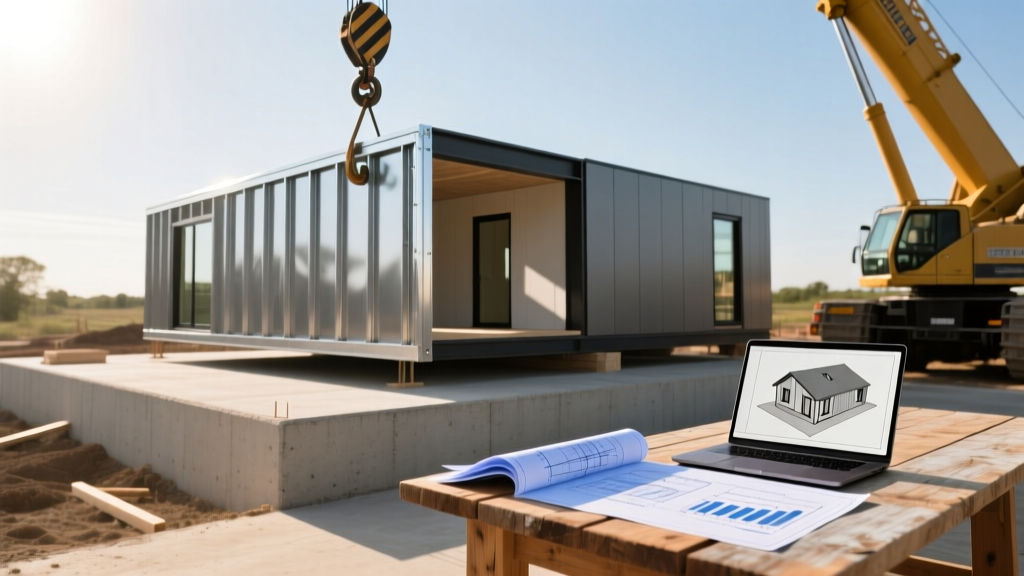
| Crane Set & Structural Marriage | $12,000 - $25,000 | $6 - $12.50 | Delivery & Set Draw |
| Interior Finishing & Trim-Out | $40,000 - $80,000 | $20 - $40 | Final Completion Draw |
Financing Mechanics: The Single-Close Construction Loan
You cannot use a standard conventional mortgage to build a prefab home from scratch. Because the property does not exist at the time of application, you must utilize a Construction-to-Permanent (C2P) loan, often called a single-close loan. As outlined by the Consumer Financial Protection Bureau (CFPB), this financial product covers the land purchase, the construction phase, and automatically converts to a standard 15- or 30-year mortgage once the certificate of occupancy (CO) is issued.
Crucial Distinction: Modular vs. Manufactured
Lenders treat IRC-compliant modular homes identically to stick-built homes, making them eligible for Conventional, FHA, and VA loans. Conversely, HUD-code manufactured homes (built on a permanent steel chassis) face severe financing restrictions. If you are building a manufactured home, you may be forced into a chattel loan with interest rates 2% to 4% higher than standard mortgages, unless it qualifies for specialized FHA Title II financing. Always verify your builder's ICC-ES evaluation report before signing a contract.
The Prefab Draw Schedule Anomaly
The most significant friction point in prefab financing is the draw schedule. A traditional stick-built home utilizes a 5-to-7 draw schedule, releasing funds incrementally as the foundation is poured, walls are framed, and the roof is dried in. Prefab construction shatters this model.
- The Factory Deposit: Builders typically require 10% to 20% down to begin manufacturing. Lenders rarely disburse construction funds for off-site factory deposits; this usually must come from your liquid cash reserves.
- The Delivery & Set Draw: When the modules arrive on-site, 50% to 60% of the total loan value is required in a single day to pay the factory and the crane operator. Lenders view this massive, single-day disbursement as high risk.
- The Mitigation Strategy: To secure approval for this front-heavy draw schedule, require your modular builder to provide a Performance and Payment Bond or an irrevocable Letter of Credit. This protects the bank's capital if the factory goes bankrupt mid-build, dramatically increasing your chances of loan approval.
Hidden Financial Traps and Edge Cases
Budget overruns in prefab builds rarely happen in the factory; they happen in the dirt and the logistics. Factor these specific edge cases into your contingency fund (minimum 15% of total site costs):
Crane Permits and Police Escorts: If your building site is in a dense suburban area or requires traveling over weight-restricted bridges, your module delivery may require a heavy-haul permit and police escort. A 150-ton mobile crane rental for a multi-module set can cost $4,500 to $8,000 per day, and if rain delays the set, you still pay the crane standby fee.
Soil Remediation and Blasting: Prefab homes require perfectly level, precisely dimensioned foundations. A modular unit cannot be 'fudged' on-site to accommodate a sloping or poorly compacted base. If your soil engineer requires over-excavation and engineered fill, or if you hit bedrock requiring blasting, foundation costs can easily double from $30,000 to $60,000+.
Step-by-Step Financing Action Plan
Execute these steps in exact sequence to prevent land-contract expirations and factory queue delays.
- Days 1-15: Land & Loan Pre-Approval. Secure a C2P loan pre-approval letter before purchasing land. The lender will order a preliminary appraisal based on the modular floor plans and your land specs.
- Days 16-30: Site Feasibility. Pay for a perc test (if no municipal sewer exists) and a boundary survey. Use this data to finalize the site-work estimate with your general contractor (GC).
- Days 31-45: Builder Contract & Bonding. Sign the modular purchase agreement. Ensure the contract explicitly states the builder will provide a draw schedule compatible with your lender's C2P requirements and secure the necessary surety bonds.
- Days 46-60: Closing & Factory Queue. Close on the construction loan. Pay the 10-20% factory deposit out-of-pocket to secure your manufacturing slot. Lead times for modular factories in 2026 average 12 to 20 weeks.
- Days 60+: Site Prep & Set. Your GC pours the foundation while the home is in the factory. The lender releases the site-prep draw. On delivery day, the lender wires the massive 'Set Draw' directly to the factory and crane company.
Expert Verdict: Financial Viability
Building a prefab home is financially advantageous primarily through time-savings rather than massive material discounts. By compressing a 9-month stick-built timeline into a 4-month modular process, you save thousands in construction loan interest payments, temporary housing costs, and weather-related material degradation. However, the rigid requirement for precise upfront planning means you cannot rely on 'figuring it out on the fly.' Secure your site data, lock in your bonded builder, and structure your draw schedule to accommodate the heavy front-loading of modular delivery.
Written by
David NakamuraDavid Nakamura is a licensed architect (AIA) and construction technology writer focused on sustainable building methods, mass timber engineering, and high-performance building envelopes. He holds a Master of Architecture from the University of Washington and is a certified Passive House Consultant (CPHC). David spent eight years at the Seattle firm Mithun, where he led the design of three LEED Platinum projects, before founding his own practice specializing in net-zero residential design. He serves on the editorial advisory board of GreenBuilder Magazine and has authored peer-reviewed papers on cross-laminated timber (CLT) connections for the Journal of Structural Engineering. In his spare time, David teaches woodworking at Pratt Fine Arts Center and kayaks the Puget Sound.
More from David Nakamura
View all
Construction Cost
Labor Cost to Build a Deck Per Sq Ft: 2026 Installation Guide
Discover the exact labor cost to build a deck per sq ft in 2026. This installation guide breaks down contractor rates, complexity factors, and hidden fees.
Aug 4, 2026

Construction Cost
How Much Does It Cost to Build a 3 Bedroom House? Financing Guide
Learn exactly how much it costs to build a 3 bedroom house and explore 2026 financing options, construction loan types, and budget frameworks for your build.
Aug 4, 2026

Construction Cost
Cost to Build a Tennis Court: 2026 Guide
How much does it cost to build a tennis court in 2026? Breakdowns for asphalt, concrete, and synthetic surfaces plus fencing and lighting.
Jul 30, 2026