How Much Does It Cost to Build a Pool? Detailed Breakdown
Discover exactly how much it costs to build a pool. Detailed breakdown of gunite, fiberglass, and vinyl prices, plus hidden excavation and equipment fees.

The True Baseline: National Averages vs. Reality
The national average to install an inground swimming pool ranges from $55,000 to $85,000, but this figure rarely reflects the final invoice. When homeowners research how much cost to build a pool entails, they are often met with base prices that exclude essential site work, upgraded filtration, and hardscaping. A turnkey 16x32-foot gunite pool with standard concrete decking and a saltwater chlorination system realistically commands between $75,000 and $110,000 in most metropolitan markets.
Understanding the line-item breakdown is critical to preventing budget overruns. The final price is dictated by four primary phases: shell construction, site preparation, mechanical systems, and finishing hardscape.
Material Matrix: Gunite vs. Fiberglass vs. Vinyl Liner
The pool shell represents 25% to 35% of the total project cost. Each material dictates not only the initial capital expenditure but also the long-term maintenance trajectory and structural lifespan.
| Material | Average Cost (16x32 ft) | Installation Time | Lifespan | 10-Year Maintenance |
|---|---|---|---|---|
| Gunite (Concrete) | $65,000 - $110,000 | 60 - 90 days | 50+ years | $4,500 (acid washes, replastering prep) |
| Fiberglass | $50,000 - $85,000 | 30 - 45 days | 30 - 40 years | $1,200 (gel coat polish) |
| Vinyl Liner | $35,000 - $60,000 | 45 - 60 days | Structural: 30+ yrs / Liner: 7-10 yrs | $6,000 (liner replacement) |
Excavation and Site Prep: The Hidden Cost Multipliers
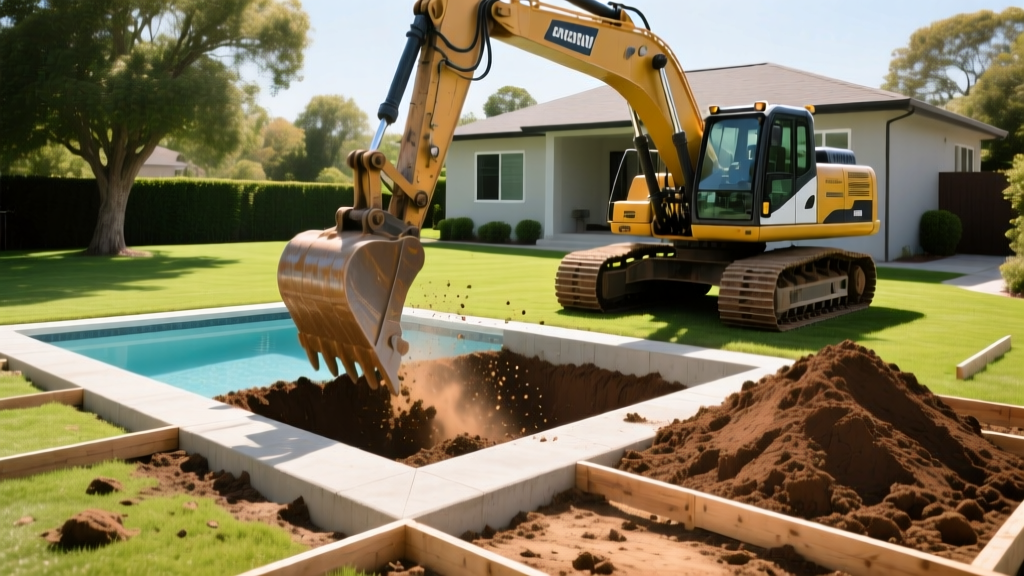
Before any steel is tied or plumbing is laid, the earth must be moved. Standard excavation for a 16x32 pool in easily accessible, loamy soil costs between $1,500 and $3,500. However, site-specific geological factors can rapidly inflate this line item.
Soil and Access Variables
- Bedrock Encounters: If excavation hits solid limestone or granite, rock hammering or blasting is required. This adds $5,000 to $12,000 to the excavation budget.
- Expansive Clay: Soils with high clay content expand and contract with moisture. Contractors must over-excavate by 12 to 18 inches and backfill with crushed gravel to prevent hydrostatic pressure from cracking the pool shell, adding $2,000 to $4,000.
- Limited Access: If a standard trackhoe cannot fit through the side yard (requiring a minimum 10-foot gate clearance), contractors must use mini-excavators and manual wheelbarrowing. This doubles the labor time, increasing costs by $3,000 to $6,000.
- Dirt Haul-Away: A 16x32 pool with an average depth of 5.5 feet generates roughly 100 cubic yards of spoil. If the dirt cannot be used to grade the property, hauling it to a municipal dump costs $15 to $30 per cubic yard.
Mechanical Systems: Plumbing, Electrical, and Filtration
The equipment pad is the cardiovascular system of your pool. Cutting corners here results in cloudy water, high energy bills, and premature equipment failure.
Plumbing Hydraulics
Standard pool plumbing utilizes Schedule 40 PVC. For a typical 15x30 pool, expect 250 to 350 linear feet of piping. Upgrading the main drain and return lines to Schedule 80 PVC adds roughly 15% to material costs but provides superior resistance to high-pressure blowouts and ground shifting. All underground joints must be primed and glued with medium-body PVC cement, then pressure-tested to 40 PSI before the trench is backfilled.
Filtration and Sanitation
Variable speed pumps are now the industry standard and are legally mandated in many jurisdictions due to their energy efficiency. According to the U.S. Department of Energy, upgrading to an ENERGY STAR certified variable speed pump like the Pentair IntelliFlo VSF can reduce pool pump energy costs by up to 90% compared to single-speed models, saving up to $1,500 annually.
For sanitation, saltwater chlorine generators (such as the Hayward AquaRite) cost $1,500 to $2,500 installed. While they eliminate the need to purchase liquid chlorine, the titanium electrolytic cell must be replaced every 3 to 5 years at a cost of $500 to $700.
Heating Systems: Extending the Swim Season
If you plan to swim outside the peak summer months, a heating system is mandatory. The choice between gas and electric heat pumps depends entirely on your local climate and utility rates.
Gas Heaters
Models: Hayward Universal H-Series, Pentair MasterTemp.
Install Cost: $2,500 - $4,500.
Pros: Heats water rapidly regardless of ambient air temperature. Ideal for spas and weekend-only swimming.
Cons: High operational costs ($200-$400/month in natural gas or propane).
Electric Heat Pumps
Models: Pentair UltraTemp, AquaCal SuperTrop.
Install Cost: $3,500 - $6,000.
Pros: Extremely low operational costs ($50-$150/month). Extracts heat from the air to warm the water.
Cons: Ineffective when ambient air temperatures drop below 50°F. Slower heat-up time.
Hardscaping and Coping: Framing the Investment
The deck and coping (the capstone bordering the pool edge) bridge the gap between the pool structure and your landscape. The Pool & Hot Tub Alliance (PHTA) emphasizes that proper hardscaping is critical for managing surface runoff and preventing contaminated water from entering the pool.
- Broom-Finished Concrete: The most economical option at $8 to $12 per square foot. It provides excellent slip resistance but is prone to minor surface cracking over time.
- Travertine Pavers: A premium choice costing $22 to $35 per square foot installed. Travertine remains cool underfoot in direct sunlight and offers a high-end aesthetic. Ensure the contractor uses polymeric sand in the joints to prevent weed growth and ant infiltration.
- Cantilevered Concrete Coping: Standard for gunite pools, costing $15 to $20 per linear foot. Foam forms are used to pour the deck and coping simultaneously, creating a seamless, rounded edge.
Permitting, Inspections, and Insurance
Do not bypass local building codes. Municipal permits for an inground pool typically range from $400 to $1,200, depending on the jurisdiction. This fee covers structural plan reviews, electrical bonding inspections, and barrier/fence compliance checks.
Furthermore, notifying your homeowner's insurance provider is mandatory. Adding a pool generally increases your annual premium by $50 to $150, but it also necessitates increasing your liability coverage limit, often from $100,000 to $300,000 or $500,000. Installing a self-closing, self-latching gate and a pool safety cover can sometimes qualify you for premium discounts.
Decision Framework: Matching Budget to Pool Type
Use this framework to align your financial parameters with the correct construction methodology:
- If your strict maximum budget is under $50,000: Opt for a vinyl liner pool with a standard polymer wall system and a basic broom-finished concrete deck. Avoid complex freeform shapes, as custom liner fabrication will erode your budget.
- If your budget is $50,000 to $80,000 and you want low maintenance: Choose a fiberglass shell. The higher upfront cost of the crane lift and shell delivery is offset by the near-zero long-term surface maintenance and rapid installation timeline.
- If your budget exceeds $85,000 and you require custom architecture: Gunite is the only viable option. This budget accommodates complex geometric designs, vanishing edges, integrated tanning ledges, and premium natural stone coping.
Accurate cost estimation requires looking past the base shell price. By accounting for soil conditions, hydraulic efficiency, and premium hardscaping, you can establish a realistic budget that ensures your pool remains a valuable asset rather than a financial burden.
Written by
Sarah WhitfieldSarah Whitfield is a chartered quantity surveyor (MRICS) and construction cost analyst with 15 years of experience in material pricing, procurement strategy, and project budgeting. She earned her degree in Construction Management from the University of Reading (UK) and has worked on projects ranging from $2M custom homes to $180M mixed-use developments across North America and Europe. Sarah currently leads cost estimating for BuildMat Insight, maintaining a proprietary database of 4,000+ material price points updated quarterly. She is a frequent contributor to RSMeans cost data panels and has presented at the International Cost Engineering Council (ICEC) congress. Based in Denver, CO, Sarah is an avid trail runner and volunteer mentor for Women in Construction.
More from Sarah Whitfield
View all
Wood & Lumber
What Are the Different Types of Wood? A Builder's Guide
Compare structural softwoods, finish hardwoods, and engineered lumber. Analyze Janka ratings, MOE values, and 2026 pricing for construction.
Aug 4, 2026

Walls & Panels
Steel Framing vs Wood Framing: Corrosion and Moisture Defense
Compare steel framing vs wood framing for moisture resistance. Learn about galvanized coatings, condensation risks, and corrosion protection strategies.
Jul 21, 2026

Stone & Masonry
How to Cut Stone Veneer: Wet Saw vs Grinder Comparison
Compare the best tools for cutting stone veneer. We review wet saws, angle grinders, and chop saws to help you achieve clean, chip-free cuts.
Jul 21, 2026