How Much Does a Prefab Home Cost to Build? 2026 Pricing Guide
Discover how much a prefab home costs to build in 2026. We break down modular, panelized, and kit home prices, plus land prep and hidden fees.

The True Cost of Building a Prefab Home in 2026
When evaluating how much does a prefab home cost to build, buyers frequently encounter misleading "starting at" advertisements. In 2026, the prefab construction industry has matured, offering highly customized, architect-designed structures that rival traditional stick-built homes in both quality and price. However, the final turnkey cost is a composite of factory manufacturing, site preparation, foundation work, and on-site assembly. According to data tracked by the U.S. Census Bureau New Residential Construction reports, while factory-built methods reduce on-site labor time by up to 40%, the material and logistics costs require precise budgeting.
A manufacturer's advertised price of $120 per square foot typically covers only the factory-built shell (walls, roof trusses, and basic interior finishes). It almost never includes land acquisition, site clearing, foundation pouring, utility trenching, crane rentals, or the "button-up" labor required to finish the home on-site. Always calculate your budget based on turnkey pricing, not factory base pricing.
Cost Breakdown by Prefab Construction Type
Prefabrication is an umbrella term. To accurately estimate your costs, you must distinguish between the three primary structural systems, each with vastly different pricing models and labor requirements.
| Prefab Type | Factory Shell Cost (Per Sq Ft) | Turnkey Cost (Per Sq Ft) | Code Standard |
|---|---|---|---|
| Modular (Volumetric) | $140 - $220 | $250 - $380+ | Local IRC / IBC |
| Panelized (Flat-Pack) | $90 - $160 | $220 - $320 | Local IRC |
| Kit Homes (Logs/Domes) | $70 - $130 | $180 - $275 | Local IRC |
| Manufactured (HUD) | $80 - $120 | $130 - $190 | Federal HUD Code |
Note: Modular homes are built to the exact same International Residential Code (IRC) as site-built homes, meaning they appraise and finance identically. Manufactured homes are built to the federal HUD code, which can complicate traditional mortgage financing and long-term appreciation.
Site Preparation and Foundation Costs
The most unpredictable variable in any prefab build is the dirt beneath your feet. Site preparation costs can range from $8,000 for a flat, cleared suburban lot to over $65,000 for a sloped, heavily wooded rural parcel requiring extensive engineering.
Essential Site Work Line Items
- Land Clearing and Grubbing: $2,500 - $8,000 per acre, depending on tree density and stump removal requirements.
- Perc Test and Soil Boring: $800 - $1,500. Mandatory for rural lots without municipal sewer access to determine septic system viability.
- Driveway and Access Road Grading: $15 - $30 per linear foot. Crucial for ensuring heavy delivery trucks and cranes can access the foundation pad without getting stuck.
- Utility Trenching and Hookups: $5,000 - $15,000. Running water, sewer/septic, electric, and fiber-optic internet from the street to the house pad.
Foundation Systems for Modular Homes
Modular homes require precise, square foundations. A deviation of even one inch can prevent the modules from seating correctly on the sill plate.
Crawlspace / Stem Wall
Cost: $12,000 - $18,000
Best for moderate climates. Requires engineered masonry or poured concrete stem walls to support the concentrated point loads of modular steel I-beams.
Full Poured Basement
Cost: $25,000 - $45,000+
Requires a crane with a longer reach to set modules over the deep excavation. Adds significant livable or storage space but increases set-day complexity.
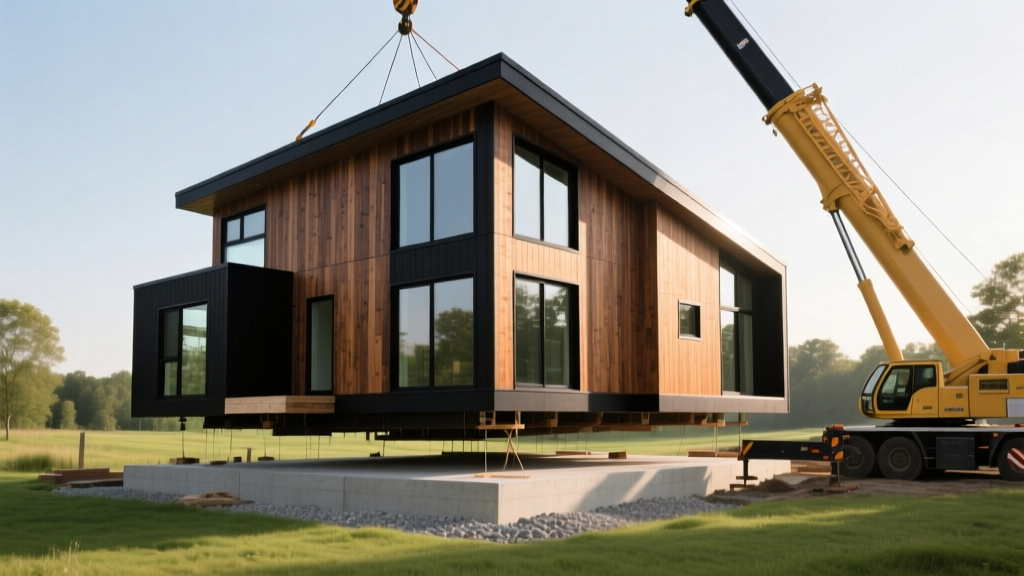
Assembly, Crane Rental, and "Set Day" Logistics
"Set day" is when the factory-built modules arrive and are lifted onto the foundation. This is a highly orchestrated, expensive 24-to-48-hour window. According to the Modular Home Builders Association (MHBA), logistical planning for set day is where inexperienced buyers and general contractors often face massive budget overruns.
The Set Day Budget
- Mobile Crane Rental (100-Ton to 200-Ton): $2,500 - $4,500 per day. The crane size depends on the weight of the modules (often 20,000 to 40,000 lbs each) and the reach required from the street to the foundation.
- Set Crew and Rigger Team: $3,500 - $6,000. Specialized labor required to guide the modules, bolt the steel marriage walls together, and secure the structure to the foundation anchors.
- Police Escorts and Oversize Load Permits: $800 - $2,000. Modules are transported on wide-load trailers that often require state highway patrol escorts and temporary road closures.
"The marriage wall—the structural seam where two modular boxes join together—requires specialized framing, structural bolts, and meticulous drywall finishing to prevent visible cracking over time. Never skimp on the button-up crew's drywall finishing experience."
Regional Price Variations and Labor Markets
Geography heavily influences the final cost to build. In high-cost labor markets like the Pacific Northwest or the Northeast corridor, on-site finishing labor (the "button-up" phase) can push turnkey costs past $400 per square foot. Conversely, in the Midwest or Southeast, where local contractor rates are lower and factory transport distances are shorter, turnkey costs often remain in the $220 to $280 range.
Furthermore, supply chain dynamics in 2026 favor regional factories. Transporting a modular home more than 500 miles from the manufacturing facility drastically increases freight costs and the risk of transit damage. Buyers should prioritize prefab manufacturers located within a 300-mile radius of their build site to optimize freight logistics.
Step-by-Step Budgeting Framework for Prefab Buyers
To avoid running out of capital mid-build, structure your construction-to-permanent loan draw schedule around these specific prefab milestones:
- Phase 1: Land & Engineering (15% of Budget) - Land acquisition, soil testing, architectural stamping of factory plans for local permitting.
- Phase 2: Factory Deposit & Manufacturing (30% of Budget) - Most manufacturers require a 50% deposit of the shell cost to begin framing on the factory floor.
- Phase 3: Site Prep & Foundation (20% of Budget) - Excavation, utility trenching, and pouring the foundation before the factory completion date.
- Phase 4: Delivery & Set Day (10% of Budget) - Freight, crane rentals, permits, and the set crew.
- Phase 5: Button-Up & Finishing (25% of Budget) - Roof shingling over the marriage seam, HVAC integration, drywall finishing, flooring, and final landscaping.
Frequently Asked Questions
Do prefab modular homes appreciate in value like traditional homes?
Yes. Because true modular homes are built to the exact same local IRC building codes as site-built homes, and are permanently affixed to traditional foundations, appraisers and banks treat them identically. They appreciate based on local real estate market conditions, not on their method of construction.
How long does the entire prefab construction process take?
From signing the contract to moving in, expect 6 to 9 months. Factory manufacturing takes 8 to 14 weeks. Site prep and foundation work happen concurrently. Once the home is set on the foundation, the on-site "button-up" and finishing phase typically takes 4 to 8 weeks, significantly faster than the 6+ months required for traditional framing and weather-drying.
Can I act as my own General Contractor for a prefab build?
While some buyers attempt this to save 15-20% on GC fees, it is highly discouraged unless you have professional construction experience. Coordinating the exact day the foundation is cured, the crane is scheduled, and the factory delivers the modules requires intense logistical precision. A delay of one week can result in thousands of dollars in factory storage fees and crane rescheduling penalties.
Written by
Priya KapoorPriya Kapoor is a real estate market analyst and construction economics researcher with expertise in housing affordability, development feasibility, and infrastructure investment. She holds a Master of Regional Planning from Cornell University and previously worked as a senior analyst at CBRE's Investment Properties group, where she modeled returns for $4B in mixed-use development pipelines. Priya now runs an independent research practice advising developers, municipalities, and REITs on construction cost forecasting and market timing. She publishes the quarterly "BuildMat Market Pulse" report tracking material price indices across 12 commodity categories. Based in Austin, TX, Priya serves on the board of Habitat for Humanity Austin and is a marathon runner.
More from Priya Kapoor
View all
Construction Cost
Cost to Build a 1600 Sq Ft Home in 2026: Full Breakdown
Accurate 2026 cost to build a 1600 sq ft home—material, labor, and regional pricing breakdowns included. Plan your budget with real-time estimates.
Aug 11, 2026

Wood & Lumber
Name the Types of Wood for Pressure Treatment and Preservation
Learn how to name the types of wood best suited for pressure treatment. Compare species treatability, chemical retention levels, and 2026 preservation costs.
Aug 4, 2026

Stone & Masonry
Stone Veneer Suppliers Lindenhurst: 2026 Cost Analysis
Analyze 2026 stone veneer costs in Lindenhurst, NY. Compare local supplier pricing, delivery fees, and Suffolk County installation labor rates.
Aug 4, 2026