How Much Does It Really Cost to Build a House? 2026 Financing
Discover how much it really costs to build a house in 2026. Explore construction loans, hidden fees, and financing strategies for your custom build.
The True Baseline: National Averages vs. Reality
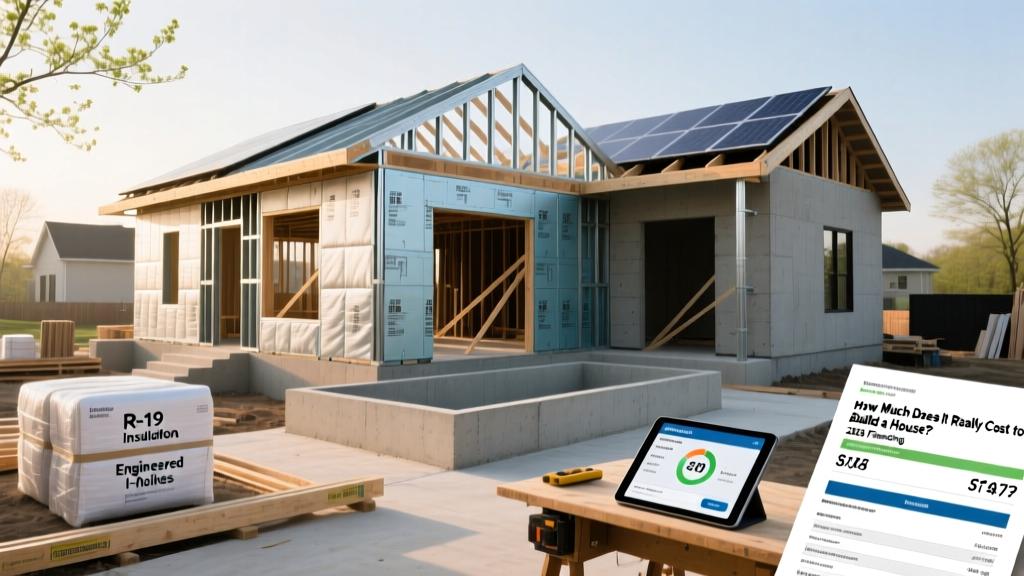
When researching how much does it really cost to build a house, most online estimators only capture baseline hard costs, leaving buyers blindsided by soft costs and financing fees. According to the National Association of Home Builders (NAHB), the national average for hard construction costs in 2026 ranges from $160 to $250 per square foot for production homes, and $300 to $450+ per square foot for semi-custom to fully custom builds. However, the true cost to build requires a comprehensive view of both the physical structure and the financial instruments used to fund it.
Financing a ground-up build is fundamentally different from securing a traditional mortgage. Lenders view construction as a high-risk venture, which dictates stricter underwriting, higher interest rates, and complex disbursement schedules. Understanding these mechanics is the difference between a smooth build and a stalled project.
Hard Costs vs. Soft Costs: The Complete Ledger
To accurately budget, you must separate the physical materials from the administrative overhead. A common failure point for first-time builders is securing a loan that only covers hard costs, forcing them to pay soft costs out-of-pocket mid-build.
Cost Breakdown Matrix
- Hard Costs (70-80% of total): Site prep, foundation, lumber, roofing, HVAC, plumbing, electrical, interior finishes, and direct labor.
- Soft Costs (15-20% of total): Architectural design (typically 8-12% of hard costs), engineering, soil testing, topographical surveys, permits, and impact fees.
- Land Acquisition (5-15% of total): The purchase price of the lot, which can sometimes be rolled into the construction loan if you lack equity.
Choosing Your Financing Vehicle
The Consumer Financial Protection Bureau (CFPB) outlines several distinct loan structures for custom builds. Your choice dictates your closing costs, rate exposure, and monthly cash flow during the 9-to-14-month build cycle.
| Loan Type | Best For | Rate Structure | Down Payment |
|---|---|---|---|
| Construction-to-Permanent (Single-Close) | Most custom homebuilders seeking rate certainty. | Interest-only during build; locks into a 30-year fixed rate at closing. | 20% minimum |
| Stand-Alone Construction (Two-Close) | Borrowers planning major design changes or selling their current home post-build. | Variable rate during build; requires a second closing for the permanent mortgage. | 25% minimum |
| HELOC / Cash-Out Refi | Building an ADU, detached garage, or minor addition on owned land. | Variable rate tied to prime; no draw schedule restrictions. | N/A (Equity-based) |
The Draw Schedule and Interest Reserves
Unlike a standard mortgage where funds are disbursed on day one, construction loans are released in tranches, or "draws," as milestones are completed. The lender will send an inspector to verify progress before releasing funds to the general contractor. According to Investopedia's construction lending guidelines, a typical custom home utilizes a 5-to-7 draw schedule.
Standard 6-Draw Disbursement Model
- Draw 1 (15%): Site clearing, excavation, and foundation pouring.
- Draw 2 (25%): Framing, roof decking, and exterior sheathing (the "dried-in" stage).
- Draw 3 (20%): Rough-in plumbing, electrical, HVAC, and exterior siding/brick.
- Draw 4 (15%): Insulation, drywall installation, and interior priming.
- Draw 5 (15%): Cabinets, flooring, trim, interior doors, and fixture installation.
- Draw 6 (10%): Final grading, landscaping, driveway, and certificate of occupancy (CO).
During the build phase, you are required to pay interest only on the money actually drawn. However, lenders typically require an "interest reserve" to be built into the total loan amount. If your loan is $500,000 and the build takes 12 months at an 8.5% rate, the lender will mandate that roughly $25,000 to $30,000 of the loan proceeds be set aside exclusively to cover these monthly interest payments, preventing out-of-pocket cash flow strain while you are likely still paying rent or a current mortgage.
Contract Types: How Lenders View Your Builder Agreement
How much it really costs to build a house is heavily dictated by the contract you sign with your general contractor. Lenders scrutinize this document to assess risk.
- Fixed-Price Contract: The builder guarantees the total cost. Lenders prefer this because the financial risk is shifted to the builder. If lumber prices spike, the builder absorbs the loss.
- Cost-Plus Contract: You pay for actual materials and labor plus a 15-20% builder fee. Lenders generally dislike this. If you use a cost-plus model, the lender will require a Guaranteed Maximum Price (GMP) rider to cap their exposure.
"Never sign a cost-plus contract for a custom build without a GMP clause. Without a hard ceiling, a supply chain disruption or labor shortage can exhaust your construction loan before the house is finished, leaving you to fund the remainder with high-interest personal loans." — Senior Construction Loan Underwriter
The Hidden Site-Prep Costs That Derail Budgets
When calculating the true cost to build, raw land is a massive variable. A $100,000 wooded lot might require $60,000 in hidden infrastructure before the foundation is even dug. Always budget for the following site-prep realities:
- Perc Tests and Septic Design: If municipal sewer is unavailable, a percolation test ($500-$1,500) determines soil absorption. A failed perc test requires an engineered mound system, which can cost $25,000 to $40,000, compared to a standard $8,000 trench system.
- Well Drilling: Drilling a 200-foot residential well typically costs $6,000 to $12,000, but hitting bedrock or requiring deep aquifer access can push this past $20,000.
- Utility Trenching: Bringing power from the street to the homesite costs roughly $30 to $50 per linear foot. A house set back 500 feet from the road faces $15,000 to $25,000 in electrical trenching and pole-setting fees.
- Impact Fees: Municipalities charge one-time fees for new hookups to water, schools, and roads. These range from $3,000 in rural counties to over $25,000 in high-growth suburban corridors.
The 20% Contingency Mandate
In 2026, material volatility and skilled labor shortages remain persistent factors in residential construction. While production builders operating on standardized floor plans might survive on a 10% contingency, custom homebuilders must allocate a strict 15% to 20% contingency fund. If your hard and soft costs total $600,000, your construction loan must be approved for $720,000. If you do not use the contingency, the surplus is typically applied to the principal balance of your permanent mortgage at the final draw, reducing your long-term interest burden.
Step-by-Step Financing Timeline
Executing a construction loan requires precise sequencing. Follow this framework to ensure capital is available when your builder needs it:
- Month 1-2: Acquire land (or use owned land as equity). Hire an architect and finalize blueprints.
- Month 3: Obtain fixed-price bids from at least three licensed, insured general contractors.
- Month 4: Submit the land deed, blueprints, builder contract, and detailed line-item budget to a construction lender for pre-approval.
- Month 5: Close on the construction loan. The title company records the lien, and the interest reserve is funded.
- Month 6-16: Construction phase. Builder submits draw requests on the 1st of the month; lender inspects and disburses by the 15th.
- Month 17: Final inspection, issuance of the Certificate of Occupancy (CO), and automatic conversion to the permanent 30-year mortgage (for single-close loans).
By understanding the interplay between soft costs, draw schedules, and contract structures, you can accurately answer how much it really costs to build a house and secure the financing necessary to cross the finish line.
Written by
David NakamuraDavid Nakamura is a licensed architect (AIA) and construction technology writer focused on sustainable building methods, mass timber engineering, and high-performance building envelopes. He holds a Master of Architecture from the University of Washington and is a certified Passive House Consultant (CPHC). David spent eight years at the Seattle firm Mithun, where he led the design of three LEED Platinum projects, before founding his own practice specializing in net-zero residential design. He serves on the editorial advisory board of GreenBuilder Magazine and has authored peer-reviewed papers on cross-laminated timber (CLT) connections for the Journal of Structural Engineering. In his spare time, David teaches woodworking at Pratt Fine Arts Center and kayaks the Puget Sound.
More from David Nakamura
View all
Construction Cost
Labor Cost to Build a Deck Per Sq Ft: 2026 Installation Guide
Discover the exact labor cost to build a deck per sq ft in 2026. This installation guide breaks down contractor rates, complexity factors, and hidden fees.
Aug 4, 2026

Construction Cost
How Much Does It Cost to Build a 3 Bedroom House? Financing Guide
Learn exactly how much it costs to build a 3 bedroom house and explore 2026 financing options, construction loan types, and budget frameworks for your build.
Aug 4, 2026

Construction Cost
Cost to Build a Tennis Court: 2026 Guide
How much does it cost to build a tennis court in 2026? Breakdowns for asphalt, concrete, and synthetic surfaces plus fencing and lighting.
Jul 30, 2026