How to Calculate Building Cost Per Square Foot by Region
Learn how to calculate building cost per square foot across US regions. Break down labor, materials, and site factors for accurate construction estimates.

The Core Formula: Base Rate vs. Regional Multipliers
Estimating construction expenses requires moving beyond national averages. The national baseline for a mid-grade, single-family residential build sits between $150 and $175 per square foot of conditioned space. However, applying this flat rate to a project in Seattle will result in a severe budget shortfall, while applying it to a project in rural Mississippi will inflate the bid and lose the contract. To accurately determine how to calculate building cost per square foot, estimators must use a localized formula:
(Base National Rate × Regional City Modifier) + Code-Specific Structural Adders + Site Topography Adjustments = True Cost Per Sq Ft
According to data tracked by the U.S. Census Bureau on construction spending, regional variance in labor and material logistics can swing total project costs by up to 45% between the highest and lowest cost markets. Understanding these micro and macro economic drivers is the first step in building a reliable estimate.
Step-by-Step: Calculating the True Square Footage Cost
Do not use the exterior footprint of the building as your primary multiplier. Follow this sequence to establish an accurate baseline:
- Calculate Conditioned Gross Floor Area (GFA): Measure only the heated and cooled interior spaces. Exclude unfinished garages, open porches, and detached structures. A 3,000 sq ft footprint with a 500 sq ft unfinished garage yields a 2,500 sq ft conditioned GFA.
- Establish the Base Material & Labor Rate: Use the current national average for your specific building class. For standard wood-framed residential (Class 3 construction), the 2026 baseline is approximately $165 per sq ft.
- Apply the RSMeans City Modifier: Multiply the base rate by the localized index. If building in Chicago (modifier ~1.10), your adjusted rate is $181.50 per sq ft.
- Add Code-Driven Structural Adders: Factor in mandatory regional engineering requirements (detailed in the matrix below).
Regional Price Matrix: US Construction Cost Index
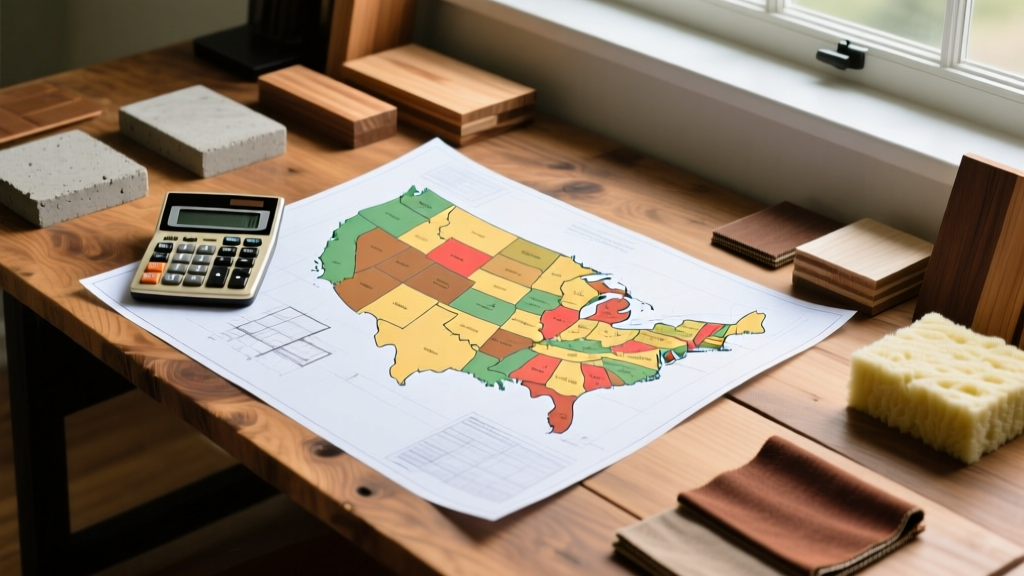
The following matrix breaks down the macro-regional pricing tiers for standard wood-framed construction. These figures represent the cost of the vertical structure and interior finishes, excluding land acquisition, permitting fees, and heavy site work.
| Census Region | Regional Modifier | Avg Cost / Sq Ft | Primary Cost Driver |
|---|---|---|---|
| Northeast | 1.15 - 1.30 | $190 - $215 | Union labor density, strict energy codes (IECC 2021+) |
| Midwest | 0.92 - 1.08 | $152 - $178 | Deep frost-line foundations, moderate labor costs |
| South | 0.85 - 1.02 | $140 - $168 | Slab-on-grade foundations, high HVAC tonnage requirements |
| West | 1.20 - 1.45 | $198 - $240 | Seismic bracing, Title 24 compliance, high material transit |
Code-Driven Regional Adders: The Hidden Square Foot Costs
Regional differences are not just about labor wages; they are heavily dictated by local adaptations of the International Residential Code (IRC). When calculating your per-square-foot cost, you must add these specific engineering requirements to your baseline:
- Pacific Coast Seismic Bracing: Building in Seismic Design Categories D1 or D2 (most of coastal California and the Pacific Northwest) requires continuous load path hardware, holdowns, and shear wall nailing patterns. This adds $4.50 to $7.00 per sq ft to the framing budget.
- Gulf Coast Wind Uplift: In High-Velocity Hurricane Zones (HVHZ) like South Florida, ASCE 7-22 wind load requirements mandate impact-resistant glazing and specialized roof tie-downs (e.g., Simpson Strong-Tie H10A anchors at 16-inch intervals). Add $3.00 to $5.50 per sq ft.
- Northern Frost-Protected Foundations: In regions where the frost line exceeds 48 inches (e.g., Minnesota, Maine), IRC Section R403 requires deep poured concrete footings or Frost-Protected Shallow Foundations (FPSF). Deep footings add $5.00 to $8.00 per sq ft of footprint area compared to southern slab-on-grade builds.
City-Level Comparison: 2,500 Sq Ft Home Breakdown
To demonstrate how to calculate building cost per square foot in practice, consider a standardized 2,500 sq ft, two-story wood-framed home with mid-grade finishes (quartz countertops, LVP flooring, asphalt shingle roof). The National Association of Home Builders (NAHB) regularly highlights how local markets distort national averages. Here is the localized breakdown:
| Location | Base Rate | Modifier | Adjusted Rate/Sq Ft | Total Estimated Cost |
|---|---|---|---|---|
| Austin, TX | $165 | 0.94 | $155.10 | $387,750 |
| Chicago, IL | $165 | 1.10 | $181.50 | $453,750 |
| Seattle, WA | $165 | 1.36 | $224.40 | $561,000 |
Labor vs. Material Variance: What Actually Drives the Multiplier?
A common misconception is that regional price differences are driven by the cost of lumber and concrete. In reality, commodity materials like dimensional lumber (SPF #2) and Portland cement are priced relatively uniformly across the country, fluctuating based on global supply chains rather than local geography.
"When analyzing regional construction indices, labor accounts for nearly 60% of the variance between a low-cost and high-cost market. Material logistics and local code compliance make up the remaining 40%."
Data from the Bureau of Labor Statistics Occupational Employment and Wage Statistics confirms this. A journeyman carpenter in the San Francisco-Oakland-Hayward metropolitan area commands a mean hourly wage upwards of $38.50, whereas the same classification in the Little Rock, Arkansas area averages $21.40. When factoring in labor burden (workers' compensation, insurance, taxes), the fully loaded labor cost in California can be 85% higher than in the Deep South, fundamentally altering the per-square-foot calculation.
Common Estimation Pitfalls to Avoid
When building your regional cost model, avoid these three critical errors that routinely destroy project margins:
1. Using Gross Footprint Instead of Conditioned Space
If you calculate the cost of a 3,500 sq ft home that includes a 600 sq ft unfinished bonus room above the garage, your per-square-foot metric will be artificially skewed. Unfinished spaces cost roughly $65 to $85 per sq ft to frame and dry-in, compared to $165+ for finished, conditioned space. Always separate these line items.
2. Ignoring the 'Last Mile' Logistics Premium
Regional modifiers often assume standard suburban access. If your build is located in a remote mountain region (e.g., the Rockies or rural Appalachia), you must add a logistics premium. Concrete mixer trucks charge significant short-load or transit-time fees for sites located more than 45 minutes from the batch plant, which can add $1.50 to $3.00 per sq ft to the foundation cost.
3. Overlooking Impact Fees and Utility Hookups
While technically 'soft costs' or site work, municipal impact fees vary wildly by region and are often mistakenly rolled into the vertical construction budget by amateur estimators. A water and sewer capacity fee in a rapidly growing Texas suburb might cost $4,500, while the exact same hookup in a constrained coastal California municipality can exceed $28,000. Isolate these fees from your vertical per-square-foot calculations to maintain historical data accuracy.
Written by
Priya KapoorPriya Kapoor is a real estate market analyst and construction economics researcher with expertise in housing affordability, development feasibility, and infrastructure investment. She holds a Master of Regional Planning from Cornell University and previously worked as a senior analyst at CBRE's Investment Properties group, where she modeled returns for $4B in mixed-use development pipelines. Priya now runs an independent research practice advising developers, municipalities, and REITs on construction cost forecasting and market timing. She publishes the quarterly "BuildMat Market Pulse" report tracking material price indices across 12 commodity categories. Based in Austin, TX, Priya serves on the board of Habitat for Humanity Austin and is a marathon runner.
More from Priya Kapoor
View all
Construction Cost
Cost to Build a 1600 Sq Ft Home in 2026: Full Breakdown
Accurate 2026 cost to build a 1600 sq ft home—material, labor, and regional pricing breakdowns included. Plan your budget with real-time estimates.
Aug 11, 2026

Wood & Lumber
Name the Types of Wood for Pressure Treatment and Preservation
Learn how to name the types of wood best suited for pressure treatment. Compare species treatability, chemical retention levels, and 2026 preservation costs.
Aug 4, 2026

Stone & Masonry
Stone Veneer Suppliers Lindenhurst: 2026 Cost Analysis
Analyze 2026 stone veneer costs in Lindenhurst, NY. Compare local supplier pricing, delivery fees, and Suffolk County installation labor rates.
Aug 4, 2026