The True Cost to Build a House in Mexico: 2026 Guide
Compare the cost to build a house in Mexico across regions and finishes. Get 2026 pricing, hidden fees, and material breakdowns for your project.

The Reality of Mexican Construction Costs in 2026
Understanding the true cost to build a house in Mexico requires looking far beyond the basic per-square-foot estimates found on generic real estate blogs. In 2026, the Mexican construction market is defined by a stark contrast between highly affordable local labor and the premium pricing of imported finish materials. While you can build a structurally sound, code-compliant home for a fraction of US or Canadian prices, attempting to replicate North American suburban construction methods in Mexico will rapidly inflate your budget.
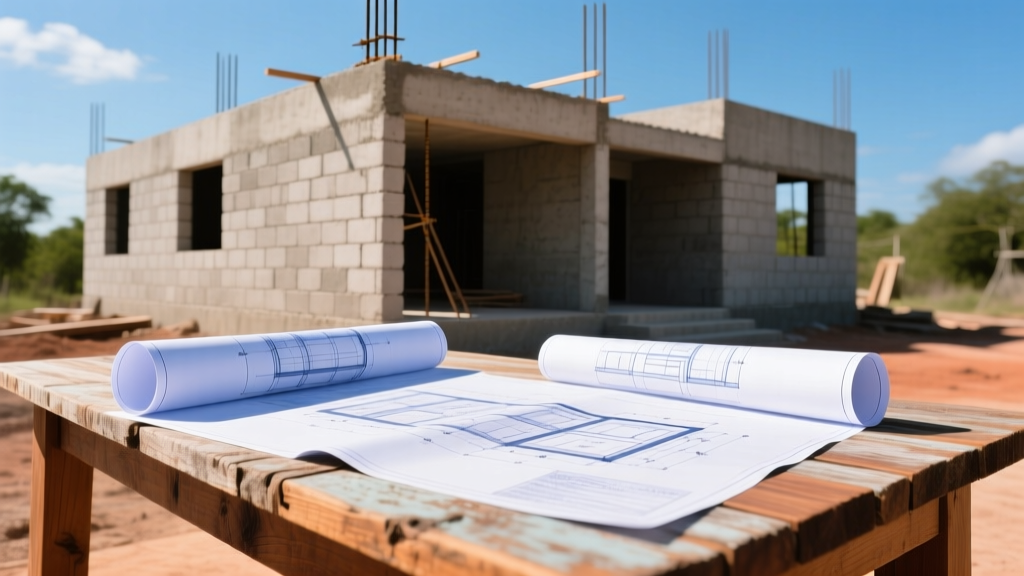
The dominant building method in Mexico is reinforced concrete block (block tradicional), utilizing cast-in-place concrete columns (castillos) and horizontal tie beams (dalas). Wood framing is exceptionally rare, reserved almost exclusively for high-end luxury projects in specific microclimates. This guide breaks down the exact costs, regional variances, and hidden liabilities you must budget for when building south of the border.
2026 Quick Cost Summary (Per Square Meter)
- Economy / Local Standard: $400 - $600 USD / m² ($37 - $55 USD / sq ft)
- Mid-Range / Expat Standard: $750 - $1,100 USD / m² ($70 - $102 USD / sq ft)
- Luxury / Custom Architectural: $1,300 - $2,200+ USD / m² ($120 - $205+ USD / sq ft)
Note: Prices are quoted in USD for budget stability, but local contractor contracts will be denominated in MXN. Land acquisition is not included in these build costs.
Regional Cost Comparison Matrix
Location dictates more than just the price of land; it influences material transport costs, labor availability, and municipal permit fees. Building in a tourist corridor like Tulum carries a 'gringo premium' and higher logistics costs compared to inland colonial cities.
| Region / City | Mid-Range Build Cost (USD/m²) | Labor Availability | Primary Cost Driver |
|---|---|---|---|
| Mérida, Yucatán | $650 - $850 | High | Climate-specific waterproofing & cooling loads |
| San Miguel de Allende | $900 - $1,200 | Moderate (High demand) | Strict historic center zoning & artisan finishes |
| Tulum / Riviera Maya | $1,100 - $1,600 | Low (High turnover) | Imported materials, eco-regulations, logistics |
| Lake Chapala / Ajijic | $700 - $950 | High | Expat-focused contractor premiums |
| Oaxaca (Coastal) | $800 - $1,100 | Moderate | Hurricane-rated structural reinforcement |
Data regarding regional housing development and urban expansion can be tracked via the National Institute of Statistics and Geography (INEGI), which monitors construction density and material usage across Mexican municipalities.
Finish Levels: Where the Budget Actually Goes
The structural shell (foundation, block walls, concrete roof slab) accounts for only 35% to 45% of the total build cost in Mexico. The remaining budget is consumed by finishes, where the gap between 'local standard' and 'imported luxury' is massive.
1. Flooring (Pisos)
- Economy: Standard 40x40cm ceramic tiles from local manufacturers like Interceramic. Cost: $12 - $18 USD per m² installed.
- Mid-Range: 60x60cm porcelain tiles or stamped concrete (concreto estampado) for patios. Cost: $25 - $45 USD per m² installed.
- Luxury: Imported European porcelain, large-format natural stone, or poured epoxy resin. Cost: $80 - $150+ USD per m².
2. Windows and Doors (Cancelería)
This is a critical area for cost and climate control. Standard natural aluminum frames are ubiquitous and cheap, but they conduct heat and corrode in coastal areas.
- Standard Aluminum: Single-pane glass, basic seals. $40 - $60 USD per m².
- Eurovent / PVC Systems: Double-pane insulated glass, UV filtering, multi-point locks. Essential for beachfront or noisy urban areas. Costs 40% to 60% more than standard aluminum, but reduces HVAC energy loads by up to 30%.
3. Roofing and Waterproofing
Flat concrete roofs (losas) are the norm. The critical expense here is not the concrete, but the waterproofing (impermeabilizante). Do not accept cheap acrylic paint-on sealants. Demand a 5-to-10-year warranty system from brands like Sika or Fester, which includes a reinforcing mesh membrane (membrana de refuerzo) applied over the primed concrete.
Warning: The IMSS Labor Liability Trap
Under Mexican labor law, the landowner is considered the primary employer. If a mason (albañil) falls from a scaffold and you have not registered the construction site and the workers with the Instituto Mexicano del Seguro Social (IMSS), you are 100% financially liable for all medical bills, rehabilitation, and potential lifelong disability pensions. Always require your general contractor to provide proof of IMSS registration for every worker on site, or purchase a specific construction-phase liability policy.
Material Breakdown: Traditional Block vs. Alternative Systems
While North American builders might default to wood framing or Structural Insulated Panels (SIPs), the Mexican market heavily favors masonry. Here is how the systems compare in the local context:
| System | Cost Factor | Pros in Mexico | Cons in Mexico |
|---|---|---|---|
| Reinforced Concrete Block | Baseline (1x) | Every mason knows the system; materials are cheap and local; excellent termite and hurricane resistance. | Poor natural insulation; requires deep chases for plumbing/electrical; slow to cure in high humidity. |
| Steel Frame / Light Gauge | 1.4x - 1.8x | Faster build time; perfectly straight walls; easy to run utilities. | Requires specialized, expensive labor; steel must be imported to many regions; vulnerable to coastal corrosion if not perfectly sealed. |
| Waffle Slab / Polystyrene Block | 1.1x - 1.3x | Superior thermal insulation for roofs and walls; lighter structural load. | Harder to hang heavy cabinets without specialized anchors; requires specific engineering stamps. |
The 'Hidden' Costs Foreigners Miss
When calculating the cost to build a house in Mexico, your spreadsheet must include administrative and legal fees that do not exist in the US or Canada. Budget an additional 8% to 12% of your total project cost for the following:
- Fideicomiso (Bank Trust) Setup: If your land is within 50km of the coast or 100km of a border, you must hold it in a bank trust. Setup costs range from $1,500 to $3,500 USD, plus annual bank fees of $500 to $800 USD. The Secretaría de Relaciones Exteriores (SRE) oversees the permit process for these trusts.
- Notario Público Fees: In Mexico, a Notario is a highly specialized government-appointed lawyer who validates all real estate and major construction transactions. Their fees for finalizing the construction declaration (declaración de obra) and property registration typically run 4% to 6% of the declared property value.
- CFE (Electricity) Hookups: Getting a permanent, high-capacity electrical drop from the Comisión Federal de Electricidad can be bureaucratic and expensive, often requiring you to pay for the transformer and pole installation if the grid is not immediately adjacent. Budget $1,000 - $3,000 USD for a standard 220V residential drop.
- IMSS and INFONAVIT Contributions: As mentioned, social security and housing fund contributions for construction workers are mandatory. A general contractor will bake this into their quote, but if you act as an owner-builder, you must calculate and pay these directly based on the project's estimated duration and square footage.
Step-by-Step Budgeting Framework
To maintain control over your capital, structure your payments to the general contractor (contratista) based on verified milestones, never on calendar dates. A standard, secure payment schedule looks like this:
- 10% - 15%: Mobilization, site clearing, and material procurement for the foundation.
- 20%: Completion of foundation and ground-floor slab (planta baja).
- 20%: Completion of structural walls, columns, and roof slab pouring.
- 15%: Rough-in of plumbing, electrical, and application of interior/exterior stucco (enjarre).
- 15%: Installation of windows, doors, flooring, and bathroom fixtures.
- 10%: Final finishes, painting, site cleanup, and handover of the finiquito (legal release of liability signed by all workers) and municipal certificate of occupancy (terminación de obra).
Frequently Asked Questions
Can I act as my own general contractor in Mexico?
Legally, yes, but practically it is highly discouraged unless you are fluent in Spanish, understand Mexican building codes (NOM standards), and have extensive local networks. Acting as an owner-builder shifts 100% of the IMSS liability and material procurement logistics onto your shoulders. The 15% to 20% fee a professional contractor charges is usually offset by their wholesale material discounts and ability to prevent costly structural mistakes.
How long does it take to build a standard 200m² house?
A realistic timeline for a 200-square-meter (2,150 sq ft) mid-range home is 8 to 12 months. Delays are frequently caused by the rainy season (June to October), which halts concrete pouring and stucco application, and by municipal permit approvals, which can take 2 to 4 months before ground is even broken.
Do I need to pay for architectural plans separately?
Yes. You will need a licensed Mexican architect or structural engineer to stamp your plans. Architectural design fees typically range from 3% to 8% of the total construction cost. Furthermore, you will need a separate structural calculation package (memoria de cálculo) signed by a certified structural engineer (Corresponsable en Desarrollo Urbano) to secure your building permit.
Written by
Marcus ChenMarcus Chen is a licensed structural engineer (PE) and building materials analyst with over 12 years of experience across residential, commercial, and industrial construction. He holds a Master of Science in Civil Engineering from UC Berkeley and spent six years at Thornton Tomasetti before transitioning to independent consulting and technical writing. Marcus specializes in material selection for seismic-prone regions, concrete reinforcement strategies, and lifecycle cost analysis. His work has been cited by the American Concrete Institute (ACI) and the Structural Engineers Association of California (SEAOC). When he is not on a job site or at his desk, you will find him hiking the Sierra Nevada or restoring a 1920s craftsman bungalow in Oakland, CA.
More from Marcus Chen
View all
Construction Cost
How Much Did the Eiffel Tower Cost to Build?
How much did the Eiffel Tower cost to build in 1889? We adjust for inflation and compare its budget to modern skyscraper construction.
Aug 4, 2026

Fire Resistance
What Is a Fire Resistant Material? Testing & Certification Guide
Discover what is a fire resistant material through ASTM and UL testing. Learn how fire ratings, certifications, and assemblies work in construction.
Aug 4, 2026

Construction Cost
How Much Did the Burj Khalifa Cost to Build?
How much did the Burj Khalifa cost to build? We break down the $1.5B project and extract 5 money-saving strategies for your next build.
Jul 30, 2026