How Much Does It Cost to Build a Subdivision? Financing Guide
Discover how much it costs to build a subdivision. Explore hard costs, soft costs, impact fees, and AD&C financing structures for land development.

The True Cost to Build a Subdivision: 2026 Benchmarks
When evaluating how much does it cost to build a subdivision, developers must look far beyond the raw land acquisition price. Horizontal land development—transforming raw acreage into finished, buildable lots—is a capital-intensive process governed by complex municipal requirements and volatile material costs. For a standard 50-lot single-family residential subdivision (assuming 2 to 3 lots per gross acre), total development costs typically range from $4.5 million to $9.5 million. This translates to a finished lot cost between $90,000 and $190,000 per pad.
These figures exclude the vertical construction of the homes themselves. The final cost per lot is heavily dictated by local topography, soil conditions, municipal impact fees, and the distance to existing trunk utilities. Understanding this cost anatomy is the first step toward structuring a viable capital stack.
Structuring the Capital Stack: How Developers Finance the Dirt
Land development carries higher risk than vertical construction, which fundamentally alters how lenders underwrite the debt. In the 2026 lending environment, traditional banks and private credit funds rely on Acquisition, Development, and Construction (AD&C) loan structures. However, the capital stack is rarely a single instrument.
- Land Acquisition Loans: Lenders typically finance only 50% to 60% of the raw land purchase price (Loan-to-Value). The developer must inject 40% to 50% in hard equity to close the land purchase.
- Development Loans: Once entitlements are secured, lenders will advance funds for horizontal improvements. These loans are based on Loan-to-Cost (LTC), usually capping at 65% to 75% of the total hard and soft development costs.
- Mezzanine Debt / Preferred Equity: To bridge the gap between the senior lender's LTC limit and the developer's required equity, mezzanine funds step in, typically charging 12% to 18% interest for the subordinate risk.
AD&C loans place a blanket lien across the entire subdivision. To sell a finished lot to a homebuilder, the developer must pay the lender a "release price." This price is usually set at 110% to 125% of the pro-rata loan amount per lot. This ensures the lender's collateral base shrinks slower than the loan balance, forcing the developer to pay down principal faster than the lots are sold.
Cost Breakdown Matrix: Where the Capital Actually Goes
The following matrix illustrates the capital allocation for a mid-tier 50-lot subdivision in a suburban market. According to housing economics data tracked by the National Association of Home Builders (NAHB), land and development costs consistently represent the largest single component of a final home's price tag.
| Cost Category | Avg. Cost Per Lot (50-Lot) | % of Total Budget | Primary Financing Source |
|---|---|---|---|
| Raw Land Acquisition | $30,000 - $60,000 | 25% - 30% | Land Loan + Developer Equity |
| Hard Costs (Site Work & Utilities) | $45,000 - $75,000 | 40% - 45% | Senior AD&C Loan |
| Soft Costs (Engineering & Legal) | $8,000 - $15,000 | 10% - 12% | AD&C Loan / Operating Cash |
| Municipal Impact Fees | $12,000 - $35,000 | 15% - 20% | AD&C Loan / Operating Cash |
| Contingency & Holding Costs | $5,000 - $10,000 | 5% - 8% | Developer Equity / Interest Reserve |
Hard Costs: Grading, Pipes, and Pavement
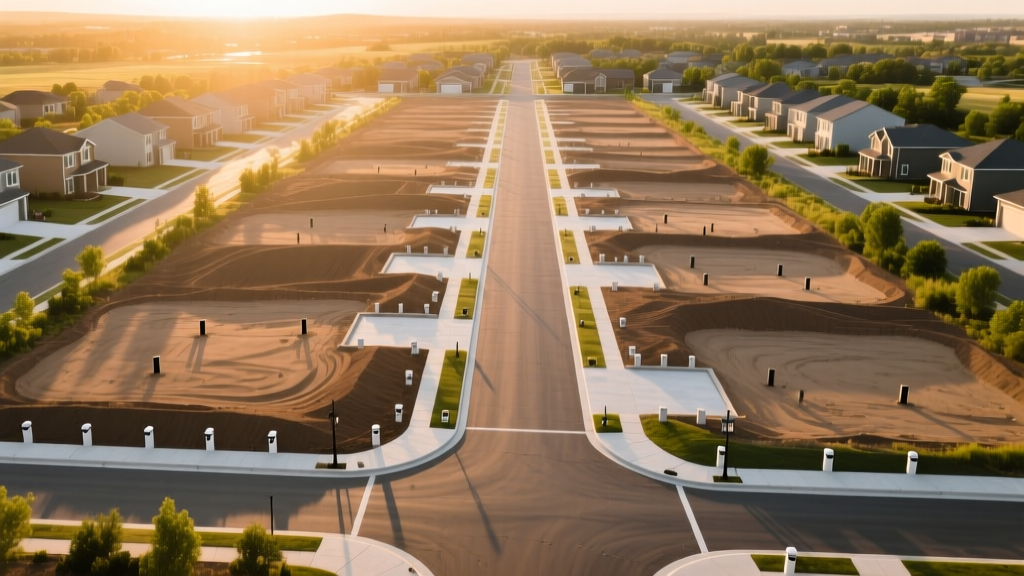
Hard costs represent the physical transformation of the site. These are the most volatile line items, highly sensitive to diesel fuel prices, aggregate availability, and local labor shortages.
Earthwork and Grading
The goal of mass grading is to achieve a "cut-and-fill balance," minimizing the need to export or import soil, which costs $15 to $35 per cubic yard. If the soil fails geotechnical testing (e.g., high plasticity clays), developers must undercut and replace it with structural fill or lime-stabilize the subgrade, adding $10,000 to $20,000 per acre in unexpected costs.
Wet and Dry Utilities
Utility installation is strictly governed by local municipal standards. Wet utilities include sanitary sewer (typically SDR-35 PVC gravity mains), stormwater management (reinforced concrete pipe or precast box culverts), and domestic water (ductile iron pipe or C900 PVC). Dry utilities encompass electrical, gas, and telecommunications. While developers pay for the trenching and conduit for dry utilities, the actual wiring and fiber are often installed by the franchise utility companies at no direct cost to the developer, provided easements are properly dedicated.
Paving and Streetscapes
Residential subdivision streets require robust engineering to handle heavy construction traffic during the vertical building phase. A standard specification includes a compacted subgrade, 6 to 8 inches of aggregate base course (ABC), a 2-inch asphalt binder course, and a 1.5-inch surface wear course. Concrete curbs, gutters, and ADA-compliant sidewalks are poured concurrently.
Soft Costs and Municipal Impact Fees
Soft costs are the intellectual and bureaucratic expenses required to secure the legal right to develop. These include ALTA/NSPS Land Title Surveys, Phase I Environmental Site Assessments (ESAs), traffic impact studies (TIS), and civil engineering design fees. Civil engineering alone typically consumes 4% to 6% of the total hard construction costs.
However, the most egregious soft costs are municipal impact fees. As documented by the Lincoln Institute of Land Policy, local governments increasingly rely on impact fees to fund public infrastructure rather than raising general taxes. Developers must pay these fees—often ranging from $15,000 to over $40,000 per lot for school capacity, parkland dedication, and fire/rescue facilities—before the municipality will issue final plat approval or building permits. These fees are non-negotiable and must be paid in cash upfront, severely straining project liquidity.
Financial Modeling: Contingency and Holding Costs
A subdivision takes 18 to 36 months to develop, from land closing to the final lot sale. During this period, capital is trapped in the dirt. Financial models must account for:
- Interest Reserves: AD&C loans are typically interest-only during the development phase. Lenders require a capitalized interest reserve (funded at closing) to cover monthly SOFR-based interest payments (often SOFR + 300 to 450 basis points) until lot sales begin generating cash flow.
- Property Taxes: As raw land is replatted and improved, county tax assessors will aggressively reassess the parcel's value, often doubling or tripling the annual tax burden mid-project.
- Contingency: A minimum 10% hard cost contingency is mandatory. If rock is encountered during sewer trenching, or if the municipality mandates an upgraded stormwater detention vault, the contingency absorbs the shock without requiring a loan modification.
- Verify the capacity of the nearest municipal wastewater treatment plant. If it is at capacity, the developer may be forced to fund a plant expansion, adding millions to the budget.
- Confirm the exact width of all public right-of-way (ROW) dedications required by the city's master thoroughfare plan.
- Calculate the exact "release prices" required by the senior lender to ensure lot margins remain positive after debt service.
Frequently Asked Questions
How long does it take to develop a 50-lot subdivision?
The physical construction (horizontal development) typically takes 9 to 14 months. However, the entitlement, zoning, and civil engineering approval process preceding construction often adds another 12 to 24 months, making the total project lifecycle 2 to 3 years.
Can I use an SBA loan to finance land development?
No. The Small Business Administration (SBA) 7(a) and 504 loan programs strictly prohibit using proceeds for speculative land development or purchasing raw land without an immediate, owner-occupied vertical construction component. AD&C loans from regional banks or private debt funds are the standard vehicles.
What is the difference between gross acres and net developable acres?
Gross acreage is the total land area purchased. Net developable acreage excludes land dedicated to public right-of-ways, stormwater retention ponds, floodplains, and utility easements. A 20-gross-acre parcel may only yield 14 net developable acres, drastically altering the per-lot cost calculus.
Written by
Priya KapoorPriya Kapoor is a real estate market analyst and construction economics researcher with expertise in housing affordability, development feasibility, and infrastructure investment. She holds a Master of Regional Planning from Cornell University and previously worked as a senior analyst at CBRE's Investment Properties group, where she modeled returns for $4B in mixed-use development pipelines. Priya now runs an independent research practice advising developers, municipalities, and REITs on construction cost forecasting and market timing. She publishes the quarterly "BuildMat Market Pulse" report tracking material price indices across 12 commodity categories. Based in Austin, TX, Priya serves on the board of Habitat for Humanity Austin and is a marathon runner.
More from Priya Kapoor
View all
Construction Cost
Cost to Build a 1600 Sq Ft Home in 2026: Full Breakdown
Accurate 2026 cost to build a 1600 sq ft home—material, labor, and regional pricing breakdowns included. Plan your budget with real-time estimates.
Aug 11, 2026

Wood & Lumber
Name the Types of Wood for Pressure Treatment and Preservation
Learn how to name the types of wood best suited for pressure treatment. Compare species treatability, chemical retention levels, and 2026 preservation costs.
Aug 4, 2026

Stone & Masonry
Stone Veneer Suppliers Lindenhurst: 2026 Cost Analysis
Analyze 2026 stone veneer costs in Lindenhurst, NY. Compare local supplier pricing, delivery fees, and Suffolk County installation labor rates.
Aug 4, 2026