How Much Does It Cost to Build a Football Field? Savings Guide
Discover exactly how much it costs to build a football field and uncover expert money-saving strategies for grading, turf selection, and LED lighting.

Baseline Cost Breakdown: How Much Does It Cost to Build a Football Field?
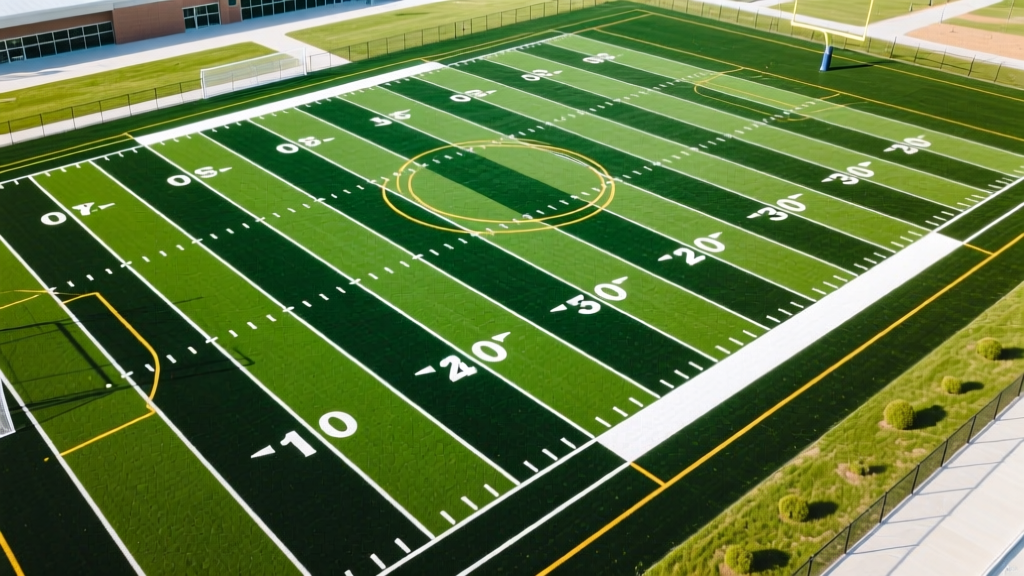
The cost to build a football field ranges from $750,000 for a basic natural grass community facility to over $4,500,000 for a fully equipped collegiate synthetic turf stadium. The wide variance is driven by site conditions, surface material, lighting requirements, and ancillary infrastructure. To answer the question of how much it costs to build a football field accurately, project managers must isolate the budget into core construction phases and apply value engineering at each step.
| Construction Component | Community / Basic HS | Elite HS / Small College | NCAA / Stadium Grade |
|---|---|---|---|
| Site Prep & Earthwork | $80,000 - $150,000 | $200,000 - $450,000 | $600,000 - $1,200,000 |
| Sub-Base & Drainage | $120,000 - $250,000 | $300,000 - $600,000 | $800,000 - $1,500,000 |
| Turf System (Material & Install) | $350,000 - $700,000 | $850,000 - $1,400,000 | $1,500,000 - $2,800,000 |
| Field Lighting & Controls | $150,000 - $250,000 | $350,000 - $600,000 | $1,000,000 - $2,500,000 |
| Total Estimated Range | $750k - $1.5M | $1.7M - $3.0M | $3.9M - $8.0M+ |
Earthwork and Drainage: Value Engineering the Sub-Base
The most common budget overruns in sports field construction occur below ground. Importing or exporting soil to achieve the required 1% to 1.5% surface slope for drainage can cost between $25 and $45 per cubic yard. The primary money-saving strategy is to design a 'cut-and-fill' balance, utilizing laser-guided grading to redistribute existing on-site soils rather than hauling material off-site and purchasing imported fill.
For the sub-base, specify Recycled Concrete Aggregate (RCA) instead of virgin crushed stone. RCA typically costs 20% to 30% less than virgin aggregate and provides excellent percolation rates when properly graded. According to guidelines from the American Sports Builders Association (ASBA), a 6-inch to 8-inch compacted base layer of RCA, meeting ASTM D2940 standards, provides a stable foundation that prevents differential settling without the premium price tag of virgin limestone.
Surface Selection Matrix: Natural vs. Synthetic ROI
When evaluating how much it costs to build a football field, the surface material dictates both upfront capital expenditure and long-term operational expenditure (OpEx). The decision should be driven by anticipated usage hours and maintenance capacity, not just initial sticker price.
Natural Grass Systems
A high-quality natural grass field utilizing a USGA-spec sand rootzone in the wear areas and a native soil base in the outskirts costs between $400,000 and $700,000. Cultivars like Tifway 419 Bermuda (for warm climates) or specialized Kentucky Bluegrass blends (for cool climates) require intense agronomic management. According to research from the Penn State Center for Sports Surface Research, natural turf requires annual aeration, topdressing, and precise irrigation, adding $25,000 to $40,000 in yearly maintenance. However, the initial capital outlay is roughly 50% lower than synthetic alternatives.
Synthetic Turf Systems
A premium monofilament polyethylene (PE) synthetic turf system with a 60mm pile height and cryogenic SBR or EPDM infill costs between $850,000 and $1,400,000. While the upfront cost is steep, synthetic turf accommodates 3,000+ hours of annual use compared to the 800-hour limit of natural grass. To save money on synthetic installations, opt for a standard shock pad rather than a custom-poured elastic layer, and utilize locally sourced silica sand for the primary infill base, reserving the expensive cryogenic rubber strictly for the top-dressing layer.
Lighting Infrastructure: Slashing OpEx with LED Optics
Field lighting is a massive capital expense, but modern value engineering focuses on lifecycle costs. Traditional metal halide systems cost less upfront ($150,000 to $250,000 for a standard high school field) but draw immense power and require $5,000+ in annual relamping and maintenance.
Investing in LED sports lighting arrays (such as those engineered to meet Illuminating Engineering Society (IES) standards for Class II or Class III play) costs between $300,000 and $500,000 initially. However, LED systems consume 50% to 60% less energy and feature lifespans exceeding 100,000 hours. To optimize the budget, utilize asymmetric optical lenses that maximize spill-light control, allowing you to achieve the required 500 lux average maintained illumination with fewer fixtures and shorter, less expensive galvanized steel poles (e.g., 60-foot poles instead of 80-foot poles).
Phased Construction Framework for Cash Flow Management
If capital is constrained, structuring the build in distinct, bid-ready phases prevents budget bottlenecks and allows facilities to generate revenue earlier.
- Phase 1: Sub-Structure and Earthwork ($400k - $800k). Complete all cut-and-fill grading, install the perimeter drainage trench, and lay the compacted RCA sub-base. This phase locks in the site geometry and prevents weather-related soil degradation.
- Phase 2: Surface and Markings ($400k - $1.2M). Install the chosen turf system, paint the field lines, and establish the immediate playability of the asset. The facility can now host events and generate gate revenue.
- Phase 3: Illumination and Ancillaries ($300k - $1.5M+). Erect the LED lighting poles, install the control systems, and construct spectator bleachers or press boxes in subsequent fiscal years as funding becomes available.
Accurately determining how much it costs to build a football field requires moving beyond square-foot averages. By balancing earthwork on-site, substituting virgin aggregate with RCA, optimizing drainage layouts, and phasing the construction timeline, project owners can reduce initial capital requirements by 15% to 25% without compromising the structural integrity or playability of the final facility.
Written by
Priya KapoorPriya Kapoor is a real estate market analyst and construction economics researcher with expertise in housing affordability, development feasibility, and infrastructure investment. She holds a Master of Regional Planning from Cornell University and previously worked as a senior analyst at CBRE's Investment Properties group, where she modeled returns for $4B in mixed-use development pipelines. Priya now runs an independent research practice advising developers, municipalities, and REITs on construction cost forecasting and market timing. She publishes the quarterly "BuildMat Market Pulse" report tracking material price indices across 12 commodity categories. Based in Austin, TX, Priya serves on the board of Habitat for Humanity Austin and is a marathon runner.
More from Priya Kapoor
View all
Construction Cost
Cost to Build a 1600 Sq Ft Home in 2026: Full Breakdown
Accurate 2026 cost to build a 1600 sq ft home—material, labor, and regional pricing breakdowns included. Plan your budget with real-time estimates.
Aug 11, 2026

Wood & Lumber
Name the Types of Wood for Pressure Treatment and Preservation
Learn how to name the types of wood best suited for pressure treatment. Compare species treatability, chemical retention levels, and 2026 preservation costs.
Aug 4, 2026

Stone & Masonry
Stone Veneer Suppliers Lindenhurst: 2026 Cost Analysis
Analyze 2026 stone veneer costs in Lindenhurst, NY. Compare local supplier pricing, delivery fees, and Suffolk County installation labor rates.
Aug 4, 2026