Symphony of the Seas Cost to Build: Mega-Ship Scope Calculator
Analyze the Symphony of the Seas cost to build using our size and scope calculator. Break down steel, propulsion, and interior fit-out expenses.
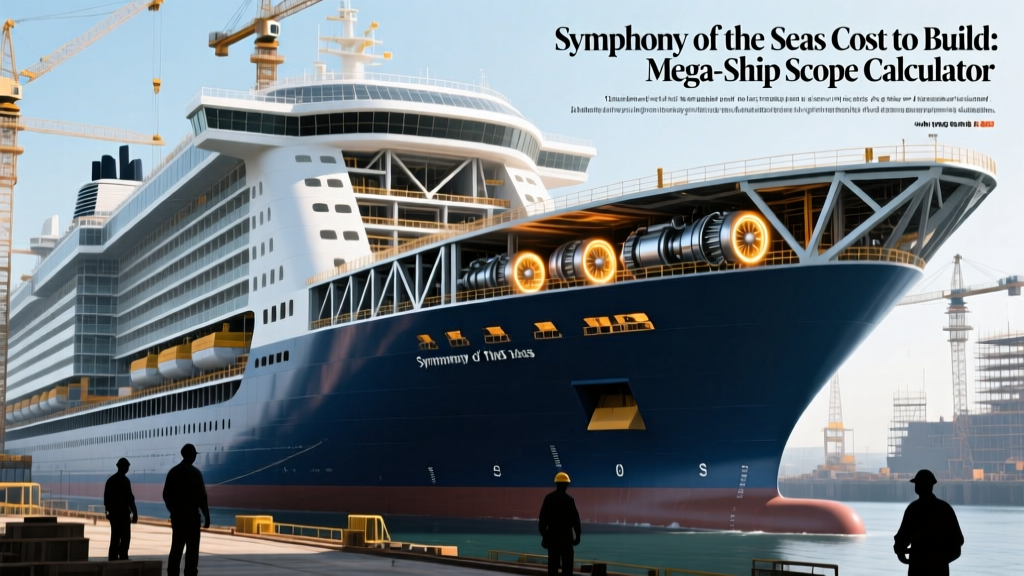
The $1.35 Billion Blueprint: Deconstructing the Symphony
When Royal Caribbean commissioned the Oasis-class vessels, they were not merely ordering ships; they were underwriting the construction of floating, self-sustaining municipalities. The Symphony of the Seas cost to build was widely reported at $1.35 billion USD upon its delivery in 2018. For construction estimators and project managers, analyzing a mega-marine project of this magnitude requires abandoning traditional terrestrial square-footage metrics in favor of gross tonnage, marine-grade material premiums, and specialized labor allocations.
Built by Chantiers de l'Atlantique (formerly STX France) in Saint-Nazaire, the vessel spans 1,188 feet in length and encompasses 18 decks. To understand how a size and scope calculator processes a $1.35 billion price tag, we must dissect the capital expenditure across hull fabrication, propulsion engineering, and luxury interior outfitting.
Scaling the Scope: Gross Tonnage vs. Terrestrial Square Footage
In commercial real estate, estimators rely on cost per square foot. In naval architecture, the standard metric is Gross Tonnage (GT), which measures the internal volume of the ship, not its weight. The Symphony of the Seas registers at 228,081 GT. Translating this into terrestrial equivalents reveals the sheer density of the construction scope.
| Mega-Structure | Primary Metric | Approx. Build Cost | Cost per Unit (Est.) |
|---|---|---|---|
| Symphony of the Seas | 228,081 Gross Tonnage | $1.35 Billion | $5,918 per GT |
| Burj Khalifa | 3.3M sq ft (Floor Area) | $1.5 Billion | $454 per sq ft |
| Wynn Las Vegas | 2.7M sq ft (Floor Area) | $2.7 Billion | $1,000 per sq ft |
| SoFi Stadium | 3.1M sq ft (Floor Area) | $5.5 Billion | $1,774 per sq ft |
While the raw cost per unit of volume appears lower for the cruise ship, this is misleading. A ship's internal volume includes vast, un-outfitted void spaces like the engine casings, ballast tanks, and crew corridors. When isolating just the passenger and revenue-generating spaces, the cost per square foot rivals high-end luxury hospitality builds.
Material & Labor Cost Breakdown by Zone
Running the Symphony of the Seas specifications through a marine scope calculator yields a distinct cost distribution that differs radically from high-rise construction. Terrestrial buildings spend the majority of their budget on structural concrete and exterior envelopes. Cruise ships invert this ratio, spending the lion's share on interior outfitting and mechanical propulsion.
The Steel and Propulsion Premium
The hull and superstructure require approximately 40,000 metric tons of specialized marine steel. However, raw steel costs represent a surprisingly small fraction of the total budget—roughly 12% to 15%. The true expense lies in the propulsion and life-support systems.
- Main Engines: The vessel relies on six Wärtsilä diesel engines (four 12V46F and two 16V46F) generating a combined 97,000 kW. These custom-built marine powerplants cost upwards of $15 million each.
- Azipod Thrusters: Three 20,000 kW ABB Azipod propulsion units provide maneuverability, costing approximately $25 million as a complete package.
- HVAC & Desalination: Marine-grade climate control and reverse-osmosis water makers capable of producing 600,000 gallons of fresh water daily add an estimated $45 million to the mechanical scope.
Interior Fit-Out: Floating Luxury Hotel Economics
Interior outfitting accounts for roughly 50% of the total capital expenditure. With 2,759 staterooms, the average cost per cabin—including custom joinery, marine-rated plumbing, and SOLAS-compliant fire suppression—hovers between $180,000 and $220,000. Public spaces like the Central Park neighborhood (featuring 20,700 live plants) and the AquaTheater require specialized structural reinforcement and waterproofing, pushing public area fit-out costs to over $1,200 per square foot.
Estimator's Note: SOLAS vs. IBC Building Codes
Terrestrial estimators must adjust their material databases when pricing marine projects. The International Building Code (IBC) does not apply at sea. Instead, the International Convention for the Safety of Life at Sea (SOLAS) dictates strict parameters. Every material used in the interior fit-out must pass stringent FTP (Fire Test Procedures) codes. Standard commercial drywall and carpeting are prohibited; estimators must source marine-grade mineral wool bulkheads and non-combustible deck underlayments, which carry a 40% to 60% price premium over standard commercial equivalents.
Applying the Size & Scope Calculator to Mega-Marine Projects
When inputting a vessel of this scale into a construction cost estimator, the workflow requires a phased approach that aligns with shipyard block construction methodologies. Unlike a building that goes up floor-by-floor, the Symphony was assembled in 90 massive steel blocks, each weighing up to 800 tons, which were pre-outfitted with piping and electrical conduits before being welded together in the dry dock.
- Block Assembly & Hull Welding (Months 1-12): Calculating labor hours for automated panel lines and manual TIG/MIG welding of high-tensile steel.
- Machinery Installation (Months 10-18): Rigging and lowering the main engines and Azipods into the hull before the upper decks are sealed.
- Outfitting & Joinery (Months 15-28): The most labor-intensive phase, requiring thousands of specialized subcontractors working in confined, overlapping zones.
- Sea Trials & Commissioning (Months 29-32): Fuel, crew, and specialized marine engineering diagnostics.
Inflation and 2026 Replacement Cost Projections
The $1.35 billion price tag reflects 2015-2018 economic conditions. If a cruise line were to commission an exact replica of the Symphony of the Seas today, the 2026 replacement cost would be drastically higher. According to industry analysis of Oasis-class deployments, the baseline vessel redefined the market, but subsequent macroeconomic shifts have altered the pricing landscape.
Key Cost Drivers in the 2026 Market:
- Shipyard Scarcity: European shipyards capable of building Oasis-class vessels (Chantiers de l'Atlantique, Meyer Werft, Fincantieri) are operating at maximum capacity, with order books extending into the early 2030s. This scarcity introduces a 15% to 20% premium on newbuild contracts.
- Marine Steel Tariffs & Supply Chain: Fluctuations in global steel markets and specialized marine alloy availability have pushed hull material costs up by approximately 28% since 2018.
- Environmental Compliance: New 2026 IMO (International Maritime Organization) regulations require advanced exhaust gas cleaning systems (scrubbers), LNG dual-fuel capabilities, and shore-power connectivity, adding an estimated $85 million to the propulsion and mechanical scope.
Projected 2026 Build Cost: Factoring in a conservative 5.2% year-over-year compounding inflation rate for specialized marine labor and materials, the estimated cost to build the Symphony of the Seas in 2026 sits between $1.85 billion and $1.95 billion USD.

Key Takeaways for Mega-Project Estimators
Analyzing the Symphony of the Seas provides critical insights for estimators tackling complex, high-density commercial projects, whether on land or at sea:
- Volume vs. Usable Space: Always separate gross structural volume from net leasable/usable area. The cost per usable square foot in mega-structures is exponentially higher than the gross average suggests.
- Regulatory Material Premiums: Never use terrestrial material databases for environments governed by specialized codes (e.g., SOLAS, FEMA flood zones, seismic Category IV). The compliance premium can exceed 50% of the base material cost.
- Pre-Outfitting Efficiencies: The shipyard block construction method—installing MEP (Mechanical, Electrical, Plumbing) systems before structural enclosure—offers a blueprint for modular terrestrial construction, potentially reducing schedule durations by 15% to 20% on large-scale hotel or hospital builds.
Written by
Priya KapoorPriya Kapoor is a real estate market analyst and construction economics researcher with expertise in housing affordability, development feasibility, and infrastructure investment. She holds a Master of Regional Planning from Cornell University and previously worked as a senior analyst at CBRE's Investment Properties group, where she modeled returns for $4B in mixed-use development pipelines. Priya now runs an independent research practice advising developers, municipalities, and REITs on construction cost forecasting and market timing. She publishes the quarterly "BuildMat Market Pulse" report tracking material price indices across 12 commodity categories. Based in Austin, TX, Priya serves on the board of Habitat for Humanity Austin and is a marathon runner.
More from Priya Kapoor
View all
Construction Cost
Cost to Build a 1600 Sq Ft Home in 2026: Full Breakdown
Accurate 2026 cost to build a 1600 sq ft home—material, labor, and regional pricing breakdowns included. Plan your budget with real-time estimates.
Aug 11, 2026

Wood & Lumber
Name the Types of Wood for Pressure Treatment and Preservation
Learn how to name the types of wood best suited for pressure treatment. Compare species treatability, chemical retention levels, and 2026 preservation costs.
Aug 4, 2026

Stone & Masonry
Stone Veneer Suppliers Lindenhurst: 2026 Cost Analysis
Analyze 2026 stone veneer costs in Lindenhurst, NY. Compare local supplier pricing, delivery fees, and Suffolk County installation labor rates.
Aug 4, 2026