How Much Does It Cost to Build a Trampoline Park? Cost Guide
Analyze the true cost to build a commercial trampoline park. Compare equipment, facility shell, and franchise vs. independent build-out expenses.

The True Economics of Trampoline Park Construction
Estimating the capital expenditure for a commercial trampoline park requires moving beyond basic square-footage multipliers. Unlike standard retail build-outs, indoor amusement facilities demand specialized structural clearances, heavy-duty HVAC engineering, and strict adherence to safety standards. In 2026, the total cost to build a trampoline park ranges from $1.2 million for a boutique 10,000-square-foot facility to over $7 million for a 45,000-square-foot mega-park.
This cost comparison breaks down the capital requirements across facility shells, specialized attraction equipment, compliance engineering, and operational runway. Whether you are evaluating a franchise opportunity or designing an independent concept, understanding these line-item variances is critical for securing accurate SBA 7(a) financing or commercial real estate loans.
Size vs. Scope: Comparing Build-Out Tiers
Trampoline parks are generally categorized into three size tiers. The cost per square foot decreases slightly as the footprint expands due to economies of scale in the building shell and HVAC infrastructure, but the absolute capital requirement scales linearly with the addition of premium attractions.
| Facility Tier | Square Footage | Estimated Total Cost | Cost Per Sq. Ft. | Ideal Market Demographic |
|---|---|---|---|---|
| Boutique / Urban | 10,000 - 15,000 sq ft | $1.2M - $2.1M | $120 - $140 | Dense urban centers, high-rent districts |
| Standard Regional | 20,000 - 30,000 sq ft | $2.5M - $4.2M | $115 - $140 | Suburban strip malls, mid-sized cities |
| Mega / Destination | 35,000 - 50,000+ sq ft | $4.8M - $7.5M+ | $110 - $150 | Regional tourist hubs, major metro outskirts |
Note: These estimates assume a cold-shell (unfinished) commercial building is leased or purchased. They include tenant improvements (TI), equipment, and architectural fees, but exclude the purchase price of the underlying real estate.
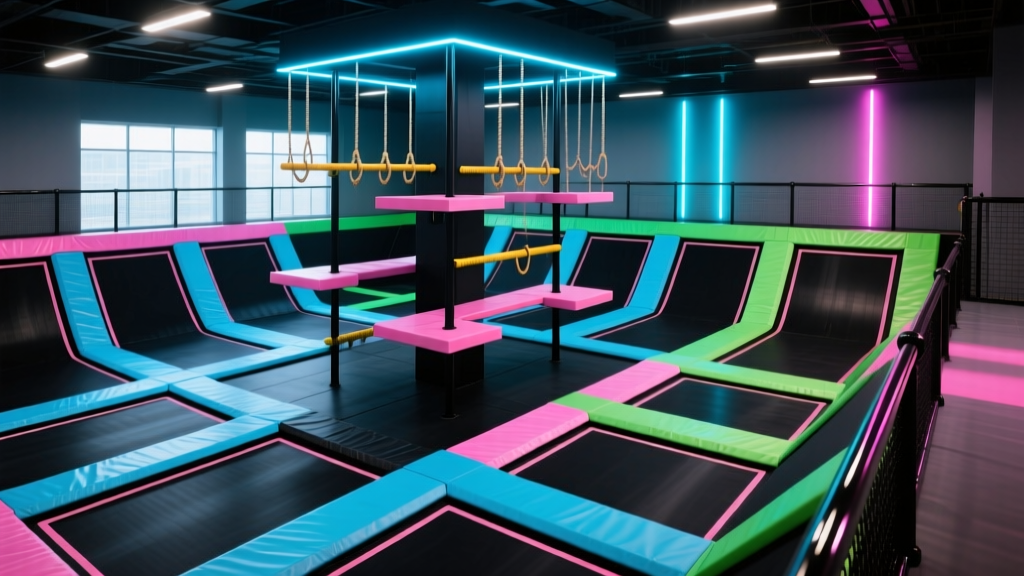
Equipment Cost Matrix: Standard vs. Premium Attractions
The attraction mix dictates your revenue per available hour (RPAH). While standard trampoline courts form the foundational footprint, premium attractions drive higher birthday party package prices and repeat visitation from older demographics. All equipment must comply with the ASTM F2970 Standard Practice for design and maintenance.
Foundational Equipment Costs
- Standard Trampoline Courts: $14 to $22 per square foot. This includes the galvanized steel frame, commercial-grade springs, UV-resistant polypropylene mats, and mandatory 2-inch closed-cell polyethylene foam padding with 14-ounce PVC vinyl covers.
- Dodgeball Courts: $16 to $25 per square foot. Requires reinforced angled padding on the dividers to withstand high-impact collisions.
- Performance Trampolines (String Beds): $35 to $50 per square foot. Used for competitive gymnastics or advanced freestyle zones, utilizing high-tensile string beds rather than standard mats.
Premium Attraction Add-Ons
- Foam Pits with Airbag Upgrades: $25,000 to $45,000. Traditional foam blocks require expensive weekly maintenance and harbor bacteria. Modern parks install commercial stunt airbags (e.g., 16ft x 24ft) beneath a tensioned top net, reducing maintenance costs by 80%.
- Ninja Warrior Courses: $45,000 to $95,000. Includes timing systems, modular steel rigs, and specialized fall-zone padding. Requires a minimum 18-foot clear height.
- Indoor Ropes Courses (Sky Trails): $85,000 to $160,000. Multi-level suspended courses require independent structural steel supports and continuous belay systems, adding significant engineering costs.
- Interactive Climbing Walls: $30,000 to $60,000. Projection-mapped climbing walls with auto-belay systems command premium hourly rates and require specialized AV installation.
Facility Shell and HVAC: The Hidden Capital Sinks
The most frequent point of failure in trampoline park pro formas is underestimating the tenant improvement (TI) costs related to the building shell and climate control.
Clear Height and Structural Requirements
Trampoline parks require a minimum 22-foot clear height, with 26 to 28 feet preferred for ninja courses and ropes courses. Modifying an existing tilt-up concrete warehouse to increase roof elevation costs between $45 and $85 per square foot. If leasing a standard retail space with a 16-foot drop ceiling, the space is fundamentally unusable without a complete roof tear-off, which rarely pencils out for a tenant.
HVAC and Air Turnover Engineering
A facility packed with 150 active jumpers generates massive sensible and latent heat loads. Standard commercial RTUs (Roof Top Units) are insufficient. You must engineer an HVAC system capable of 4 to 6 Air Changes per Hour (ACH) with heavy-duty destratification fans to prevent heat pooling at the 28-foot ceiling. Budget $12 to $18 per square foot for a high-capacity commercial HVAC retrofit, including smart-building management systems (BMS) to optimize energy usage during off-peak hours.
Insurance carriers will not underwrite a trampoline park without a third-party audit confirming strict adherence to ASTM F2970. This includes specific court spacing (minimum 2 feet between courts), structural load testing of mezzanines, and documented netting tensile strength. Budget $8,000 to $15,000 for an independent safety audit prior to opening to secure your general liability policy.
Franchise vs. Independent: A Financial Showdown
Choosing between a recognized franchise (e.g., Sky Zone, Urban Air, Launch Trampoline) and an independent build fundamentally alters your capital stack and long-term cash flow.
| Financial Metric | Franchise Build-Out | Independent Build-Out |
|---|---|---|
| Initial Franchise Fee | $30,000 - $50,000 | $0 |
| Architectural & Engineering | $15,000 - $25,000 (Pre-approved templates) | $45,000 - $80,000 (Custom design & structural engineering) |
| Equipment Sourcing | Mandated vendors (often 10-15% premium) | Direct from manufacturer (IAAPA certified suppliers) |
| Ongoing Royalty Fee | 5% - 7% of Gross Revenue | 0% |
| Marketing Fund | 1% - 2% of Gross Revenue | Variable (Self-funded) |
The Verdict: Franchises offer faster build timelines and pre-negotiated insurance rates, which can save $15,000+ annually on premiums. However, the 6% royalty on gross revenue severely limits EBITDA margins. Independent parks require heavier upfront architectural spending but capture 100% of their top-line revenue, making them vastly more profitable by Year 3 if the operator possesses strong local marketing capabilities.
Insurance and Operational Runway Capital
Trampoline parks are classified as high-risk amusement facilities. In 2026, general liability insurance premiums range from $35,000 to $75,000 annually, heavily dependent on your claims history, state regulations, and the presence of high-risk attractions like foam pits. Furthermore, workers' compensation premiums are elevated due to the physical nature of court monitors.
When securing your construction loan, you must include a minimum of $150,000 to $250,000 in working capital reserves. This runway covers your first six months of lease payments, utility deposits, insurance down payments (usually 25% upfront), and the aggressive pre-opening digital marketing required to book the first 1,000 birthday parties.
Phased Construction Strategy for ROI Optimization
To mitigate initial capital risk, modern developers utilize a phased build-out strategy. Instead of outfitting 100% of the leased footprint on Day 1, partition the space.
- Phase 1 (Months 1-6): Build out the core trampoline courts, main dodgeball arena, cafe/party rooms, and front-of-house. Leave 20% to 30% of the rear footprint as a finished but empty 'white box'.
- Phase 2 (Months 12-18): Use the positive cash flow from Phase 1 operations to finance the installation of premium attractions (ropes course, ninja warrior, climbing walls) in the reserved space.
- Phase 3 (Year 2+): Introduce high-margin, low-footprint additions like arcade redemption zones, virtual reality arenas, or toddler-specific soft play zones based on actual demographic data collected from your point-of-sale system.
By aligning your capital expenditure with proven customer demand, you avoid sinking $150,000 into a premium attraction that your specific local market may not utilize, ultimately optimizing your return on invested capital (ROIC) and ensuring long-term viability. For further operational benchmarks, refer to the IAAPA safety and operational resources to align your facility with global amusement standards.
Written by
Marcus ChenMarcus Chen is a licensed structural engineer (PE) and building materials analyst with over 12 years of experience across residential, commercial, and industrial construction. He holds a Master of Science in Civil Engineering from UC Berkeley and spent six years at Thornton Tomasetti before transitioning to independent consulting and technical writing. Marcus specializes in material selection for seismic-prone regions, concrete reinforcement strategies, and lifecycle cost analysis. His work has been cited by the American Concrete Institute (ACI) and the Structural Engineers Association of California (SEAOC). When he is not on a job site or at his desk, you will find him hiking the Sierra Nevada or restoring a 1920s craftsman bungalow in Oakland, CA.
More from Marcus Chen
View all
Construction Cost
How Much Did the Eiffel Tower Cost to Build?
How much did the Eiffel Tower cost to build in 1889? We adjust for inflation and compare its budget to modern skyscraper construction.
Aug 4, 2026

Fire Resistance
What Is a Fire Resistant Material? Testing & Certification Guide
Discover what is a fire resistant material through ASTM and UL testing. Learn how fire ratings, certifications, and assemblies work in construction.
Aug 4, 2026

Construction Cost
How Much Did the Burj Khalifa Cost to Build?
How much did the Burj Khalifa cost to build? We break down the $1.5B project and extract 5 money-saving strategies for your next build.
Jul 30, 2026