How Much Does a Waymo Car Cost to Build? 2026 Hardware Breakdown
Discover exactly how much a Waymo car costs to build in 2026. We break down the OEM base, 6th-gen sensor suite, compute, and integration costs.

The economics of autonomous vehicle (AV) manufacturing have shifted dramatically over the last three years. When evaluating how much a Waymo car costs to build in 2026, the answer requires separating the base electric vehicle (EV) platform from the proprietary 'Waymo Driver' sensor and compute suite. Based on current fleet deployments utilizing the Zeekr RT and Hyundai Ioniq 5 platforms, the fully integrated build cost ranges from $68,500 to $84,200 per unit at scale. This represents a massive reduction from the estimated $150,000+ build cost of the earlier Jaguar I-PACE Gen 5 retrofits.
This detailed breakdown analyzes the exact hardware, integration, and homologation costs required to produce a commercial-grade Level 4 robotaxi in 2026, providing fleet operators and hardware engineers with a transparent look at AV unit economics.
The Base Platform: OEM Chassis and Drive Train Costs
Waymo does not manufacture the base vehicle from scratch. Instead, they partner with original equipment manufacturers (OEMs) to produce purpose-built EVs designed for autonomous integration. The primary 2026 platform is the Zeekr RT, built on Geely's SEA-M (Sustainable Experience Architecture - Mobility) platform, alongside the Hyundai Ioniq 5 robotaxi variant.
Unlike consumer models, these base platforms are heavily modified at the factory level for AV duty cycles. Key cost additions to the base chassis include:
- Redundant Steer-by-Wire and Braking: Dual-motor steering racks and redundant hydraulic/electronic braking controllers to ensure fail-operational safety. (+$2,400)
- High-Capacity Electrical Architecture: Upgraded 800V electrical systems and secondary 12V/48V lithium-ion backup batteries to power the sensor suite if the main traction battery disconnects. (+$1,800)
- Structural Reinforcement: Hardened roof rails and custom mounting hardpoints for the sensor pod, requiring specialized stamping and welding on the assembly line. (+$950)
At fleet-scale wholesale pricing, the base Zeekr RT AV-ready chassis costs Waymo approximately $36,000 to $41,000 per unit, depending on battery capacity configurations (typically 100 kWh for 24/7 operational uptime).
The 6th Generation Waymo Driver: Sensor Suite Breakdown
The most significant variable in AV construction is the sensor array. According to Waymo's 6th Generation Driver reveal, the latest iteration utilizes a highly integrated, custom-designed sensor suite that drastically reduces part count and assembly time compared to the externally bolted Gen 5 arrays.
| Component | 2026 Specification | Estimated Unit Cost | Function & Edge Case Mitigation |
|---|---|---|---|
| Custom LiDAR Array | Hybrid Solid-State, 360° FOV, 500m range | $8,500 | Generates high-density point clouds. Heated apertures prevent ice/fog occlusion in northern markets. |
| Vision System | 20+ Cameras (8MP to 12MP), HDR, 60fps | $4,200 | Traffic light state detection and semantic segmentation. Uses specialized polarizing filters to mitigate sun glare. |
| 4D Imaging Radar | 6x Short/Mid-Range, 2x Long-Range | $2,800 | Velocity and elevation mapping. Crucial for penetrating heavy rain and snow where LiDAR scatters. |
| External Audio System | Directional speakers + pedestrian mics | $1,100 | Communicates intent to visually impaired pedestrians and captures emergency vehicle sirens. |
| Automated Cleaning | High-pressure fluidic nozzle network | $850 | Clears mud, bugs, and road grime from optical surfaces without human intervention. |
The total hardware cost for the 6th Generation sensor suite sits between $17,450 and $19,500. This is a monumental achievement in AV cost reduction, driven by custom silicon integration and the elimination of legacy mechanical spinning LiDAR units.
Compute, Networking, and Thermal Management
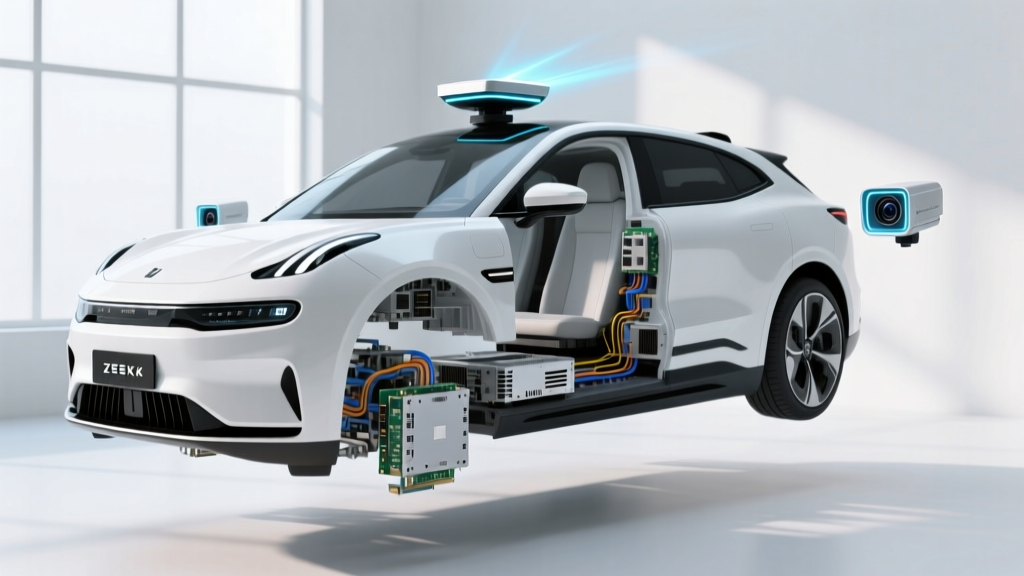
Processing 20 high-resolution camera feeds alongside dense LiDAR point clouds requires immense onboard compute. The vehicle's 'brain' is typically housed in the trunk or underbody, utilizing advanced AI inference chips (such as custom ASICs or NVIDIA DRIVE Orin-based architectures) capable of exceeding 1,000 TOPS (Tera Operations Per Second).
The Hidden Cost: Thermal Throttling Mitigation
A frequent failure mode in early robotaxi deployments was compute thermal throttling in high-ambient-heat environments like Phoenix or Death Valley. When the AI trunk exceeds 85°C, the system intentionally degrades processing power to prevent silicon damage, forcing the vehicle to pull over. To solve this, 2026 builds incorporate a dedicated liquid cooling loop separate from the cabin HVAC and battery thermal systems.
Adding a secondary glycol-based liquid cooling loop, complete with dedicated radiators, pumps, and aerospace-grade shielding, adds approximately $3,200 to the build cost and requires an additional 45 minutes of assembly line time. However, this eliminates heat-related disengagements, increasing fleet uptime by an estimated 14%.
The combined cost for the compute node, shielded twisted-pair networking harnesses (required to prevent electromagnetic interference with the 800V drive system), and the dedicated thermal management loop is approximately $9,800.
Integration, Calibration, and Homologation Overhead
Assembling the hardware is only half the battle. Before a Waymo vehicle can be deployed, it must undergo rigorous end-of-line (EOL) calibration and federal homologation. The NHTSA Automated Vehicles Safety guidelines mandate strict documentation and validation for all Level 4 ADS (Automated Driving Systems).
- Optical Calibration (45 minutes): The vehicle is driven into a specialized light-controlled booth where targets are used to align the extrinsic parameters of all 20+ cameras and LiDAR units to the millimeter.
- IMU and Steering Bias Mapping (20 minutes): The vehicle's inertial measurement units are calibrated to the exact center of gravity and steering rack dead-center.
- Software Flashing and Cryptographic Signing (15 minutes): The ADS software stack is securely flashed, and hardware security modules (HSM) are provisioned to prevent remote hijacking.
Factory integration, specialized EOL calibration equipment amortization, and regulatory compliance testing add roughly $6,500 to $8,200 per vehicle. According to Deloitte's autonomous vehicle market analysis, mastering this end-of-line calibration process is the primary bottleneck preventing newer AV startups from scaling their fleets as rapidly as Waymo.
Total Build Cost vs. Revenue Payback Period
When aggregating the OEM base platform ($38,500 avg), the 6th Gen sensor suite ($18,500 avg), compute and thermal systems ($9,800), and integration/calibration ($7,350 avg), the median build cost for a 2026 Waymo Zeekr RT lands at $74,150.
While this is significantly higher than a standard consumer EV, the unit economics of a robotaxi favor high utilization. A human-driven rideshare vehicle generates revenue for perhaps 4 to 6 hours a day. A Waymo vehicle, limited only by charging and automated cleaning, can operate for 18 to 20 hours a day. At an average gross margin of $15 per trip, and completing 40 trips daily, the hardware payback period for the AV premium (the ~$35,000 delta over a standard Zeekr RT) is achieved in roughly 14 to 18 months of continuous operation, well before the vehicle's 5-year/500,000-mile structural lifespan expires.
Frequently Asked Questions
How much does it cost to replace a damaged LiDAR unit in the field?
While the factory build cost for the LiDAR array is around $8,500, field replacement costs are higher due to labor and the requirement for mobile recalibration. Expect a field replacement invoice to exceed $11,000 per incident, which is why the 6th Gen pod features sacrificial impact-absorbing shrouds designed to protect the optical cores from minor low-speed collisions.
Does the build cost include the remote assistance hardware?
Written by
Elena RodriguezElena Rodriguez is a civil engineer and technical writer specializing in concrete technology, masonry systems, and ASTM/ACI compliance. She earned her B.S. in Civil Engineering from Texas A&M University and spent a decade at a materials testing laboratory, performing over 2,000 concrete compressive strength tests and masonry prism evaluations. Elena is an ACI-certified Field Testing Technician (Grade I) and a member of ASTM Committee C12 on Natural Building Stone. She currently consults on forensic engineering cases involving concrete failures and moisture intrusion. Based in San Antonio, TX, Elena is a proud member of the Society of Women Engineers (SWE) and coaches her daughter's FIRST Robotics team.
More from Elena Rodriguez
View all
Walls & Panels
Cost Analysis: Light Gauge Steel Framing Advantages and Disadvantages
Evaluate light gauge steel framing advantages and disadvantages through a strict cost analysis lens, comparing material, labor, and lifecycle expenses.
Aug 4, 2026

Walls & Panels
Gypsum Board Types: Exact Specifications, Thickness & Dimensions
Compare standard, Type X, and moisture-resistant gypsum board types. Get exact specifications, thicknesses, dimensions, and ASTM standards for your project.
Aug 4, 2026

Fire Resistance
Best Fire-Resistant Outdoor Decking Materials: 2026 Buyer Guide
Discover the best fire-resistant outdoor decking materials for 2026. Compare Class A PVC, aluminum, and hardwood options for WUI compliance and safety.
Aug 4, 2026