Cost to Build a Wind Farm: Detailed 2026 Breakdown
Comprehensive breakdown of the cost to build wind farm infrastructure in 2026, covering turbine CapEx, civil works, grid interconnection, and soft costs.

The Economics of Utility-Scale Wind Infrastructure
Estimating the cost to build wind farm infrastructure requires moving beyond simple per-megawatt averages. Utility-scale onshore wind projects involve complex supply chains, heavy civil engineering, and high-voltage electrical integration. In 2026, the baseline capital expenditure (CapEx) for a utility-scale onshore wind farm ranges from $1.5 million to $2.2 million per megawatt (MW) of installed capacity. However, this figure fluctuates wildly based on geotechnical conditions, grid interconnection distances, and turbine class selection.
According to data from the National Renewable Energy Laboratory (NREL) Annual Technology Baseline, while turbine efficiency has improved with larger rotor diameters, the physical logistics of transporting and erecting these massive structures have driven up balance-of-plant (BOP) costs. Developers must account for every phase, from pre-development permitting to final substation commissioning.
Capital Expenditure (CapEx) Breakdown by Component
The following table illustrates the typical cost distribution for a 100 MW onshore wind project utilizing modern 5 MW to 7 MW class turbines. Costs are expressed per megawatt of nameplate capacity.
| Project Component | Estimated Cost per MW | % of Total CapEx | Primary Cost Drivers |
|---|---|---|---|
| Turbine Procurement | $950,000 - $1,250,000 | 60% - 65% | Nacelle, blades, tower sections, OEM warranties |
| Civil Works & Foundations | $200,000 - $350,000 | 12% - 16% | Concrete, rebar, access roads, crane pads |
| Electrical BOP & Collection | $150,000 - $250,000 | 10% - 12% | Medium-voltage cabling, pad-mounted transformers |
| Grid Interconnection & Substation | $100,000 - $220,000 | 7% - 10% | High-voltage transmission lines, switchgear, SCADA |
| Erection & Installation Labor | $80,000 - $120,000 | 5% - 6% | Main crawler cranes, rigging crews, specialized equipment |
| Pre-Development & Soft Costs | $50,000 - $90,000 | 3% - 5% | Environmental studies, permitting, legal, land leases |
Turbine Procurement and Heavy Haul Logistics
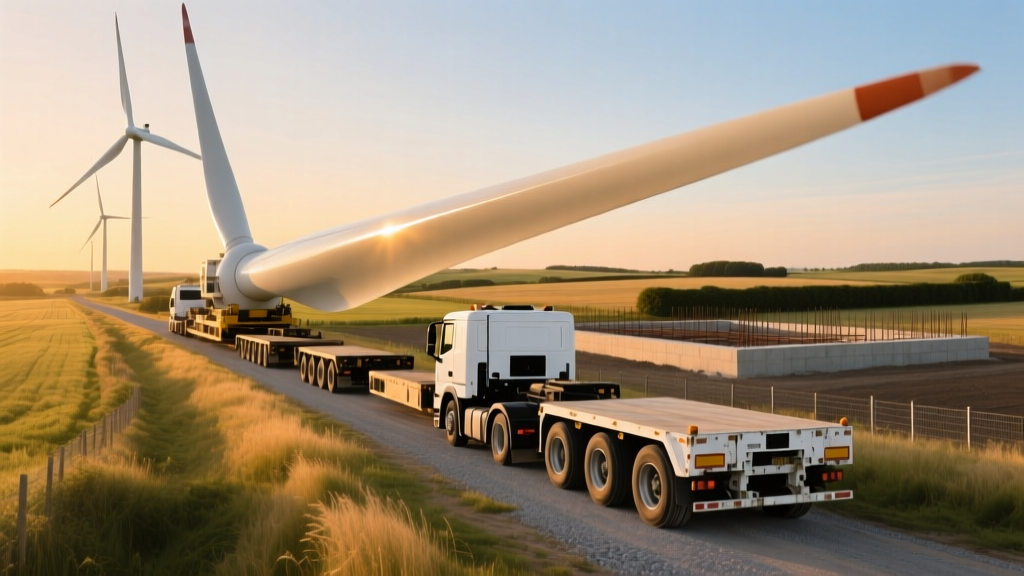
The turbine itself represents the largest single line item. Modern onshore turbines, such as the GE Vernova 6.1-158 or Vestas V172, feature rotor diameters exceeding 160 meters to capture lower wind speeds. While the ex-works price of these turbines has stabilized, the logistics of delivering them to the site introduce severe cost variables.
Civil Works and Foundation Engineering
Wind turbine foundations are massive gravity structures designed to withstand extreme overturning moments. For a 6 MW turbine with a 160-meter hub height, the foundation typically requires 800 to 1,100 cubic yards of high-strength concrete (often a 5,000 PSI mix with fly ash to manage heat of hydration) and 60 to 90 tons of epoxy-coated reinforcing steel.
Geotechnical conditions dictate the final civil cost. If bedrock is encountered within the top 15 feet, drilling and blasting operations will be required, increasing excavation costs by 20% to 40%. Conversely, poor soil bearing capacity may necessitate driven steel H-piles or auger-cast piles extending 60 feet below grade, pushing foundation costs toward the upper end of the $350,000 per MW spectrum.
Pre-Development and Soft Costs: The Hidden Budget Killers
Warning: Interconnection Queue Delays
Do not underestimate the carrying costs of interconnection delays. According to the Lawrence Berkeley National Laboratory (LBNL) Wind Technologies Market Report, projects frequently spend 12 to 24 months in interconnection queues. During this period, developers must absorb land lease option payments, legal retainers, and inflation on locked-in EPC (Engineering, Procurement, and Construction) contracts, which can erode project IRR (Internal Rate of Return) by 1.5% to 3% before a single shovel hits the dirt.
Soft costs also encompass extensive environmental and acoustic modeling. Developers must fund avian radar studies, shadow flicker analysis, and noise propagation modeling to secure local conditional use permits. Budget a minimum of $40,000 to $75,000 per site for comprehensive Phase I and Phase II environmental site assessments and biological surveys.
Grid Interconnection and Electrical Balance of Plant (BOP)
The electrical collection system aggregates the power generated by individual turbines and routes it to a central substation. This involves trenching or directional boring for 15 kV to 34.5 kV medium-voltage underground cables. Directional boring is increasingly preferred in agricultural areas to minimize topsoil disruption, but it costs approximately 30% more than traditional open-trenching.
The point of interconnection (POI) substation is a critical cost milestone. A 100 MW project stepping up voltage from 34.5 kV to 115 kV or 230 kV requires a custom-built substation featuring power transformers, capacitor banks for reactive power compensation, and high-voltage circuit breakers. Substation costs scale non-linearly; a 345 kV interconnection can cost three times as much as a 115 kV connection due to the required clearance distances and heavy-duty switchgear.
Utility-Scale vs. Distributed Small Wind: Cost Comparison Matrix
Not all wind projects are utility-scale. Distributed or 'small wind' projects (under 100 kW) serve a completely different economic model, often used for agricultural or remote industrial applications.
| Feature | Utility-Scale Onshore (>50 MW) | Distributed / Small Wind (<100 kW) |
|---|---|---|
| Cost per kW | $1,500 - $2,200 | $4,000 - $8,000 |
| Turbine Size | 3 MW - 7 MW | 5 kW - 100 kW |
| Grid Connection | High-voltage substation required | Direct to local distribution panel |
| Maintenance Model | OEM Long-Term Service Agreement (LTSA) | Owner-operated or third-party local tech |
| Primary Use Case | Wholesale power market, PPA sales | Behind-the-meter offset, remote pumping |
Value Engineering: Reducing Cost Per Megawatt
To optimize the cost to build wind farm infrastructure, developers and EPC contractors employ several value engineering strategies:
- LiDAR Wind Resource Assessment: Replacing traditional 100-meter meteorological towers with ground-based vertical profiling LiDAR units reduces site assessment costs by 40% and allows for rapid relocation to optimize micro-siting.
- Standardized Foundation Designs: Utilizing standardized gravity base designs across a project portfolio, adjusting only the rebar density and concrete volume based on localized soil bearing capacity, reduces engineering overhead and formwork fabrication time.
- Optimized Crane Pads: Instead of compacting massive 10,000-square-foot crane pads for the main erection crane (such as a Liebherr LR 11000), engineers use high-modulus geogrids and crushed aggregate to reduce earthwork volume while maintaining the required ground bearing pressure of 2,500 PSF.
- Collector System Voltage Optimization: Upgrading the internal collection system from 15 kV to 34.5 kV allows for longer cable runs with lower amperage, reducing copper/aluminum cable size and minimizing line losses, which offsets the slightly higher cost of 34.5 kV pad-mounted transformers.
Frequently Asked Questions
How long does it take to construct a 100 MW wind farm?
Physical construction typically takes 9 to 14 months from the start of civil earthwork to final commissioning. However, pre-development, permitting, and interconnection studies usually require an additional 2 to 4 years prior to breaking ground.
What is the operational lifespan factored into these costs?
Modern utility-scale wind farms are engineered for a 25 to 30-year operational lifespan. The CapEx estimates above include standard OEM warranties (typically 2 to 5 years), after which the owner assumes operations and maintenance (O&M) costs, which average $40 to $50 per kW per year.
Written by
Elena RodriguezElena Rodriguez is a civil engineer and technical writer specializing in concrete technology, masonry systems, and ASTM/ACI compliance. She earned her B.S. in Civil Engineering from Texas A&M University and spent a decade at a materials testing laboratory, performing over 2,000 concrete compressive strength tests and masonry prism evaluations. Elena is an ACI-certified Field Testing Technician (Grade I) and a member of ASTM Committee C12 on Natural Building Stone. She currently consults on forensic engineering cases involving concrete failures and moisture intrusion. Based in San Antonio, TX, Elena is a proud member of the Society of Women Engineers (SWE) and coaches her daughter's FIRST Robotics team.
More from Elena Rodriguez
View all
Walls & Panels
Cost Analysis: Light Gauge Steel Framing Advantages and Disadvantages
Evaluate light gauge steel framing advantages and disadvantages through a strict cost analysis lens, comparing material, labor, and lifecycle expenses.
Aug 4, 2026

Walls & Panels
Gypsum Board Types: Exact Specifications, Thickness & Dimensions
Compare standard, Type X, and moisture-resistant gypsum board types. Get exact specifications, thicknesses, dimensions, and ASTM standards for your project.
Aug 4, 2026

Fire Resistance
Best Fire-Resistant Outdoor Decking Materials: 2026 Buyer Guide
Discover the best fire-resistant outdoor decking materials for 2026. Compare Class A PVC, aluminum, and hardwood options for WUI compliance and safety.
Aug 4, 2026