Best Fire-Resistant Outdoor Decking Materials: 2026 Buyer Guide
Discover the best fire-resistant outdoor decking materials for 2026. Compare Class A PVC, aluminum, and hardwood options for WUI compliance and safety.

Homeowners and contractors building in wildfire-prone regions require WUI compliant deck boards to meet stringent safety codes. Wildland-Urban Interface (WUI) compliant decking refers to materials that have passed rigorous fire testing, specifically achieving a Flame Spread Index (FSI) of 200 or less under American Society for Testing and Materials (ASTM) E84 standards, or earning a specific listing from the California Office of the State Fire Marshal (OSFM) under Chapter 7A. For residents in high-risk fire zones, selecting the right WUI approved decking is not just a code requirement; it is a critical defense against ember intrusion.
Key Takeaways
- WUI compliance requires a Flame Spread Index (FSI) of 200 or lower.
- Capped PVC and aluminum decking offer the highest inherent fire resistance.
- Standard wood-plastic composites must be specifically tested and listed for WUI zones.
- Substructure and under-deck clearance are just as critical as the surface boards.
Table of Contents
- Core Definitions
- Top WUI Approved Decking Materials
- Material Comparison Matrix
- Substructure and Clearance Requirements
- Frequently Asked Questions
- Conclusion and Next Steps
Core Definitions
Wildland-Urban Interface (WUI): The geographical zone where human development and infrastructure meet or intermingle with undeveloped wildland vegetation, creating a high-risk environment for wildfire spread and necessitating specialized fire-resistant building materials to protect residential structures from radiant heat and flying embers during seasonal fires.
Flame Spread Index (FSI): A numerical rating assigned to a building material based on standardized testing that measures how quickly flames travel across its surface. A lower index indicates superior fire resistance, with modern wildland codes typically requiring a rating below two hundred for exterior applications.
Top WUI Approved Decking Materials
When evaluating fire-resistant decking materials for the 2026 building season, you must look beyond basic aesthetics and focus on thermal performance and ember resistance.
Capped Polymer and PVC Decking
Cellular polyvinyl chloride (PVC) decking is widely considered the gold standard for Chapter 7A compliant deck boards. Because it contains no wood fibers, it lacks the organic fuel that feeds fires. High-end PVC boards typically achieve an FSI between 75 and 120. While the upfront cost ranges from $12 to $16 per square foot, the material will not absorb moisture or ignite from small wind-blown embers.
Capped Wood-Plastic Composites
Not all composite decking is WUI compliant. Standard composites contain wood flour, which can smolder. However, heavily capped composites featuring a 5/4-inch thickness and a full polymer shield can pass WUI testing. Always verify the specific product SKU against the California OSFM WUI Building Materials list before purchasing, as compliance varies by color and manufacturing batch.
Aluminum Decking Systems
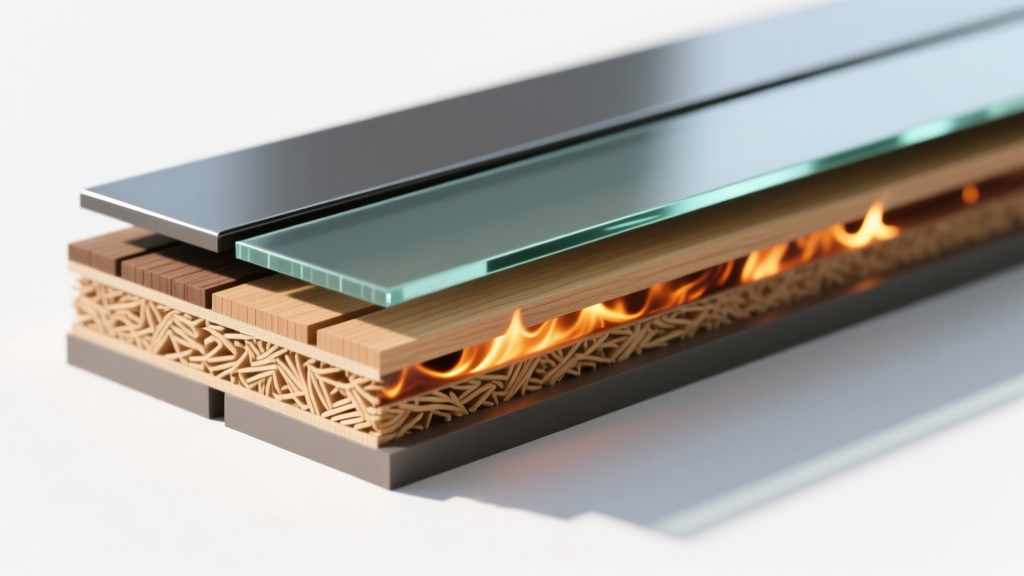
Aluminum decking is entirely non-combustible and will not contribute to a fire's fuel load. Modern aluminum boards feature interlocking channels that prevent embers from falling into the substructure. The primary drawback is the higher price point, averaging $15 to $22 per square foot, and a distinct metallic aesthetic that differs from natural wood.
Fire-Retardant Treated (FRT) Wood
For homeowners demanding a natural wood look, FRT lumber is pressure-impregnated with fire-retardant chemicals. While it meets initial WUI codes, the National Fire Protection Association (NFPA) notes that the fire-retardant efficacy can diminish over time if exposed to continuous moisture. FRT wood requires strict adherence to a 25-year warranty maintenance schedule, including annual sealing, to remain compliant.
WUI Decking Material Comparison Matrix
| Material Type | Average FSI | Cost per Sq Ft | Ember Resistance | Maintenance Level |
|---|---|---|---|---|
| Capped PVC | 75 - 120 | $12 - $16 | Excellent | Low |
| WUI-Listed Composite | 130 - 190 | $9 - $14 | Very Good | Low |
| Aluminum | 0 (Non-combustible) | $15 - $22 | Superior | Minimal |
| FRT Wood | 150 - 200 | $6 - $9 | Good (when sealed) | High |
Beyond the Boards: Substructure and Clearance Requirements
Installing WUI compliant deck boards is only half the battle. The National Fire Protection Association emphasizes that embers frequently ignite the substructure or debris trapped beneath the deck. To achieve true wildfire resilience, you must maintain a strict 10-foot clearance of non-combustible material (like gravel or concrete) directly under the deck. Furthermore, consider using steel joists or heavy timber framing (minimum 6x6 inches) rather than standard 2x8 pine joists, as heavier timbers char on the outside and retain structural integrity longer during a radiant heat event.
Frequently Asked Questions About WUI Decking
What makes a deck WUI compliant?
A deck is WUI compliant when its surface boards, substructure, and under-deck clearance meet local wildland fire codes. This generally requires surface materials with an FSI of 200 or less, non-combustible under-deck zoning, and the use of metal flashing to protect the ledger board where the deck attaches to the house.
Can I use standard composite decking in a WUI zone?
No. Standard, uncapped, or older-generation composite decking often contains high percentages of exposed wood fiber and fails WUI testing. You must use specific SKUs of capped composite that are explicitly listed on your state's approved WUI materials registry.
How do I maintain WUI decking to keep it compliant?
Maintenance involves clearing pine needles, leaves, and debris from the deck surface and the gaps between boards. For FRT wood, you must reapply approved fire-retardant sealants according to the manufacturer's schedule to prevent the chemicals from leaching out due to weathering.
Conclusion and Next Steps
Selecting the best fire-resistant outdoor decking materials for wildfire zones requires balancing upfront costs with long-term survivability. Capped PVC and aluminum provide the most reliable, low-maintenance defense against ember intrusion, while WUI-listed composites offer a middle ground for budget-conscious builders. To ensure your project passes inspection, your immediate next step is to download the current year's approved materials list from your local building department or the State Fire Marshal's website, and cross-reference your chosen decking SKU before finalizing your lumber order.
Written by
Elena RodriguezElena Rodriguez is a civil engineer and technical writer specializing in concrete technology, masonry systems, and ASTM/ACI compliance. She earned her B.S. in Civil Engineering from Texas A&M University and spent a decade at a materials testing laboratory, performing over 2,000 concrete compressive strength tests and masonry prism evaluations. Elena is an ACI-certified Field Testing Technician (Grade I) and a member of ASTM Committee C12 on Natural Building Stone. She currently consults on forensic engineering cases involving concrete failures and moisture intrusion. Based in San Antonio, TX, Elena is a proud member of the Society of Women Engineers (SWE) and coaches her daughter's FIRST Robotics team.
More from Elena Rodriguez
View all
Walls & Panels
Cost Analysis: Light Gauge Steel Framing Advantages and Disadvantages
Evaluate light gauge steel framing advantages and disadvantages through a strict cost analysis lens, comparing material, labor, and lifecycle expenses.
Aug 4, 2026

Walls & Panels
Gypsum Board Types: Exact Specifications, Thickness & Dimensions
Compare standard, Type X, and moisture-resistant gypsum board types. Get exact specifications, thicknesses, dimensions, and ASTM standards for your project.
Aug 4, 2026

Construction Cost
How Much Did the Biltmore Estate Cost to Build? $6M (1895)
The Biltmore Estate cost $6M in 1895 — $1.6B in today's GDP terms. See the full construction cost breakdown, inflation analysis & modern financing.
Jul 30, 2026