How Much Does It Cost to Build a Wine Cellar? Size & Scope Guide
Discover how much it costs to build a wine cellar based on size, scope, and cooling needs. Use our calculator framework for accurate budgeting.

The Core Variables: How Size and Scope Dictate Wine Cellar Costs
Determining exactly how much does it cost to build a wine cellar requires moving beyond simple square-footage averages. A wine cellar is essentially a highly calibrated refrigerator wrapped in finished carpentry. The final price is driven by three intersecting scopes: the physical footprint (square and cubic footage), the thermal envelope (insulation and vapor barriers), and the mechanical load (cooling capacity and electrical requirements).
As of current 2026 material and labor rates, a fully active, climate-controlled wine cellar costs between $300 and $650 per square foot. However, calculating your specific budget requires breaking down the project by bottle capacity and structural conversion type.
Wine Cellar Cost Calculator: Price per Square Foot & Bottle Capacity
Use the matrix below to estimate your baseline construction costs. These ranges assume a dedicated, actively cooled space with custom racking, proper insulation, and an exterior-grade door.
| Cellar Size (Sq. Ft.) | Cubic Volume | Approx. Bottle Capacity | Estimated Cost Range | Cost Per Sq. Ft. |
|---|---|---|---|---|
| 25 - 50 | 200 - 400 cu ft | 150 - 400 | $8,000 - $22,000 | $320 - $440 |
| 50 - 100 | 400 - 800 cu ft | 400 - 900 | $22,000 - $55,000 | $440 - $550 |
| 100 - 200 | 800 - 1,600 cu ft | 900 - 1,800 | $55,000 - $110,000 | $550 - $550 |
| 200 - 400+ | 1,600+ cu ft | 1,800 - 4,000+ | $110,000 - $250,000+ | $550 - $650+ |
Scope Breakdown: Where the Budget Actually Goes
To understand your quote, you must understand the proportional weight of each construction phase. Here is how a typical $50,000 wine cellar budget is distributed.
1. Insulation and Vapor Barriers (15% - 20% of Budget)
This is the most critical hidden cost. A standard interior wall (R-13 fiberglass batts) is entirely insufficient for a wine cellar. You must achieve a minimum of R-19 in the walls and R-30 in the ceiling. The industry standard is 2lb closed-cell spray foam. According to the U.S. Department of Energy, closed-cell foam not only provides high R-values per inch but also acts as a primary moisture barrier. However, a secondary 6-mil polyethylene vapor barrier must still be installed on the warm side of the walls, with all seams taped using specialized acoustic/sealant tape to prevent ambient moisture from migrating into the cellar and causing mold or cooling coil freeze-ups.
2. Climate Control Systems (20% - 25% of Budget)
Wine requires strict environmental stability. As noted by Wine Spectator, the ideal storage temperature is 55°F with a relative humidity between 55% and 75%. To achieve this, you cannot use a standard HVAC register. You need a dedicated wine cooling unit (brands like WhisperKOOL, CellarPro, or Wine Guardian).
- Through-the-wall units: $1,500 - $3,000. Best for small, under-stair cellars under 300 cu. ft.
- Split systems (evaporator inside, condenser outside): $4,000 - $8,500. Required for larger rooms or spaces where exterior wall venting is impossible.
- Ducted systems: $6,000 - $12,000+. Used for high-end custom builds where the mechanical equipment must be completely hidden and silent.
3. The Door Specification (5% - 8% of Budget)
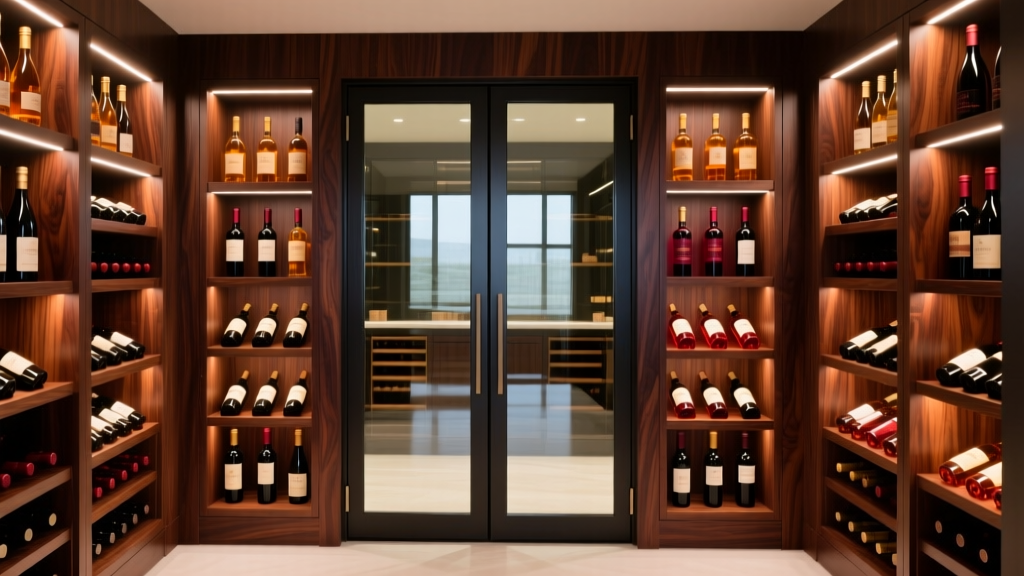
A standard interior bedroom door will ruin a wine cellar. The door must be exterior-grade, minimum 1.75 inches thick, and feature an automatic door bottom (ADB) to seal the gap at the threshold. If you want a glass door to display the collection, it must be dual-pane, tempered, argon-gas-filled, and feature a UV-blocking low-E coating. Expect to pay $2,500 to $5,500 for a properly rated custom glass wine door.
Material Tiers: Racking, Flooring, and Lighting
The aesthetic scope is where budgets experience the highest variance. Use this comparison matrix to select your material tier.
| Component | Economy / Builder Grade | Mid-Tier / Custom Standard | Premium / Luxury |
|---|---|---|---|
| Racking Wood | Kiln-dried Pine or Rustic Redwood ($6-$10/bottle opening) | All-Heart Redwood or Honduran Mahogany ($12-$22/bottle opening) | Acrylic, Metal, or Exotic Hardwoods like Walnut ($25-$45+/bottle opening) |
| Flooring | Sealed concrete or basic porcelain tile ($8-$12/sq ft) | Cork, slate, or engineered hardwood ($14-$22/sq ft) | Reclaimed wine barrel flooring or custom stone mosaic ($30-$60+/sq ft) |
| Lighting | Recessed LED cans ($150-$300 total) | LED ribbon lighting under shelves with dimmers ($800-$1,500 total) | Fiber optic chandeliers and backlit onyx display walls ($3,000-$8,000+) |
Real-World Scenarios: 3 Wine Cellar Build Profiles
Scenario A: The Under-Stair Conversion (Small Scope)
- Dimensions: 35 sq. ft. / 280 cu. ft.
- Capacity: ~250 bottles
- Scope: Framing existing space, installing a through-the-wall cooling unit (e.g., WhisperKOOL SlimLine), basic redwood racking, solid wood exterior door, and LED puck lighting.
- Estimated Cost: $11,000 - $16,000
Scenario B: The Spare Bedroom Conversion (Medium Scope)
- Dimensions: 120 sq. ft. / 960 cu. ft.
- Capacity: ~1,100 bottles
- Scope: Full demo of existing drywall, closed-cell spray foam, 6-mil vapor barrier, split-system cooling unit with exterior condenser, mahogany racking with a center tasting table, cork flooring, and a custom dual-pane glass door.
- Estimated Cost: $45,000 - $65,000
Scenario C: The Basement Custom Build-Out (Large Scope)
- Dimensions: 250 sq. ft. / 2,250 cu. ft.
- Capacity: ~2,500 bottles
- Scope: Framing new walls in an existing basement, ducted climate control system hidden in the ceiling, premium metal and wood hybrid racking, stone tile flooring, backlit display rows for large-format bottles, and a commercial-grade humidity injection system.
- Estimated Cost: $125,000 - $180,000+
Common Sizing Mistakes That Inflate Costs
When using a size and scope calculator, avoid these frequent miscalculations that lead to massive change orders mid-project:
- Ignoring the Heat Load of Glass: If your cellar features a large glass viewing wall facing a living room, your cooling unit must be sized up by at least 30% to compensate for the thermal transfer. Standard BTU calculators assume solid, insulated walls.
- Undersizing the Electrical Circuit: Most split-system and ducted wine cooling units require a dedicated 20-amp circuit. If your electrical panel is full, adding a sub-panel or upgrading service can add $1,500 to $3,500 to your scope.
- Forgetting the Condensate Drain Line: Active cooling units pull moisture from the air. While some small units use evaporative trays, larger split systems require a gravity or pumped condensate drain line routed to a floor drain or sink. If plumbing is not nearby, installing a condensate pump and running PVC tubing through finished walls adds $600 to $1,200 to the labor scope.
By accurately calculating your cubic volume, selecting the appropriate thermal envelope, and matching your cooling unit to the specific heat load of your room, you can lock in an accurate budget and protect your wine investment for decades.
Written by
Marcus ChenMarcus Chen is a licensed structural engineer (PE) and building materials analyst with over 12 years of experience across residential, commercial, and industrial construction. He holds a Master of Science in Civil Engineering from UC Berkeley and spent six years at Thornton Tomasetti before transitioning to independent consulting and technical writing. Marcus specializes in material selection for seismic-prone regions, concrete reinforcement strategies, and lifecycle cost analysis. His work has been cited by the American Concrete Institute (ACI) and the Structural Engineers Association of California (SEAOC). When he is not on a job site or at his desk, you will find him hiking the Sierra Nevada or restoring a 1920s craftsman bungalow in Oakland, CA.
More from Marcus Chen
View all
Construction Cost
How Much Did the Eiffel Tower Cost to Build?
How much did the Eiffel Tower cost to build in 1889? We adjust for inflation and compare its budget to modern skyscraper construction.
Aug 4, 2026

Fire Resistance
What Is a Fire Resistant Material? Testing & Certification Guide
Discover what is a fire resistant material through ASTM and UL testing. Learn how fire ratings, certifications, and assemblies work in construction.
Aug 4, 2026

Construction Cost
How Much Did the Burj Khalifa Cost to Build?
How much did the Burj Khalifa cost to build? We break down the $1.5B project and extract 5 money-saving strategies for your next build.
Jul 30, 2026