How Much Does It Cost to Build a WordPress Website for Contractors?
Discover exactly how much it costs to build a WordPress website for your construction business, from hosting to premium plugins and financing.
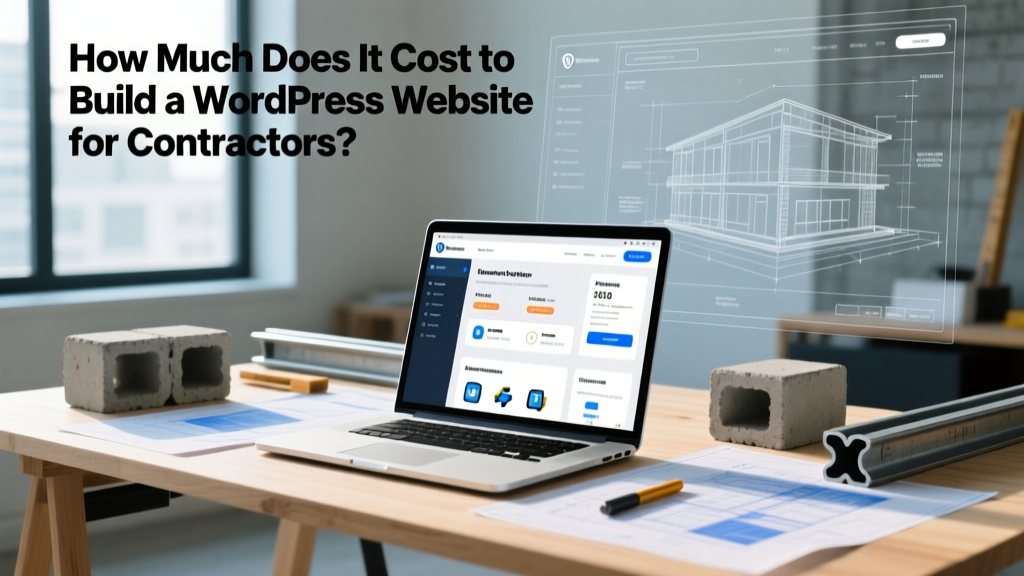
The Digital Foundation: Estimating Your Online Build
When construction firm owners ask how much does it cost to build a WordPress website, they are usually comparing digital overhead against physical equipment leases. Just as you would not pour a foundation without a soil test and structural blueprint, you should not invest in a digital presence without a precise cost estimate. For general contractors, custom home builders, and specialized trades, a website is not just a digital brochure; it is a 24/7 lead-generation engine, a client portal for project updates, and a recruitment tool for skilled labor.
In 2026, the cost of building a professional WordPress site for a construction business ranges from $450 per year for a basic DIY setup to over $15,000 for a fully integrated, agency-built digital headquarters. This guide breaks down the exact material and labor costs of your digital build, helping you secure the right financing and allocate your technology budget effectively.
Core Infrastructure: Domains, Hosting, and Security
Your domain name is your digital job site address, and your hosting server is the land it sits on. Construction websites are notoriously media-heavy, requiring high-resolution project galleries, 3D render downloads, and drone footage videos. Standard shared hosting will buckle under this load, resulting in slow page speeds that destroy your local SEO rankings.
Hosting Tiers for Construction Sites
| Hosting Tier | Recommended Provider | Est. Annual Cost | Best For |
|---|---|---|---|
| Entry-Level Managed | SiteGround (GoGeek) | $180 - $250 | Single-trade contractors (plumbing, roofing) with static portfolios. |
| Professional Managed | WP Engine (Professional) | $600 - $800 | General contractors needing high-speed image delivery and staging environments. |
| Enterprise / High-Traffic | Kinsta or WP Engine (Scale) | $1,200 - $2,500+ | Large design-build firms with heavy traffic, client portals, and API integrations. |
Domain & SSL: Expect to pay $15 to $25 annually for a premium .com domain. SSL certificates are typically included free with managed WordPress hosts via Let's Encrypt, but specialized EV (Extended Validation) SSL certificates for client portal security can cost an additional $150 to $300 per year.
Design and Development: Theme vs. Custom Build
The structural framing of your website dictates both upfront costs and long-term maintenance. You have three primary paths for the design phase.
1. Premium Templates (The Prefab Approach)
Using a premium theme like Astra Pro or GeneratePress combined with a page builder like Elementor Pro is the digital equivalent of modular construction. It is fast, cost-effective, and highly customizable.
- Astra Pro / GeneratePress Premium: $59 to $79 annually.
- Elementor Pro: $59 annually (for a single site license).
- Labor (DIY or Freelancer): $0 to $1,500 for setup and customization.
2. Custom Agency Build (The Architect-Designed Approach)
For design-build firms requiring bespoke interactions, custom CSS/JS animations, and deep CRM integrations, hiring a specialized digital agency is necessary. Agencies conduct UX research, design custom Figma prototypes, and code lightweight, bespoke themes.
- Upfront Cost: $6,000 to $15,000+.
- Timeline: 8 to 14 weeks.
- Value Add: Includes conversion rate optimization (CRO), technical SEO architecture, and ADA compliance (WCAG 2.2 standards).
Essential Plugins for the Construction Trade
A bare WordPress installation is like a framed house without MEP (mechanical, electrical, plumbing) rough-ins. To make your site functional for a construction business, you must install specialized plugins. Here are the non-negotiable tools for 2026:
- Gravity Forms (Elite License): $259/year. Essential for building complex 'Get a Quote' calculators and multi-step project intake forms.
- HubSpot CRM Integration: Free to $800/year. Automatically routes form submissions to your sales team and tracks client interactions.
- Smush Pro / ShortPixel: $60 to $120/year. Automatically compresses massive drone and job-site photos without losing visual fidelity, preserving your page load speeds.
- Wordfence Premium: $119/year. Construction sites are frequent targets for botnets looking to exploit vulnerable plugins. Enterprise-grade firewalls are mandatory.
Financing Your Digital Build: CapEx vs. OpEx
Understanding how to finance and account for your website is critical for cash flow management. A $10,000 custom website build should not necessarily be paid out of a single month's operating account.
Capital Expenditure (CapEx) vs. Operating Expense (OpEx)
According to IRS guidelines (always consult your CPA), the initial development cost of a custom website can often be capitalized as a digital asset and depreciated over time, or potentially deducted under Section 179. Conversely, monthly hosting, domain renewals, and plugin subscriptions are treated as standard operating expenses (OpEx).
Financing Options for Contractors
- SBA Microloans: The SBA Microloan program provides up to $50,000 for small business upgrades, including digital transformation and marketing infrastructure. This is ideal for firms needing a $15,000 agency build but wanting to preserve working capital for physical materials.
- Business Line of Credit: Draw against your existing credit line to pay the 50% upfront deposit required by most web agencies, paying it down as the new website generates qualified leads.
- Equipment Financing Tie-ins: Some forward-thinking construction lenders allow you to bundle 'digital infrastructure' into larger technology upgrade loans alongside drone fleets and laser scanners.
Total Cost Matrix: Year One vs. Ongoing
To accurately forecast your digital overhead, review this cost matrix comparing the three primary build strategies for a construction firm.
| Cost Category | DIY / Modular Build | Freelance Developer | Specialized Agency |
|---|---|---|---|
| Hosting & Domain | $200 / yr | $600 / yr | $1,500 / yr |
| Theme & Builder Licenses | $120 / yr | $0 (Included in fee) | $0 (Included in fee) |
| Premium Plugins (Forms, SEO) | $300 / yr | $400 / yr | $800 / yr |
| Design & Development Labor | $0 (Your time) | $2,500 - $5,000 | $8,000 - $15,000+ |
| Copywriting & SEO Strategy | $0 (DIY) | $500 - $1,000 | $2,500 - $5,000 |
| Total Year One Cost | $620 | $4,000 - $7,000 | $12,800 - $22,300 |
| Year Two+ Maintenance | $620 / yr | $1,000 / yr + retainers | $2,300 / yr + retainers |
Ongoing Maintenance: The Digital Punch List
A website is never truly finished; it requires continuous maintenance, much like a physical facility. Budget for the following ongoing costs to prevent your digital asset from degrading:
- Plugin & Core Updates: 2 to 4 hours per month. If you do not have an in-house IT person, expect to pay a freelancer $75 to $125 per hour for a monthly maintenance retainer ($150 - $500/month).
- Content Updates: Uploading new project galleries, writing case studies, and updating team bios. Allocate 5 hours of internal staff time monthly.
- SEO & Local Search: Maintaining local citations, optimizing for 'general contractor near me' keywords, and managing Google Business Profile integrations. Agency retainers for construction SEO typically start at $1,500/month.
'A cheap website is like a cheap foundation. It might look fine on the day of the handover, but within a year, the cracks will show, the leads will dry up, and you will pay double to tear it out and start over.' — Senior Construction Marketing Consultant
Final Estimating Takeaways
Determining how much it costs to build a WordPress website for your construction business ultimately depends on your firm's revenue goals. If you are a solo handyman or specialized trade relying on word-of-mouth, a $600 annual DIY setup using Elementor and SiteGround is sufficient. However, if you are a commercial GC or high-end custom builder competing for $2M+ contracts, your digital presence must reflect your physical build quality. In that case, securing $15,000 in financing for a bespoke, agency-built WordPress platform with deep CRM integrations is not an expense—it is a critical capital investment in your firm's future pipeline.
Written by
Marcus ChenMarcus Chen is a licensed structural engineer (PE) and building materials analyst with over 12 years of experience across residential, commercial, and industrial construction. He holds a Master of Science in Civil Engineering from UC Berkeley and spent six years at Thornton Tomasetti before transitioning to independent consulting and technical writing. Marcus specializes in material selection for seismic-prone regions, concrete reinforcement strategies, and lifecycle cost analysis. His work has been cited by the American Concrete Institute (ACI) and the Structural Engineers Association of California (SEAOC). When he is not on a job site or at his desk, you will find him hiking the Sierra Nevada or restoring a 1920s craftsman bungalow in Oakland, CA.
More from Marcus Chen
View all
Construction Cost
How Much Did the Eiffel Tower Cost to Build?
How much did the Eiffel Tower cost to build in 1889? We adjust for inflation and compare its budget to modern skyscraper construction.
Aug 4, 2026

Fire Resistance
What Is a Fire Resistant Material? Testing & Certification Guide
Discover what is a fire resistant material through ASTM and UL testing. Learn how fire ratings, certifications, and assemblies work in construction.
Aug 4, 2026

Construction Cost
How Much Did the Burj Khalifa Cost to Build?
How much did the Burj Khalifa cost to build? We break down the $1.5B project and extract 5 money-saving strategies for your next build.
Jul 30, 2026