Deck Materials Plymouth: 2026 Cost Breakdown Guide
Detailed 2026 cost breakdown for deck materials in Plymouth, MA. Compare wood, composite, and PVC pricing, labor rates, and coastal building tips.

The Plymouth Microclimate: How Coastal Exposure Dictates Material Choice
When sourcing deck materials, Plymouth homeowners face a unique set of environmental stressors that dictate long-term performance and overall budget. Situated on the South Shore of Massachusetts, Plymouth is exposed to high-humidity salt air, driving Nor'easters, and a strict 48-inch frost depth. These factors eliminate standard building practices and force a shift toward specialized coastal-grade materials.
Standard pressure-treated lumber, while initially cheap, requires annual sealing to prevent moisture intrusion and warping caused by the coastal freeze-thaw cycle. Furthermore, the salt spray accelerates the corrosion of standard galvanized fasteners, leading to structural failure within 5 to 7 years if improper hardware is used. According to the FEMA Coastal Construction guidelines, structures within 3,000 feet of the coastline must utilize highly corrosion-resistant materials, making capped composites and advanced PVC the dominant choices for Plymouth properties in 2026.
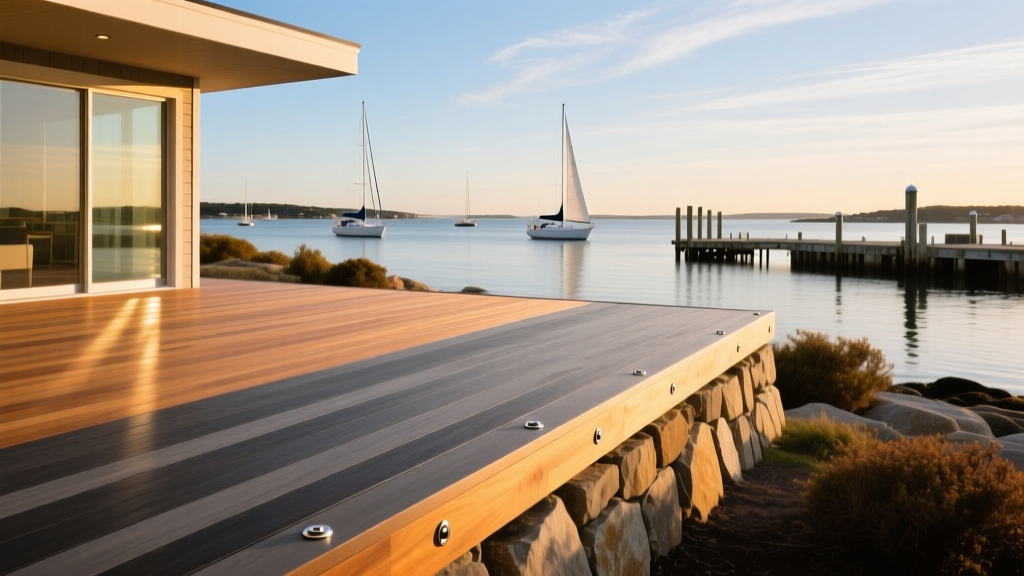
2026 Deck Materials Cost Matrix: Plymouth Market Rates
The cost of decking boards is just one variable in the total project budget. Below is a breakdown of the most common decking materials used in the Plymouth area, reflecting 2026 supplier pricing per square foot (materials only).
| Material Type | Brand / Product Line Example | Material Cost (Per Sq. Ft.) | Lifespan | Coastal Suitability |
|---|---|---|---|---|
| Pressure-Treated Pine | YellaWood / Standard SYP | $3.50 - $5.00 | 10-15 Years | Low (Requires annual sealing) |
| Cedar / Redwood | Western Red Cedar Clear | $7.00 - $10.50 | 15-20 Years | Medium (Prone to salt-air graying) |
| Capped Composite | Trex Transcend Lineage | $11.00 - $14.50 | 25-30 Years | High (Resists moisture and salt) |
| Advanced PVC | TimberTech Landmark | $14.00 - $18.00 | 30-50 Years | Very High (Zero moisture absorption) |
For Plymouth homes directly on the water (such as those in the Saquish Neck or Clark's Island areas), Advanced PVC is the recommended investment. PVC contains no wood fibers, meaning it cannot absorb the ambient coastal moisture that causes composite boards to swell or harbor mold in shaded, north-facing installations.
Beyond the Boards: Framing, Fasteners, and Footings
The most common point of failure in South Shore decks is not the decking board itself, but the substructure. A premium PVC deck will still collapse if the joists rot or the fasteners snap.
Substructure and Framing Costs
- Pressure-Treated Joists (Standard): $4.00 - $6.00 per sq. ft. Must be heavily flashed with butyl tape (e.g., Trex Protect) to prevent rot at the joist tops where water pools.
- Light-Gauge Steel Framing: $12.00 - $16.00 per sq. ft. Systems like Trex Elevations are increasingly popular in Plymouth because they will not rot, warp, or attract carpenter ants, ensuring the frame outlasts the PVC decking.
Fasteners: The Salt-Air Imperative
Footings: Navigating Plymouth's Frost Line and Soil
Massachusetts enforces a strict 48-inch frost depth, as outlined in the Massachusetts State Building Code (780 CMR). Traditional sonotubes filled with concrete require digging 4-foot-deep holes, which is highly labor-intensive in Plymouth's dense glacial till and rocky soil.
The 2026 Solution: Helical Piles. Steel helical piles (such as Techno Metal Post) are mechanically screwed into the ground below the frost line. They cost between $350 and $550 per pier installed but eliminate the need for concrete curing time, prevent frost heave, and cause minimal disruption to coastal root systems and landscaping.
Labor, Permitting, and Hidden Costs in Plymouth
Labor rates on the South Shore of Massachusetts run higher than the national average due to high local demand and the cost of living. According to data from the National Association of Home Builders (NAHB), specialized outdoor construction labor in the Northeast consistently tracks at the top tier nationally.
- Deck Framing & Board Installation Labor: $18.00 - $32.00 per sq. ft.
- Railing Installation (Composite/Glass): $35.00 - $60.00 per linear foot.
- Demolition & Haul-Away (Old Deck): $6.00 - $10.00 per sq. ft.
Plymouth Building Department Permit Fees
Any deck attached to a home, or freestanding deck over 200 square feet, requires a building permit from the Town of Plymouth. Permit fees are based on the estimated construction valuation. For a standard $30,000 deck project, expect to pay between $250 and $400 in permit fees. Additionally, if your property is located in a designated FEMA Flood Zone or near a coastal marsh, you will need a Conservation Commission review, which can add $500 to $1,500 in consulting and application fees.
Real-World Budget Scenario: 200 Sq. Ft. Coastal Deck
To provide a concrete financial framework, here is an itemized cost breakdown for a 200 square foot (10x20) attached deck using mid-to-high-tier materials suitable for Plymouth's coastal environment. This scenario assumes an 8-foot height requiring standard railings and stairs.
| Project Phase | Material Specification | Estimated Cost (2026) |
|---|---|---|
| Demo & Site Prep | Tear down existing 200 sq ft wood deck, haul away | $1,600 |
| Footings | 6x Helical Piles (installed to 54" depth) | $2,700 |
| Framing | PT Lumber with Butyl Joist Tape + Type 316 Hangers | $3,200 |
| Decking Boards | Capped Composite (e.g., Trex Select) + Hidden Clips | $2,600 |
| Railing & Stairs | Composite Railing with Aluminum Balusters (45 LF) | $3,150 |
| Labor | Full installation by licensed South Shore contractor | $5,500 |
| Permits & Misc | Plymouth Building Dept Permit, flashing, trim | $850 |
| TOTAL PROJECT COST | $19,600 | |
This yields a blended average cost of $98.00 per square foot. Opting for Advanced PVC and steel framing will push this total closer to $145 - $160 per square foot.
Sourcing Locally: Plymouth & South Shore Supply Dynamics
Procuring materials locally can save significantly on freight delivery fees, which have remained volatile. Big-box retailers (Home Depot, Lowe's) in nearby Kingston and Plymouth carry standard composite lines like Trex Enhance and TimberTech Prime. However, for premium lines (Trex Transcend Lineage, TimberTech Landmark PVC) and specialized Type 316 marine fasteners, you will need to order through specialized regional lumberyards.
Established South Shore suppliers like Brosnahan Lumber or regional distributors in the Greater Plymouth area can special-order premium PVC and color-matched steel framing. Ordering 6 to 8 weeks in advance during the spring rush (April-May) is critical to avoid project delays, as coastal-grade materials frequently face backorders heading into the New England summer season.
Frequently Asked Questions
Is PVC worth the extra cost over composite in Plymouth?
If your home is directly on the water or less than a quarter-mile from the harbor, yes. PVC's zero-absorption rate prevents the edge-swell and mold issues that capped composite can experience in constant, high-humidity salt air. For inland Plymouth neighborhoods (like South Plymouth or Micajah Heights), high-quality capped composite is perfectly sufficient and more cost-effective.
Do I need a permit for a small patio or ground-level deck?
In Plymouth, a freestanding deck that is less than 200 square feet and less than 30 inches above grade at any point does not require a building permit. However, if you live in a historic district or near a coastal wetland, local conservation bylaws may still require a review regardless of the structure's size.
How often should I wash a composite deck near the ocean?
Salt residue and organic debris (like pine needles from local pitch pines) should be washed off at least twice a year. Use a mild soap and a soft-bristle brush. Avoid high-pressure power washing, which can etch the protective polymer cap on composite boards, voiding the manufacturer's warranty.
Written by
James ThorntonJames Thornton is a construction industry veteran with 25 years of hands-on experience in wood framing, lumber grading, and residential building codes. He started as a framing carpenter in rural Oregon, earned his ICC Residential Building Inspector certification, and eventually became a senior plan reviewer for the City of Portland Bureau of Development Services. James holds a B.S. in Wood Science & Technology from Oregon State University and is a certified lumber grader through the West Coast Lumber Inspection Bureau (WCLIB). He has inspected over 3,000 residential construction sites and authored the city's internal guide on advanced framing techniques (2x6 at 24" O.C.). James lives in Bend, OR, where he builds custom timber-frame cabins and competes in lumberjack sports.
More from James Thornton
View all
Insulation
Best Home Insulation Materials: Complete 2026 Guide
Compare top home insulation materials for 2026. Find R-values, installed costs per square foot, and best uses for fiberglass, spray foam, and mineral wool.
Aug 4, 2026

Sustainable Building
Certify Your Green Building Material for LEED and WELL
Step-by-step guide to certifying a green building material for LEED v5 and WELL v2. Master EPDs, HPDs, and VOC limits for 2026 project specifications.
Aug 4, 2026

Stone & Masonry
Veneer Stacked Stone Panels: Interior Design & Style Showcase
Discover how veneer stacked stone panels transform interiors. Explore modern design profiles, material pairings, and technical installation specs.
Aug 4, 2026